ROFL!


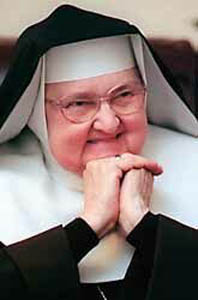
Mother must be laughing her head off at this!

Sister Doris Gottemoeller, RSM
Posted on 02/07/2007 8:03:51 AM PST by Alex Murphy
WASHINGTON (CNS) -- Present trends suggest a declining future for many communities of men and women religious, but religious are called to imagine a different future, Sister Doris Gottemoeller said Feb. 3.
Sister Gottemoeller, former president of the Sisters of Mercy of the Americas and of the Leadership Conference of Women Religious, and Father Canice Connors, a former provincial minister of the Conventual Franciscans and former president of the Conference of Major Superiors of Men, were the main speakers at Washington Theological Union's annual Religious Life Symposium.
The theme of this year's symposium was "Re-Imagining Religious Life in the 21st Century." Sister Gottemoeller addressed the overall theme, while Father Connors described a specific effort by a community of Conventual Franciscans in Syracuse, N.Y., to create a new center of Conventual life and ministry.
Noting that a futurist tries to analyze current trends and prevailing forces and extrapolate them accurately into the future, Sister Gottemoeller said present trends in religious life include:
-- "The aging and numerical diminishment of traditional religious congregations," with a median age of about 70 in many congregations.
-- Withdrawal from or only token presence in many institutions once run by one's congregation.
-- A "tendency of many congregations to embrace an individualism in spirituality, interpretation of the vows and communal practices, which dilutes any distinctive identity."
-- "Initiatives of surprising creativity ... (and) great generosity and willingness to redeploy limited resources on behalf of mission."
Extrapolating from those and other current trends in the church, she said, "we can picture a church within 15 to 20 years which looks very different from what we know today. Religious life will be a vestigial presence at best. Our intellectual, spiritual and ministerial patrimony will be largely depleted.
"Most Catholics will have never met a religious and will have no appreciation of this way of life as a possible option for themselves. The religious who remain will be isolated in retirement centers or absorbed into parishes without a distinctive identity," she said.
Describing religious life as a gift to the church and a witness to a distinctive way of life that "contributes to the holiness of the church," Sister Gottemoeller asked her audience, "Can we imagine a future in which this way of life flourishes again?"
"It is eminently possible," she said, noting that in the course of church history religious life has waxed and waned.
But she said the future of a religious congregation is up to that congregation.
"Individual members can live lives of admirable holiness or apostolic zeal, but they can't change the membership unless it wants to change," she said. A key to change that will lead to growth, she said, is answering with clarity "the fundamental questions: How will we live and what will we do?"
On how to live, she said that "community living is the template for the other dimensions of our life" because "my living situation qualifies my experience of poverty, of celibacy, of obedience."
"Within a congregation a corporate spirituality is nourished by shared prayer, reflection, ritual and celebration ... (as) part of the warp and woof of daily living," she said.
She said it is never easy to determine how to adapt one's founding charisms to changing needs, but "whatever direction is chosen by an institute, I would suggest that it must be prophetic and corporate. ... It requires a facility in drawing the gaze of the inquirer from ourselves to the Gospel that we proclaim and which animates us."
"What is needed is deep discernment on the part of each congregation, leading to a clear vision, clearly expressed and vividly demonstrated. In the absence of that, our future is indeed perilous," she said.
Father Connors said that when he was elected provincial minister in the 1990s his province had just been through four years of "low-grade depression" brought on by "ungrieved losses consequent to the Covenant House scandal."
A province member, Father Bruce Ritter, internationally renowned for his work with runaway youths and the founder and head of Covenant House, was removed from that post in 1990 following allegations of sexual misconduct with some of the youths he served.
"At the initiating assembly of my term, the friars risked giving voice to the sullen silence of grief and anger. ... The consequence was a surprising burst of creative energy within our ranks and the sequence of decisions to create new centers of Conventual life and ministry," Father Connors said.
He described an experiment in Syracuse in which "eight friars started from scratch without the benefits and burdens of ministry assignments, mandated to develop relationships and practices that would ground and support community life and mission."
He described the prayer life, community life, forms of outreach to people in need and alliances formed in the wider community as that community seeks to find new ways to follow in the footsteps of St. Francis.
After completing his term as provincial minister, Father Connors became a member of that community.
It is possible to disagree with Catholics on this or that point without trying to launch a crusade against them at every turn, as you seem eager to do.
The whacky, liberal, no-more-habit-or-liturgy-of-the-hours "communities" are certainly in decline. Deo gratias. But those with stricter adherence to their respective charisms and rules are certainly on the rise. And the average age of these communities is quite a bit younger. So your added comment to the headline tells only part of the story.
There are plenty of thriving relgious orders, I know ten ladies who enetered convents in the last five years, all of which are bursting at the seems and can't house the ladies fast enough.
It's all about holding fast to the Gospel. Those that do, thrive.
ROFL!
Mother must be laughing her head off at this!
Sister Doris Gottemoeller, RSM
BTW, Alex, a half truth is worse than a complete lie.

Sisters of Casa Maria

Community of St. John, Vezelay

Carmelites in Wyoming

Click on photo for slideshow of the monastery in progress
Clear Creek Monastery
Click on picture to view progress of monastery
A note that the Sisters of Casa Maria have a German Shepherd.
Ha ha.
For some odd reason, Sister Doris Gottemoeller, RSM looks ... different ... from all the others.Something is missing....;)
Oh, the joyful faces of these vibrant young women who love the Lord and are thronging into the faithful, traditional Sisterhood! Meanwhile, G'bye, liberal feminist nuns. "Re-imagine" yourselves into feminist oblivion.
This woman - poor thing - actually inspires hope; communities like hers, no matter how many there are, will basically fade away and no longer be around to promote heresy. Meanwhile the communities that are attracting new members (and ONLY the ones that are faithful to the magisterium are) will revive the traditional image of the nun and continue to grow and one day be as ubiquitous as the dead and dying communities once were.
Amen.
Should read [CINO religious communities in decline; Catholic religious communities flourishing]
Nope - IMO they're all Catholics, just like there's 40,000+ Protestant denominations. The difference is, the number of Protestant denominations grew by an astounding 33% in the last week of January alone!
The declining religious orders are really "protestant" -- and they are declining because they
(1) Aren't faithful to Catholic teaching;
(2) Don't even LOOK like religious;
(3) Don't ACT like religious;
(4) Don't offer prospective members anything other than a vaguely religious social action club.
Why bother to join an order if it doesn't require anything that you can't do just as well by staying in bed on Sunday morning?
The religious orders (and the seminaries) that are faithful to Catholic teaching and call their members to a true religious life are thriving and turning people away at the door.
BWA HAHAHAHAHA
Now I understand how Protestant denominations grew by 33% in the last week of January. The conservative Catholic laity threw their liberal brethren overboard w/o excommunicating them, instead declaring them to be "protestant"!
This a very deceptive number as many Protestants consider themselves beholden to their local church only, even if the one down the street teaches the exact same thing.
In the cited example, that's two denominations by your count.
How many, then, for the whole city?
Sorry, Mom...
You don't have a monopoly on Our Lord.
And, believe me, you don't WANT these CINOs. They would be trouble in any church, you know like that song "The Mississipppi Squirrel Revival" -- "talk about gossip and church dissension . . . " because the only thing they believe in is "What I Want". And that's just as likely to differ from the teaching of Scripture whether they're in a straight-up Latin Mass parish or the First Foursquare Gospel Holiness Assembly of God.
I wish we could figure out a way to get all the faux-Catholics, the Jimmy Carter Baptists, the Feminist Methodists, and the Loony Liberal Presbyterians to join the Episcopal Church. Then we'd have them all in one place where we could keep an eye on them.
I wouldn't know. After all, it's not my count.
Disclaimer: Opinions posted on Free Republic are those of the individual posters and do not necessarily represent the opinion of Free Republic or its management. All materials posted herein are protected by copyright law and the exemption for fair use of copyrighted works.