Skip to comments.
Catholic Devotional: Mary, the New Eve
Various
| 1/27/07
| KAC and Others
Posted on 01/27/2007 9:13:29 AM PST by Knitting A Conundrum
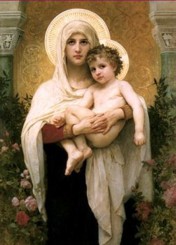 O sweet Virgin Mary, O Mary our mother,
You, with your yes so generous and bold,
Shaking the earth to its foundation, like only one other,
Mother Eve's fearsome no, so self-centered and cold.
With the help of the Father, your Yes opened the door,
through the workings of the Spirit, light entered the world
The richest of gifts, through one humble and poor,
Heaven reached out and its banner unfurled.
Emmanuel, God with us, came down with that Yes,
Entering this world as you welcomed him in,
His light to transform, find the lost, and to bless,
Then die on the cross to save us from sin.
O sweet Virgin Mary, O Mary our mother,
whose advice to us here always has been
"Do whatever he tells you," that, and no other,
Pray for us now, and when our lives shall end.
--KAC
The Fathers on Mary as Second Eve
Justin Martyr
Around the year 155 A.D., St. Justin Martyr wrote in his Dialogue with Trypho the Jew that the Holy Scriptures teach us concerning Christ,
"'that He became Man by the Virgin so that the course which was taken by disobedience in the beginning through the agency of the serpent, might be also the very course by which it would be put down. For Eve, a virgin and undefiled, conceived the word of the serpent, and bore disobedience and death. But the Virgin Mary received faith and joy when the angel Gabriel announced to her the glad tidings that the Spirit of the Lord would come upon her and the powers of the Most High would overshadow her, for which reason the Holy One being born of her would be called the Son of God. And she replied: 'Be it done unto me according to thy word.'"
St. Justin Martyr therefore parallels the Virgin Mary with the Virgin Eve. Just as the word of the serpent bore fruit through the Virgin Eve, so the word of God came into the world through the Virgin Mary. Eve believed the word of an evil angel and death was brought into the world, while Mary believed the word of a good angel and Life Himself was brought into the world.
Irenaeus
Now let's look at another passage: around the year 190 A.D., St. Ireneus, in his masterwork, Against All Heresies, writes,
"Consequently, then, Mary the Virgin is found to be obedient, saying: "Behold, O Lord, your handmaid; be it done to me according to your word." Eve, however, was disobedient; and when yet a virgin, she did not obey.... having become disobedient, was made the cause of death for herself and for the whole human race; so also Mary, betrothed to a man but nevertheless still a virgin, being obedient, was made the cause of salvation for herself and for the whole human race.... Thus, the knot of Eve's disobedience was loosed by the obedience of Mary. What the virgin Eve had bound in unbelief, the Virgin Mary loosed through faith."
So again we see the second century fathers contrasting Mary and Eve, saying that the evil done through Eve was undone through Mary.
Tertullian
Now let us look at another text, this one from the beginning of the third century. Around the year 210 A.D., the Catholic Tertullian wrote in his treatise, On The Flesh of Christ, that
"...it was while Eve was still a virgin that the word of the devil crept in to erect an edifice of death. Likewise, though a Virgin, the Word of God was introduced to set up a structure of life. Thus, what had been laid waste in ruin by this sex, was by the same sex re-established in salvation. Eve had believed the serpent; Mary believed Gabriel. That which the one destroyed by believing, the other, by believing, set straight."
As a result, we see three of the most important fathers of the second and third century bearing witness to the implication of the Genesis 3:15 prophecy, that after the woman of Genesis 3 there will come a second woman, a second Eve, who will give birth to Christ while still a virgin. Thus Mary helps rectify what Eve brought about. Eve brought sin and death into the world by her relationship with the first Adam, from whom we inherit Original Sin, while Mary brought helped bring holiness and life into the world by her relationship to the Second Adam, the Lord Jesus Christ.
Notice that in both cases it is the Adams who do the actual work. It was the first Adam who was responsible for us inheriting Original Sin. St. Paul indicates that it is our unity with the First Adam which produces sin and death in us, while it is our unity with the Second Adam that produces righteousness and life in us. The Adams are the key players, the ones who do all the work, but their work happens to be brought about through the agency of the two Eves, the first one who believed an evil angel and the second one who believed a good angel.
This distinction is reflected in the saying of the Church fathers: "Death through Eve, life through Mary." Even though Eve and Mary were not the ultimate causes of death and life, it was through their actions that death and new life entered the world. ( commentary from Jimmy Akins)
TOPICS: Apologetics; Catholic; Prayer
KEYWORDS: catholiccaucus; mary; neweve; theotokos
Navigation: use the links below to view more comments.
first 1-20, 21 next last
The New Eve
by John O'Connell
Early in the history of Christianity the Fathers of Church spoke of the Blessed Virgin Mary as the New Eve. St. Irenaeus (d. after 193 A.D.), the most eloquent proponent of Mary as the New Eve among the Fathers wrote, "It was right and necessary that Adam be restored in Christ...that Eve be restored in Mary, so that a Virgin, become advocate of a virgin, might erase and abolish the disobedience of a virgin by her obedience as Virgin."
The title of the New Eve, although not found in the Bible, has a strong Scriptural resonance. St. Paul, in several passages of his Epistles, identifies Christ as the New Adam and contrasts Him with the old Adam. While the first sin of the old Adam brought forth sin and death, the salvific action of Jesus Christ the New Adam, the head and father of the human race, redeemed mankind and offers to us the grace of eternal life. Yet Adam did not act alone, for Eve cooperated substantially in the Fall of man. So too, Jesus Christ, who alone purchased our redemption by the price of His Blood, willed to associate His Immaculate Mother in a real and profound way with His salvific work.
The Fathers stressed in writing on the Blessed Mother as the New Eve the idea of Mary's obedience to the will of God as an integral part of the economy of salvation. Mary's obedience in uttering her fiat repaired the disobedience of Eve and, because of God's eternal design, became a necessary element of our redemption from the bondage of sin. As St. Jerome succinctly wrote: "Death through Eve, life through Mary."
"The man called his wife Eve, because she was the mother of all the living" (Gen 3:20). Eve was the mother of the living; similarly, Mary as the New Eve is the Mother of the living in the order of grace. Mary proved her faithful obedience not only at the Annunciation but also through her entire earthly life, especially when she gave her silent, heart-wrenching fiat as she stood under the bloody Cross of Calvary watching her Son, who is her God, die the most excruciating of deaths.
Several Roman Pontiffs have written on the Blessed Virgin Mary as the New Eve. Pius XII said in Munificentissimus Deus: "We must remember especially that, since the second century the Virgin Mary has been designated by the holy Fathers as the new Eve, who, although subject to the new Adam, is most intimately associated with Him in that struggle against the infernal foe which, as foretold in the Protoevangelium, would finally result in that most complete victory over sin and death which are always mentioned together in the writings of the Apostle of the Gentiles." (The Protoevangelium refers to the passage in Genesis [Gen 3:15] where God promises to the fallen Adam and Eve a Redeemer who will be born of the Woman.)
Reflecting upon Mary as the New Eve we can begin to discern that Our Lady's exalted position in the Church flows from her crucial role in salvation history. Thus, the Blessed Virgin Mary is also Queen, Advocate, Intercessor, Co-Redemptrix, and Mediatrix of graces.
Here is Reverend Adrian Fortescue's translation (Latin Hymns) of a Hymn at Lauds of the Blessed Virgin by Venantius Fortunatis (c. 600):
Glorious among virgins, high above the stars,
thou dost nourish at thy breast
as a child Him who created thee.
What unhappy Eve lost thou dost restore by thy holy Child;
thou dost open the gates of heaven
that sinners may rise to the stars.
Thou art queen of the gates on high
and of the shining halls of light.
People redeemed, praise the life-given through the Virgin.
Jesus, to Thee be glory who art born of the Virgin,
with the Father and the Holy Ghost for ever and ever.
To: GirlShortstop; Salvation; Maeve; Siobhan; tiki; SuziQ; Mr. Thorne; Tribune7; Jaded; Unam Sanctam; ..
Devotional ping. This one has more apologetics meat in it than usual from me.
2
posted on
01/27/2007 9:15:02 AM PST
by
Knitting A Conundrum
(Act Justly, Love Mercy, and Walk Humbly With God Micah 6:8)
To: Knitting A Conundrum
O Blessed Mother,
Impossible for me to imagine, really,
all those years with him who was love incarnate,
growing up straight and tall ,
a graceful sapling
turnng into a man.
I can imagine him
playing games through the streets of Nazareth,
sitting at Joseph's feet among the wood shavings,
watching you sewing.
Yet, to be with him all that time -
Did not the villagers notice
something special
about the youth
growing in their midst?
And you -
impossible to imagine
a lifetime spent
tending and caring,
loving and fixing for
God on earth -
Amazing that the glory invisible in your home
did not shatter your walls -
Indelible the brightness
it left upon your soul!
3
posted on
01/27/2007 9:18:52 AM PST
by
Knitting A Conundrum
(Act Justly, Love Mercy, and Walk Humbly With God Micah 6:8)
Comment #4 Removed by Moderator
To: Knitting A Conundrum
Mary, the New Eve
Rev. Matthew R. Mauriello
![[Garden of
Eden]](http://campus.udayton.edu/mary/images2/neweve1.jpg)
Missal of Bernhard von Rohr,
Archbishop of Salzburg
ca.1481
from Eva Und Maria
Verlag Böhlau |
- The first insight regarding the Blessed Virgin Mary, the mother of Our Lord Jesus Christ, which was given by the Church Fathers was the vision of Mary as the New Eve. The earliest patristic texts regarding the Eve-Mary parallel begin in the later half of the Second Century. St. Justin, the Martyr, (+165) in his work, Dialogue with Trypho, states that, "Christ became a man by a virgin to overcome the disobedience caused by the serpent ...in the same way it had originated."
The name Eve is taken from the Hebrew word, HAWAH, a verb which means "to live." "The man called his wife Eve, because she became the mother of all the living"(Gen. 3:20). Eve, the first woman, was a virgin at the time that she was tempted by the serpent in the garden. Thus, Eve, a virgin, conceived disobedience and death, whereas, Mary, a virgin, conceived the Word in obedience and brought forth Life. - St. Ireneus, Bishop of Lyons, (+202) is considered the first theologian of the Virgin Mary. He took up St. Justin's Mary-Eve theme and further integrated it into his theology. Therein, Mary is treated as the New or Second Eve who is the beginning of the second Creation or re-creation of humanity through the Redemption.
|
He wrote, "The knot of Eve's disobedience was loosened by Mary's obedience. The bonds fastened by the virgin Eve through disbelief were untied by the virgin Mary through faith." (Adv. haereses,3:22)
- Jesus Christ is the New Adam, the Lord of the New Creation ( I Cor. 15:45-49 ) and Mary the New Eve who undid what the first Eve had done. The first Eve disobeyed God and thereby brought sin and death into the world. The New Eve, Mary, obeyed and believed God's message which was given to her at the Annunciation ( Lk .1 :26-38 ), and brought salvation and life to the world in her son, Jesus, who crushes the head of the serpent. Mary, like us, shares in this victory .
- Tertullian ( +220 ), another Church Father, used the Eve-Mary parallel as a secondary argument in favor of the virginal conception of Jesus Christ and emphasizes the act of faith involved. Building on the insights of Justin, Ireneus and Tertullian, the theme of the Eve-Mary parallel was expanded upon after the Council of Nicaea in the year 325.
St. Ambrose of Milan ( +397 ) writes, "it was through a man and woman that flesh was cast from paradise; it was through a virgin that flesh was linked to God." St. Jerome (+420 ) succinctly stated, "Death through Eve, Life through Mary." (Epist. 22,2 I ). St. Peter Chrysologus ( +450 ) picked up on this theme in his writings, "Christ was born of a woman so that just as death came through a woman, so through Mary, life might return."
- In our own century. Pope Pius XII is responsible for the principle papal contributions on this theme. In the Encyclical, AD CAELI REGINAM. dated 11 Oct. 1954, he wrote: "Mary, in the work of Redemption was by God's will, joined with Jesus Christ, the cause of salvation, in much the same way as Eve was joined with Adam. the cause of death.
The Fathers of the Second Vatican Council recall the Eve-Mary parallel in the document on the Church. LUMEN GENTIUM, Chapter 8, the role of the Blessed Virgin Mary. They quote from the Church Fathers, Sts. Ireneus, Jerome, and Epiphanius : "What the virgin Eve bound by her unbelief, Mary loosened by her faith, "( L.G. 56 ) In the same document, the Eve-Mary parallel is treated in relation to the Church: "For believing and obeying, Mary brought forth on earth the Father's Son. This she did, knowing not man but overshadowed by the Holy Spirit, as the New Eve. who put absolute trust. not in the ancient serpent, but in the messenger of God.( L.G. 63) We, the faithful of the Church are called to follow Mary's example of trusting faith and fidelity to the Holy Will of God."
5
posted on
01/27/2007 9:47:44 AM PST
by
Knitting A Conundrum
(Act Justly, Love Mercy, and Walk Humbly With God Micah 6:8)
To: Knitting A Conundrum
MARY, THE NEW EVE, FREELY OBEYED GOD
Pope John Paul II
Before the great mystery of the Incarnation, Mary spoke her ‘yes’ and expressed her complete acceptance of God’s saving plan for mankind
"In stating her total 'yes' to the divine plan, Mary is completely free before God. At the same time, she feels personally responsible for humanity, whose future was linked with her reply", the Holy Father said at the General Audience of Wednesday, 18 September, as he examined the significance of Mary as the New Eve. Here is a translation of the Pope's catechesis, which was given in Italian and was the 33rd in the series on the Blessed Mother.
1. Commenting on the episode of the Annunciation, the Second Vatican Council gives special emphasis to the value of Mary's assent to the divine messenger's words. Unlike what occurs in similar biblical accounts, it is expressly awaited by the angel: "The Father of mercies willed that the Incarnation should be preceded by assent on the part of the predestined mother, so that just as a woman had a share in bringing about death, so also a woman should contribute to life" (Lumen gentium, n. 56).
Lumen gentium recalls the contrast between Eve's behaviour and that of Mary, described by St Irenaeus: "Just as the former—that is, Eve—was seduced by the words of an angel so that she turned away from God by disobeying his word, so the latter—Mary—received the good news from an angel's announcement in such a way as to give birth to God by obeying his word; and as the former was seduced so that she disobeyed God, the latter let herself be convinced to obey God, and so the Virgin Mary became the advocate of the virgin Eve. And as the human race was subjected to death by a virgin, it was liberated by a Virgin; a virgin's disobedience was thus counterbalanced by a Virgin's obedience..." (Adv. Haer., V, 19, 1).
Mary co-operated through free faith and obedience
2. In stating her total "yes" to the divine plan, Mary is completely free before God. At the same time, she feels personally responsible for humanity, whose future was linked with her reply.
God puts the destiny of all mankind in a young woman's hands. Mary's "yes" is the premise for fulfilling the plan which God in his love had prepared for the world's salvation.
The Catechism of the Catholic Church briefly and effectively summarizes the decisive value for all humanity of Mary's free consent to the divine plan of salvation. "The Virgin Mary 'cooperated through free faith and obedience in human salvation'. She uttered her yes 'in the name of all human nature'. By her obedience she became the New Eve, mother of the living" (n. 511).
3. By her conduct, Mary reminds each of us of our serious responsibility to accept God's plan for our lives. In total obedience to the saving will of God expressed in the angel's words, she becomes a model for those whom the Lord proclaims blessed, because they "hear the word of God and keep it" (Lk 11:28). Jesus, in answering the woman in the crowd who proclaimed his mother blessed, discloses the true reason for Mary's blessedness: her adherence to God's will, which led her to accept the divine motherhood.
In the Encyclical Redemptoris Mater, I pointed out that the new spiritual motherhood of which Jesus speaks is primarily concerned with her. Indeed, "Is not Mary the first of 'those who hear the word of God and do it'? And therefore does not the blessing uttered by Jesus in response to the woman in the crowd refer primarily to her?" (n. 20). In a certain sense therefore Mary is proclaimed the first disciple of her Son (cf. ibid.) and, by her example, invites all believers to respond generously to the Lord's grace.
4. The Second Vatican Council explains Mary's total dedication to the person and work of Christ: "She devoted herself totally, as a handmaid of the Lord, to the person and work of her Son, under and with him, serving the mystery of redemption, by the grace of almighty God" (Lumen gentium, n. 56).
For Mary, dedication to the person and work of Jesus means intimate union with her Son, motherly involvement in nurturing his human growth and co-operation with his work of salvation.
Mary became cause of salvation for all humanity
Mary carries out this last aspect of her dedication to Jesus "under him", that is, in a condition of subordination, which is the fruit of grace. However this is true co-operation, because it is realized "with him" and, beginning with the Annunciation, it involves active participation in the work of redemption. "Rightly, therefore", the Second Vatican Council observes, "the Fathers see Mary not merely as passively engaged by God, but as freely co-operating in the work of man's salvation through faith and obedience. For, as St Irenaeus says, she 'being obedient, became the cause of salvation for herself and for the whole human race (Adv. Haer. III, 22, 4)’" (ibid.).
Mary, associated with Christ's victory over the sin of our first parents, appears as the true "mother of the living" (ibid.). Her motherhood, freely accepted in obedience to the divine plan, becomes a source of life for all humanity.
http://www.ewtn.com/library/papaldoc/jp2bvm33.htm
6
posted on
01/27/2007 9:57:26 AM PST
by
Knitting A Conundrum
(Act Justly, Love Mercy, and Walk Humbly With God Micah 6:8)
To: Knitting A Conundrum; Religion Moderator
This interpretation of this passage not only contradicts the early Christian interpretation as represented by the Fathers, but also that of many Protestants! It discards the messianic significance of Genesis 3:15 by arguing that the "seed of the woman" is just Eve's general posterity, not the Messiah! Is this how far some Evangelicals are willing to go to cut down Mary? They are willing to cut down Jesus in the process?
THIS is a Catholic devotional thread? I don't think so.
To: Alex Murphy; Religion Moderator
Is too. Its celebrating Mary, and why we say this about her. You don't think catholics have the right to catechize each other? That's not a devotional activity? It is in the Catholic faith, one of the works of Mercy.
8
posted on
01/27/2007 10:02:38 AM PST
by
Knitting A Conundrum
(Act Justly, Love Mercy, and Walk Humbly With God Micah 6:8)
To: Knitting A Conundrum
This excerpt from St. Irenaeus' classic second century work Against Heresies (Lib. 5, 19, 1; 20, 2; 21,1: SC 153, 248-250. 260-264) shows that the Blessed Virgin Mary is truly a new Eve. It is used in the Roman Office of Readings for Friday in the Second Week of Advent.
The Lord, coming into his own creation in visible form, was sustained by his own creation which he himself sustains in being. His obedience on the tree of the cross reversed the disobedience at the tree in Eden; the good news of the truth announced by an angel to Mary, a virgin subject to a husband, undid the evil lie that seduced Eve, a virgin espoused to a husband.
Eve in the GardenAs Eve was seduced by the word of an angel and so fled from God after disobeying his word, Mary in her turn was given the good news by the word of an angel, and bore God in obedience to his word. As Eve was seduced into disobedience to God, so Mary was persuaded into obedience to God; thus the Virgin Mary became the advocate of the virgin Eve.
Christ gathered all things into one, by gathering them into himself. He declared war against our enemy, crushed him who at the beginning had taken us captive in Adam, and trampled on his head, in accordance with God’s words to the serpent in Genesis: I will put enmity between you and the woman, and between your seed and her seed; he shall lie in wait for your head, and you shall lie in wait for his heel.
The one lying in wait for the serpent’s head is the one who was born in the likeness of Adam from the woman, the Virgin. This is the seed spoken of by Paul in the letter to the Galatians: The law of works was in force until the seed should come to whom the- promise was made.
Mary Crushin the SerpentHe shows this even more clearly in the same letter when he says: When the fullness of time had come, God sent his Son, born of a woman. The enemy would not have been defeated fairly if his vanquisher had not been born of a woman, because it was through a woman that he had gained mastery over man in the beginning, and set himself up as man’s adversary.
That is why the Lord proclaims himself the Son of Man, the one who renews in himself that first man from whom the race born of woman was formed; as by a man’s defeat our race fell into the bondage of death, so by a man’s victory we were to rise again to life.
http://www.crossroadsinitiative.com/library_article/70/Mary_as_the_New_Eve___St._Irenaeus.html
9
posted on
01/27/2007 10:04:44 AM PST
by
Knitting A Conundrum
(Act Justly, Love Mercy, and Walk Humbly With God Micah 6:8)
To: Knitting A Conundrum
10
posted on
01/27/2007 10:05:38 AM PST
by
Frank Sheed
("It is terrible to contemplate how few politicians are hanged." --G.K. Chesterton)
To: Knitting A Conundrum
ping to read later
explains the many statues of Mary that feature the serpent under her feet
11
posted on
01/27/2007 10:10:41 AM PST
by
silverleaf
(Fasten your seat belts- it's going to be a BUMPY ride.)
To: Knitting A Conundrum; Religion Moderator
Frankly, you were doing fine up until post #4. I have no issue with your choice of subject matter for conversation and debate.
But when it includes offal like "Is this how far some Evangelicals are willing to go to cut down Mary? They are willing to cut down Jesus in the process?, then the wheels fall off the "devotional" wagon and this becomes a thread open for debate. Pull post #4, and I'd have no issue with this thread keeping it's "devotional" tag.
To: Knitting A Conundrum; Alex Murphy
As with the other thread this morning,
The Early Church Fathers - this thread is speaking for and of Protestants.
It's a sad state of affairs because the rest of the material appears to be quite devotional in nature.
Nevertheless, should a Protestant disagree with those representations (e.g. find them inaccurate, incomplete, etc.) - the thread is open for a rebuttal statement.
Please keep the Protestant rebuttals on the specific claims made here and do NOT drift into general theological disagreements.
This thread was intended to be a devotion! You're in the other guys' church, so be respectful.
To: Knitting A Conundrum
The creation of Eve from the rib of the first Adam becomes a prefigurement for the emergence of the new Eve -- by that is meant Mary, but, at the same time, also the whole Church -- from the opened side of the new Adam. The woman who is bound to her husband in true Christian matrimony, that is, in an indissoluble union of life and love, represents the Church as God's bride. Even more impressively and perfectly, the Church is personally embodied in the woman who as Spouse of Christ has consecrated her life to the Lord and has entered into an indissoluble contract with Him. She herself stands at His side like the Church, and assists in His work of redemption like its prototype, the Mother of God, in whom it has its origin. The complete surrender of her life and being is to live and work with Christ; but that means also to suffer and die with Him -- that fruitful death from which springs the life of grace for all humanity. And so the life of God's bride becomes supernatural maternity for all of redeemed humanity, whether she works directly with the soul herself or whether she only brings forth through her sacrifice the fruits of grace, of which she and perhaps no other has knowledge.
"Mary is the most perfect symbol of the Church because she is its prefigurement and origin. She is also a unique organ of the Church, that organ from which the entire Mystical Body, even the Head itself, was formed. She might be called, and happily so, the heart of the Church in order to indicate her central and vital position in it. . . . The title of Mary as our mother is not merely symbolic. Mary is our mother in the most real and lofty sense, a sense which surpasses that of earthly maternity. She begot our life of grace for us because she offered up her entire being, body and soul, as the Mother of God."
- St. Edith Stein, "Church, Woman, Youth", Essays on Woman.
http://blog-by-the-sea.typepad.com/blog_bythesea/2005/12/mary_and_the_si.html
14
posted on
01/27/2007 10:13:23 AM PST
by
Knitting A Conundrum
(Act Justly, Love Mercy, and Walk Humbly With God Micah 6:8)
To: Knitting A Conundrum
Or, I can pull #4, your choice.
To: Religion Moderator
Pull it, if it's causing troubles. I don't argue, I demonstrate.
16
posted on
01/27/2007 10:14:23 AM PST
by
Knitting A Conundrum
(Act Justly, Love Mercy, and Walk Humbly With God Micah 6:8)
To: Knitting A Conundrum; Alex Murphy
#4 is removed so now the thread is back to "Closed" status and the assembly is not to be disturbed from here on.
To: Alex Murphy
Pulled and gone...I was focusing on the quotes from the fathers....not the nuances.
18
posted on
01/27/2007 10:17:26 AM PST
by
Knitting A Conundrum
(Act Justly, Love Mercy, and Walk Humbly With God Micah 6:8)
To: Knitting A Conundrum
"Come, let us wonder at the virgin most pure, wondrous in herself, unique in creation, she gave birth, yet knew no man; her pure soul with wonder was filled, daily her mind gave praise in joy at the twofold wonder: her virginity preserved, her child most dear. Blessed is He who shone forth from her!"
+Ephrem the Syrian, The Harp of the Spirit.
"Joseph was amazed as he saw what was supernatural. He understood, O Virgin, the rain upon the fleece In thy conception without seed. And he understood the bush that burned without fire and was unconsumed, And Aaron's rod, which blossomed. Indeed, thy betrothed and guardian cried out to the priests: "A virgin gives birth, and after the birth remains a virgin." The Kontakia of Romanos "On the Annunciation"
19
posted on
01/27/2007 11:13:53 AM PST
by
Kolokotronis
(Christ is Risen, and you, o death, are annihilated!)
To: Kolokotronis
I am trying to find some good sources for Saint Ephrem's writings...not enough online! I'm going to have to buy books!
20
posted on
01/27/2007 11:18:28 AM PST
by
Knitting A Conundrum
(Act Justly, Love Mercy, and Walk Humbly With God Micah 6:8)
Navigation: use the links below to view more comments.
first 1-20, 21 next last
Disclaimer:
Opinions posted on Free Republic are those of the individual
posters and do not necessarily represent the opinion of Free Republic or its
management. All materials posted herein are protected by copyright law and the
exemption for fair use of copyrighted works.
FreeRepublic.com is powered by software copyright 2000-2008 John Robinson