Skip to comments.
Vittorio Messori and "The Mary Hypothesis"
Zenit ^
| 11/25/05
| Zenit
Posted on 11/26/2005 5:02:26 AM PST by Knitting A Conundrum
Vittorio Messori and "The Mary Hypothesis"
Mariology Is Christology, Says Author ROME, NOV. 25, 2005 (Zenit.org).- One of the most popular Catholic writers is back in bookstores with "The Mary Hypothesis," published in Italy by Ares.
Vittorio Messori, author of "The Jesus Hypothesis" (1976), is the first journalist in history to publish a book-length interview with a Pope, the best-selling "Crossing the Threshold of Hope" (1994).
He also published "The Ratzinger Report" (1987), based on an interview with then prefect of the Vatican Congregation for the Doctrine of the Faith, Cardinal Joseph Ratzinger, now Benedict XVI.
In this interview with ZENIT, Messori discusses the meaning of his most recent work, in which he reflects on the "depth of mystery" that the Virgin Mary represents.
Q: Who is Mary? How can one explain the mystery of a woman chosen by the Creator to give birth to the Son of God?
Messori: Mary is but a humble woman from a humble village. No pre-Christian text speaks of Nazareth, to the point that an attempt was made to demonstrate that no place existed with that name.
For the wisdom of the world, Mary is nothing, but from the perspective of the faith she is the depth of mystery. She is a human person like us, and at the same time the indispensable instrument for the greatest and most unique event -- the incarnation of God himself.
From the Catholic perspective, at present there are in heaven two bodies like ours, glorified for eternity: the one belonging to Jesus and that of his Mother. They anticipate what we too will be.
Q: Why write this book? What is the objective and meaning of this research?
Messori: When, in 1976, I published my first book, "The Jesus Hypothesis," many readers asked me to work on "The Mary Hypothesis."
The matter, then, seemed strange to me, and unacceptable.
My thinking was that Jesus is on the streets, and his Mother is at home. … One knows and loves her only when one attains sufficient closeness with the Son to enter where he dwells.
In any event, there are two challenges that I have tried to address in these more than 500 pages.
First, to show that it is possible to be devoted to Mary without falling into a certain rhetoric. Also, to show that to make room for the Virgin is not the hobby of sentimental or ignorant believers, but a need of every believer which cannot be ignored.
Everything that the Church has said and says about the Mother is, in fact, at the service of Christ, in defense of his humanity and at the same time of his divinity.
Mariology is, in fact, Christology. Her dogmas are but the confirmation and bulwark of her Son's. Whenever Mary has been neglected, sooner or later Christ has also disappeared.
Q: Given the waves of secularization of the last three decades, Marian devotion has preserved many Catholic communities. The latter, by praying the rosary, have kept the faith and tradition. Nevertheless, in some Catholic realms Marian devotion is considered anti-modern and too traditional. What is your opinion in this respect?
Messori: In "The Mary Hypothesis" I write a great deal about apparitions, even though I limit myself to those recognized by the Church.
In the Virgin's apparitions, she continues her vocation of Mother who hastens to her children in difficult moments. Since the beginning of modernity, it is faith itself that is threatened; the flock of believers seems to be in danger of scattering.
The apparitions are a call, a jolt, a confirmation, a strengthening. I go when I can, as a pilgrim, in addition to going as a scholar, to European Marian shrines. I encounter multitudes there that no longer go to their parishes, but that are attracted by those places where the maternal presence has manifested itself.
In the West, the increase in pilgrimages has been the only index of a positive sign in a Church where everything is in decline, from participation in the sacraments to vocations. Marian devotion is at present perhaps the greatest pastoral resource.
And I don't know what to think of certain "intellectual clerics" who reject or even scorn this extraordinary possibility. However, fortunately, average people do not read the "adult" and "critical" theologians, but rather continue to be fascinated before the possibility that a merciful Mother awaits them in a shrine.
Q: Historically, the increase of Christians is also explained thanks to a lofty conception of woman in contrast to the pagan world. To what point does the figure of Mary explain the Christian conception of woman? What could Mary say today to the movement for the emancipation of woman?
Messori: Twenty years ago, after a few days of conversation with the prefect of the former Holy Office, Cardinal Joseph Ratzinger, I published "The Ratzinger Report." The future Benedict XVI told me that Christians should oppose the crisis of woman, often so painful for her, with an antidote: Mary. In that same person coexists the two great feminine vocations: virginity and maternity.
If properly understood, Marian devotion is not an obstacle, but rather a precious help for women to rediscover a way that truly values the mystery of femininity.
TOPICS: Catholic
KEYWORDS: catholic; faith; jesus; mariology; mary
Navigation: use the links below to view more comments.
first 1-20, 21-40, 41-53 next last
O Mary, Theotokos,
Mother of Sorrows,
thank you for saying yes
when the angel came
for saying yes
when Simeon told you
how the sword would pierce your heart,
for saying yet
when it was time to flee
to Egypt,
for saying yes
when seeing your son
burdened, falling, beaten, bleeding,
for saying yes
when you held his cold and bloodstained body,
for saying yes
as you left the tomb as its stone rolled into place.
O Mary, Mother of Sorrow,
Mother of Consolation,
as we enter this time of waiting,
Advent,
help us always remember why your son came into the world,
pray for us, O holy Mother of God,
that in gratitude and love,
we like you,
may learn always to say yes
to the call of our Lord.
To: Knitting A Conundrum
Messori: Twenty years ago, after a few days of conversation with the prefect of the former Holy Office, Cardinal Joseph Ratzinger, I published "The Ratzinger Report." The future Benedict XVI told me that Christians should oppose the crisis of woman, often so painful for her, with an antidote: Mary. In that same person coexists the two great feminine vocations: virginity and maternity. Wise words from the Pope.
2
posted on
11/26/2005 5:07:24 AM PST
by
Puddleglum
(Thank God the Boston blowhard lost)
To: Knitting A Conundrum
DEVOTION TO MARY IS BASED ON JESUS’ WILL
Pope John Paul II
May all discover in his words ‘Behold, your mother!’ the invitation to accept the blessed Virgin as mother and respond to her as true children
"The words, 'Behold, your mother!', express Jesus' intention to inspire in his disciples an attitude of love for and trust in Mary, leading them to recognize her as their mother, the mother of every believer", the Holy Father said at the General Audience on Wednesday, 7 May. The Pope was continuing his catechesis on the role of the Blessed Mother, focusing this time on her spiritual motherhood. Here is a translation of his reflection, which was the 50th in the series on the Blessed Virgin and was given in Italian.
1. After entrusting John to Mary with the words "Woman, behold your son!", Jesus, from the Cross, turns to his beloved disciple, saving to him, "Behold, your mother!" (Jn 19:26-27). With these words, he reveals to Mary the height of her motherhood: as mother of the Saviour, she is also the mother of the redeemed, of all the members of the Mystical Body of her Son.
In silence the Virgin accepts the elevation to this highest degree of her motherhood of grace, having already given a response of faith with her "yes" at the Annunciation.
Jesus not only urges John to care for Mary with special love, but he entrusts her to him so that he may recognize her as his own mother.
During the Last Supper, "the disciple whom Jesus loved" listened to the Master's commandment: "Love one another as I have loved you" (Jn 15:12) and, leaning his head against the Lord's breast, he received from him a unique sign of love. Such experiences prepared him better to perceive in Jesus' words an invitation to accept her who had been given him as mother and to love her as Jesus did with filial affection.
May all discover in Jesus' words: "Behold, your mother!", the invitation to accept Mary as mother, responding to her motherly love as true children.
The Blessed Virgin teaches us to love the Lord deeply
2. In the light of this entrustment to his beloved disciple, one can understand the authentic meaning of Marian devotion in the ecclesial community. In fact, it places Christians in Jesus' filial relationship to his mother, putting them in a condition to grow in intimacy with both of them.
The Church's devotion to the Virgin is not only the fruit of a spontaneous response to the exceptional value of her person and the importance of her role in the work of salvation, but is based on Christ's will.
The words "Behold, your mother!", express Jesus' intention to inspire in his disciples an attitude of love for and trust in Mary, leading them to recognize her as their mother, the mother of every believer.
At the school of the Virgin, the disciples learn to know the Lord deeply, as John did, and to have an intimate and lasting relationship of love with him. They also discover the joy of entrusting themselves to the Mother's maternal love, living like affectionate and docile children.
The history of Christian piety teaches that Mary is the way which leads to Christ and that filial devotion to her takes nothing from intimacy with Jesus; indeed, it increases it and leads to the highest levels of perfection.
The countless Marian shrines throughout the world testify to the marvels wrought by grace through the intercession of Mary, Mother of the Lord and our Mother.
Turning to her, drawn by her tenderness, the men and women of our time also meet Jesus, Saviour and Lord of their lives.
Above all, the poor, tried in heart, in their affections and in their material need, find refuge and peace in the Mother of God, and discover that for all people true riches consist in the grace of conversion and of following Christ.
Every Christian should make room for Mary in his daily life
3. According to the original Greek, the Gospel text continues: "From that hour the disciple took her among his possessions" (Jn 19:27), thus stressing John's ready and generous adherence to Jesus' words and informing us about his behaviour for the whole of his life as the faithful guardian and docile son of the Virgin.
The hour of acceptance is that of the fulfilment of the work of salvation. Mary's spiritual motherhood and the first manifestation of the new link between her and the Lord's disciples begins precisely in this context.
John took the Mother "among his possessions". These rather general words seem to highlight his initiative, full of respect and love, not only in taking Mary to his house but also in living his spiritual life in communion with her.
In fact, a literal translation of the Greek expression "among his possessions" does not so much refer to material possessions since John—as St Augustine observes (In Ioan. Evang. tract. 119, 3)—"possessed nothing of his own", but rather to the spiritual goods or gifts received from Christ: grace (Jn 1:16), the Word (Jn 12:48; 17:8), the Spirit (Jn 7:39; 14:17), the Eucharist (Jn 6:32-58).... Among these gifts which come to him from the fact that he is loved by Jesus, the disciple accepts Mary as his mother, establishing a profound communion of life with her (cf. Redemptoris Mater, n. 45, note 130).
May every Christian, after the beloved disciple's example, "take Mary into his house" and make room for her in his own daily life, recognizing her providential role in the journey of salvation.
3
posted on
11/26/2005 5:26:46 AM PST
by
Knitting A Conundrum
(Act Justly, Love Mercy, and Walk Humbly With God Micah 6:8)
To: Knitting A Conundrum
A Woman for Our Times
Mary of Nazareth seems on the surface to be an ordinary Jewish woman whose life was indistinguishable from many others. She cooked, sewed and cleaned. She prayed, conversed and served the needs of her family. Yet what we see in the biblical stories of Jesus’ birth shows that Mary’s life was extraordinary. Her extraordinariness did not lie in herself; it was a divine gift. By the free choice of God the Father, she was predestined to be the mother of the Redeemer. By His mercy, the heavenly Father filled her soul with His grace and His presence. In divine providence, Mary became the Spouse of the Holy Spirit by receiving in her womb the Son of God. In the silence of her Son’s infant life, she contemplated the astounding truths of heaven.
This contrast between the ordinary and the extraordinary is important. The significance of Mary’s life was hidden from everyday view. Rarely could others around her see the remarkable power and meaning of her life, just as many could see nothing remarkable about the life of her Son. And Mary precedes us all in that same respect. Paul says our life is also hidden with Christ in God (Col 3:3,4). Our outward life may seem very ordinary, but the inner strength of our life is the same as Mary’s. The source of that strength is the One whom Mary bore—the Savior of Bethlehem.
We share so much with Mary. Like her, we are called to be disciples of her Son. When she and Joseph found Jesus in the temple, they both learned more of what being disciples meant. It means giving over to God the Father the things in our lives which are most precious to us. But discipleship is impossible without faith, and Mary’s example of faith calls us to the same commitment. When she said YES to God (Lk 1:38), she called us to faith in Christ by her example. Faith also means walking with God in the dark times when we can’t see where the road ahead is leading. Mary knew that experience by her hidden life. She won no awards and received no acclaim from the world in her day. Yet her hidden life was brimming with importance and power.
Though her life appeared insignificant, her greatest influence came through the suffering she would endure. Simeon’s words in Luke 2:35 call us to the same life as Mary’s—a life of blessing through suffering. And not just any suffering. Her suffering and ours must be united with and flow from the sufferings of Mary’s Son, Mary’s Lord and ours.
We must recognize that while we are like Mary in many ways, she is also unique. The Mother of Jesus became a unique channel of Christ’s bodily presence in the world. Through her body the Son of God, indeed God Himself, took His shape and form. Her eyes, her face, her stature, her blood, her DNA. Whatever natural makeup His body had, it came from this blessed virgin. We can never give to Jesus what Mary gave to Him. She cooperated in God’s plan of salvation in a unique way. We can never give the substance of our bodies to Jesus the way Mary did, but we can do what others around Mary did. We can welcome Jesus into our lives, our world, our businesses, our homes, our schools and our hearts. We can welcome both the Son of God into our lives, and His mother who is blessed above all women (Lk 1:42).
Imagine yourself to be Simeon and you see the salvation of Israel (Lk 2:30,31). Would it have been possible to hail the One who would redeem the world, and not also call His mother blessed among women? Don’t we call them happy, even blessed, who receive great gifts from God? Isn’t Mary then the most blessed person to have ever lived? She received in her own body the greatest gift that anyone has ever received.
Mary is an instrument of the presence of God. She is a tabernacle where the Son of God came to dwell in the midst of His people (cf. John 1:14). We can look at the experience and promise of God’s presence in the Old Testament among the people of Israel because it is there that we learn of God’s yearning to live among His people.
When the people of Israel were in the desert and saw the pillar of cloud by day and of fire by night, they bowed down and worshiped the Lord who had come to visit them with His special, local presence (Ex 33: 9,10). The same experience happened at the birth of Jesus. Matthew tells us that the Magi "found the child with Mary his mother." Their response was like that of the ancient Israelites who encountered the presence of God directly. "They fell down and worshiped him" (Mt 2:11). The Magi didn’t simply feel God’s general presence around them. They came to a specific place where God had given His presence in a specific way. They worshiped an infant boy who was God’s presence made specific and local. They did not worship Mary just as the Israelites did not worship the tabernacle itself. But the Magi did honor Mary with their gifts because they recognized that she was the instrument of bringing God’s presence into the world.
Our goal as Christians is to find those places where God manifests His presence in our times, and to go there with the expectation of worshiping Him and of honoring those who are the instruments of His presence. God transforms and unifies His people by giving them His presence. And God’s presence, once it fills the hearts of God’s people, brings unity in their relationships with one another. I believe that if Christians recognized Mary as God’s chosen instrument of unity for Christians, we would see a level of spiritual life and unity among Christians unprecedented in the last four hundred years of western Christianity.
Mary’s Response and Ours
Mary’s response to God’s grace in her life helps us to understand that unity among Christians comes through faith and obedience. Mary is a sign, an indicator of how we must respond to God. What were Mary’s responses? The most justly famous is her response to God’s invitation through Gabriel, "Behold the handmaiden of the Lord. Be it done to me according to your word" (Lk 1:38). With this commitment she showed herself to be Jesus’ mother in both the natural and supernatural orders. It was a response prompted by grace and fulfilled by obedience. And obedience leads to praise. Mary praised her heavenly Father in the Magnificat (Lk 1:46-55) for the salvation that had dawned on the human race. Any parent knows the delight of having a child express thanks for favors done. Mary knew instinctively that the Father in heaven would be pleased with her song of thanksgiving. She wanted to give praise to Him because she wanted to delight His heart.
What moved Mary to obedience and praise? Wasn’t it her contemplative spirit? She constantly "treasured up these words" turning them over in her mind and heart again and again (Lk 2:19, 51). Mary knew, as Paul would later write, that the life of her Son, the Christ, was a mystery (see Col 1:24-2:3 esp. 2:2). Indeed, Christ’s life contained "the mystery that was hidden for ages and generations, but now has been revealed to the saints" (Col 1:26).
Mystery in the Bible is not a five dollar novel but a priceless revelation of the Father’s glory (cf. Jn 1:14-18). Paul calls it a mystery because it is at once revealed and concealed. Concealed to the spiritually obtuse; revealed to those with open hearts.
Since Mary’s life was inseparably bound to Jesus, her life becomes a mystery just like His. In fact, their lives are not two separate mysteries but one grand mystery—the mystery of salvation. Jesus’ life is the saving mystery and Mary was drawn into it by grace. That’s why Mary’s life is a sign of salvation, because her life is drawn into the mystery of her Son’s life. Salvation is to be drawn into the love and power of the Son of God. Christ humbled himself to share in our humanity that we might share His divinity. Mary is a harbinger of our future.
Our response to Mary is indicated by how others around her responded to her extraordinary life. Those responses strike me as compelling because I looked on Mary as little more than the virgin-mother for the first forty years of my life. Mary was simply a biblical fact. Even then I never plumbed the depths of her virginity or maternity. But the responses to Mary in the Bible compel us because they provide wisdom and guidance on how we should respond to God’s extraordinary work in her life. They compel us because they are responses to God’s grace. And what does our salvation depend on? On how we respond to God’s grace and salvation!
No better clue to our response can be found than Elizabeth’s, John the Baptist’s mother. Her spirit-filled words to Mary (cf Lk 1:41) should penetrate every Christian’s heart, "Blessed are you among women and blessed is the fruit of your womb" (Lk 1:42). We can scarcely imagine what it would be like for the mother of our Lord to come to our home as she carried God within her womb (Lk 1:43). We can and should be no less amazed than Elizabeth to have Mary in our lives.
Simeon provides a further indicator of the proper response to Mary. For Simeon, the baby in Mary’s arms was "the light of revelation for the Gentiles and the glory of Israel." The old prophet knew that this child was destined for "the falling and rising of many in Israel and a sign to be contradicted" (Lk 2:34). But Simeon also knew that Mary’s future life was so intimately bound to her Son’s that he promised her, under the direct inspiration of the Spirit, that "a sword will also pierce your soul" (Lk 2:35). The future sufferings of Jesus would be so profuse that they would overflow into Mary’s life. Her life would become a mirror of His life. Today, we can look upon Mary as a reflection of Jesus her Son. Mary is our window into the one and only Son of God who alone can unify people torn apart by misunderstanding and prejudice.
But perhaps our most important response to Mary is guided by that of Joseph. It is almost impossible to imagine the puzzlement and pain he must have felt when he learned that his espoused was pregnant (Mt 1:20). Yet Matthew’s account shows clearly how Joseph obediently played the role that divine providence had set for him. In the quiet background, Joseph took his place in the kingdom of God to perform God’s will no less than Mary. And his love for Mary and Jesus flowed from a truly just and holy heart (Mt 1:19). His love for his wife Mary was a perfect picture of Christ’s love for the Church (cf. Eph 5:29). It is the same love we are called to have for Jesus and Mary.
Kenneth J. Howell, Ph.D.
http://www.chnetwork.org/journals/mary/mary_3.htm
4
posted on
11/26/2005 5:49:36 AM PST
by
Knitting A Conundrum
(Act Justly, Love Mercy, and Walk Humbly With God Micah 6:8)
To: Knitting A Conundrum
Hail Mary
By Lynn Nordhagen
The Hail Mary, traditionally known as the Ave Maria, is a Biblical prayer. In the first half, the words are directly from the Gospel of St. Luke, while the second half reflects what this could mean to us, praying Christians in the Body of Christ, pondering these things in our hearts.
The account of the angel Gabriel announcing to Mary that she is to be the mother of our Savior is familiar to all Christians. We find here the first elements of the Ave Maria. The angel’s words are "Hail, O favored one," (Luke 1:28 RSV), or as Jerome translated it in his 4th century Latin edition, "full of grace."
What does it mean to be greeted as one "full of grace"? At the very least, Mary is highly favored by having been chosen to bear the Son of the Most High. The Latin translation using "full" points to the overflowing abundance and perfection involved. God Himself will dwell in her womb, the Creator will come into the world. The Holy Spirit will overshadow and dwell in her. It is all of grace. By this grace, Mary is special and blessed. The Church’s reflections over the centuries have their root in these words of the angel Gabriel, sent from God. She teaches us to look to Mary for our model of what we ourselves hope to become by God’s fullness of grace.
Mary, and we too, have the next words of the angel to assure us of His help in this. "The Lord is with you" (Luke 1:28). How many times in salvation history have servants of God heard these words? In Genesis 26:24, the Lord appears to Isaac, saying, "Fear not, for I am with you". The Lord God promises to be with Jacob (Gen. 31:3), with Moses (Exod. 3:12), with Joshua (Joshua 1:5), and with Gideon (Judges 6:16). Jesus Himself tells his accusers, "He who sent me is with me; he has not left me alone, for I always do what is pleasing to him"(John 8:29). The Lord will be with Paul in the city where He has many people (Acts 18:10). This is His promise to the Church in Matthew 28:20, "I am with you always." And in Revelation 21:3, a great voice tells us, "Behold, the dwelling of God is with men. He will dwell with them and they shall be his people and God himself will be with them." The Lord is with Mary, according to the angel, and we know He is with us. His assistance in the Old Testament has been brought to great fulfillment by His very presence with Mary in her womb. "The Lord is with you," has been a pregnant phrase throughout salvation history. And now in the Church, His real presence is with us in His Eucharist.
"Blessed art thou among women," says the prayer, in the words of Elizabeth (Luke 1:42). All the promises of blessing in the Old Testament are fulfilled with the coming of the Savior. Elizabeth, filled with the Holy Spirit, continues, "and blessed is the fruit of your womb". Mary is blessed because of her child, Son of the Most High. Elizabeth recognizes this, saying in astonishment, "And why is this granted me, that the mother of my Lord should come to me?" (Luke 1:43). Both Mary and Elizabeth are pregnant miraculously, by the grace of God, emphasizing to us that our life in God is all of grace, all by His willing and doing. We, too, are totally dependent on His grace, His mighty acts, his fulfilling of promises. In the Incarnation, Mary is blessed to have the God of the universe dwell in her womb. In the Church, we are graced to receive in the Eucharist His presence, His very body, the fruit of Mary’s womb.
The scriptural first half of the prayer ends with the name of Jesus (Luke 1:31). We are told in Acts that "there is salvation in no one else, for there is no other name under heaven given among men by which we must be saved" (Acts 4:12). Mary rejoices in God her Savior, and all generations shall call her blessed. Like Mary, we are to rejoice in God’s salvation through Jesus. Like Mary, we are blessed in the Son of the Most High. And like her, we are to be conformed to his image. "For those whom He foreknew, He also pre destined to be conformed to the image of His Son, in order that He might be the first-born among many brethren" (Rom. 8:29). Catholics believe that Mary’s sinlessness is due only and completely to the grace of her Savior, her Son. She did not earn this great privilege, but was prepared by His saving grace to shine as a promise of what we will be, when "we shall be like Him" (1John 3:2).
The second half of the prayer is a prayer of the Body of Christ, His Church. "Holy Mary," we pray. When we call anyone or any thing holy, it is because of its relationship to God, who is "Holy, holy, holy" (Isaiah 6:3, Rev. 4:8). Vessels for the temple were considered holy because they were set aside for sacred use. We call the Bible the "Holy Bible," because it is the word of God. People become holy when they become close to God. Mary listened to the angel’s message, and she answered humbly, "Let it be to me according to your word" (Luke 1:38). She carried Jesus in her womb and gave birth to Him, she nursed Him and lived side by side with Him. Her holiness comes from her relationship to God. She responded freely and with total faith, giving herself completely to God. "Behold, I am the handmaid of the Lord" (Luke 1:38). Her obedience of faith (cf. Rom. 16:25) made her holy. Her nearness to her Son made her holy. Our nearness and obedience to Her Son is to make us holy. "As obedient children, do not be conformed to the passions of your former ignorance, but as he who called you is holy, be holy yourselves in all your conduct, since it is written ‘You shall be holy because I am holy’" (1 Peter 1:14-16).
Mary can rightly be called holy, but what about addressing a prayer to her? As members of the communion of saints, we often ask fellow believers here on earth to pray for us. Catholic faith sees that those who have gone before us are nonetheless truly alive in Christ, "... who died for us, so that whether we wake or sleep, we might live with Him" (1 Th. 5:10). Therefore, it is appropriate to ask for their prayers, also. When we ask the Saints in heaven to pray for us, we are not offering them worship. "Praying to" the saints means asking them to pray for us, not worshipping them as divine.
So we pray, "Holy Mary, Mother of God." Mary’s title, Mother of God, does not mean she existed before God and brought Him into existence; it does not mean He is dependent upon her. The title grew out of the Church’s struggle against the Arian heresy in the fourth century. The Arians denied that Jesus was God. The Council of Ephesus in A.D. 431 declared that Mary was the "God-bearer" (Theotokos) as a way of teaching that Jesus was truly God. They intended to teach about Jesus, but they also taught about Mary. Jesus is truly God. If Mary is the mother of Jesus, and if Jesus is God, then she is the mother of God. He is one person, and she is His mother, and so she is the mother of God. In this way, Jesus is recognized as both Son of God and Son of Man. The Reformers also accepted this title of Mary, for example in the Lutheran Formula of Concord (1577).
"Pray for us sinners." Here we come back to the issue of praying to saints. We, saints and sinners, are all in this Body of Christ together, whether we are living or "dead," because we all are united in Christ by the same Holy Spirit. The Holy Spirit made us saints, and also perfected our brothers and sisters, the Saints in heaven. Although we seem to be separated by both space and time, in Him we are united as members of Christ. There is no big difference between asking a breathing saint beside us to pray for us, and asking St. Francis de Sales or Mary to pray for us. We are all in Christ. He is alive, and we are all alive in Him.
Protestants are not accustomed to addressing anyone but God in prayer. That’s why, at first, praying to saints seems idolatrous, even when a Catholic explains that we are really just asking—to pray means to ask—we are asking the saints to pray FOR us. Catholics know Mary is not God. She is not the Savior. She is not the one Mediator. Jesus is the only Mediator we need; we can always approach Him. He loves us tenderly. He also loves Mary tenderly. She is, like each of us, a member of His Church, embodying for all of us the prayerful posture, "Let it be to me according to your word" (Luke 1:38). She is a living example to us of receiving all the grace He desires to give us. She stands with us, in the Church, receiving grace upon grace. She also stands as our example of how powerful the grace of Christ is.
"Now and at the hour of our death. Amen." This is God’s eternal now, in which our deaths, too, are present to Him. In Catholic faith, the communion of saints includes all the members of the Body, past, present, and future (to us) who are being built together by Him into a holy temple (cf. Eph.2:22), our prayers for one another being an aspect of each part working properly (cf. Eph.4:16). The prayers of Mary and the saints are certainly to be counted among those of the righteous, which we always need (cf. James 5:16).
The first half of the Hail Mary, then, is directly from Scripture. The second half is simply putting into practice what Scripture teaches about our life in the Body of Christ, which is His Church. As we pray this beautiful prayer, may we behold the glory of the Lord in his presence with us and, like Mary, be "changed into his likeness, from one degree of glory to another; for this comes from the Lord who is the Spirit" (2Cor 3:18).
http://www.chnetwork.org/journals/mary/mary_6.htm
5
posted on
11/26/2005 6:08:57 AM PST
by
Knitting A Conundrum
(Act Justly, Love Mercy, and Walk Humbly With God Micah 6:8)
To: Knitting A Conundrum; american colleen; Lady In Blue; Salvation; narses; SMEDLEYBUTLER; redhead; ...
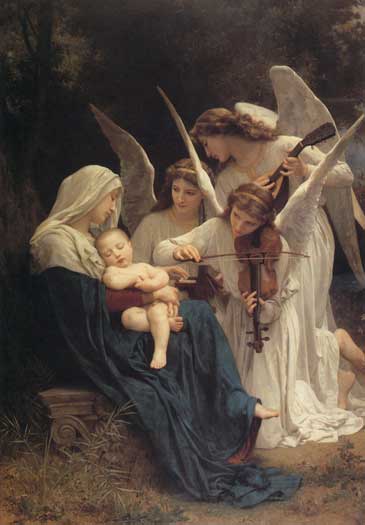
A Biblical Portrait of Mary
Mary is prefigured immediately after the Fall of Man; her divine motherhood is prophesied.
- Gen 3:14-15
- Then the Lord God said to the serpent: "... I will put enmity between you and the woman, and between your offspring and hers; He will strike at your head, while you strike at his heel."
Mary and her role in the history of our salvation is foretold by the prophet Isaiah; her virginity and divine motherhood is confirmed.
- Is 7:14
- Therefore the Lord himself will give you this sign: the virgin shall be with child, and bear a son, and shall name him Immanuel.
Matthew begins his genealogy with Abraham and ends with Mary.
- Mt 1:16
- Jacob the father of Joseph, the husband of Mary. Of her was born Jesus who is called the Messiah.
Luke narrates the angel Gabriel's announcement to Mary that she is to conceive a son and remain a virgin.
- Lk 1: 26-38
- ...(The angel Gabriel said) "Hail, favored one! The Lord is with you ... The holy Spirit will come upon you, and the power of the Most High will overshadow you. Therefore the child to be born will be called holy, the Son of God." ... Mary said, "Behold, I am the handmaid of the Lord. May it be done to me according to your word."
Luke also narrates Mary's visit to her cousin Elizabeth (pregnant with John the Baptist). It is Elizabeth who first calls Mary "the mother of God (Lord)".
- Lk 1:39-45
- ... When Elizabeth heard Mary's greeting, the infant leaped in her womb, and Elizabeth, filled with the holy Spirit, cried out in a loud voice and said, "Most blessed are you among women, and blessed is the fruit of your womb. And how does this happen to me, that the mother of my Lord should come to me? ... Blessed are you who believed that what was spoken to you by the Lord would be fulfilled."
- Lk 1:46-49
- And Mary said: "My soul proclaims the greatness of the Lord; my spirit rejoices in God my savior. For he has looked upon his handmaid's lowliness; behold, from now on will all ages call me blessed. The Mighty One has done great things for me, and holy is his name."
Matthew records Mary's engagement to Joseph.
- Mt. 1:18-25
- ... When his mother Mary was betrothed to Joseph, but before they lived together, she was found with child through the holy Spirit. ... the angel of the Lord appeared to him in a dream and said, "Joseph, son of David, do not be afraid to take Mary your wife into your home. For it is through the holy Spirit that this child has been conceived in her. She will bear a son and you are to name him Jesus, because he will save his people from their sins." He (Joseph) had no relations with her until she bore a son, and he named him Jesus.
Luke narrates the birth events of Jesus.
- Lk 2:1-19
- ... Joseph too went up from Galilee from the town of Nazareth to Judea, to the city of David that is called Bethlehem, because he was of the house and family of David, to be enrolled with Mary, his betrothed, who was with child. While they were there, the time came for her to have her child, and she gave birth to her firstborn son. She wrapped him in swaddling clothes and laid him in a manger ... (Shepherds) went in haste and found Mary and Joseph, and the infant ... Mary kept all these things (that the shepherds told her), reflecting on them in her heart.
Luke includes the circumcision and presentation of Jesus.
- Lk 2:33-35
- The child's father and mother were amazed at what was said about him; and Simeon blessed them and said to Mary his mother, "Behold, this child is destined for the fall and rise of many in Israel, and to be a sign that will be contradicted (and you yourself a sword will pierce) so that the thoughts of many hearts may be revealed."
Luke narrates the loss and finding of Jesus in the temple in Jerusalem by Mary and Joseph.
- Lk 2:48-51
- When his parents saw him, they were astonished, and his mother said to him, "Son, why have you done this to us? Your father and I have been looking for you with great anxiety." And he said to them, "Why were you looking for me? Did you not know that I must be in my Father's house?" But they did not understand what he said to them. He went down with them and came to Nazareth, and was obedient to them; and his mother kept all these things in her heart.
John records the wedding feast at Cana where Mary prompts Jesus' first miracle.
- Jn 2:1-12
- On the third day there was a wedding in Cana in Galilee, and the mother of Jesus was there. Jesus and his disciples were also invited to the wedding. When the wine ran short, the mother of Jesus said to him, "They have no wine." (And) Jesus said to her, "Woman, how does your concern affect me? My hour has not yet come." His mother said to the servers, "Do whatever he tells you." ... Jesus did this as the beginning of his signs in Cana in Galilee and so revealed his glory, and his disciples began to believe in him. After this, he and his mother, (his) brothers, and his disciples went down to Capernaum and stayed there only a few days.
Matthew writes of Jesus' own words that compare his relationship with his followers to his relationship with his mother.
- Mt 12:46-50 (Mk 3:31-35)
- While he was still speaking to the crowds, his mother and his brothers appeared outside, wishing to speak with him. ... And stretching out his hand toward his disciples, he said, "Here are my mother and my brothers. For whoever does the will of my heavenly Father is my brother, and sister, and mother."
It is John (an eye witness) who recalls his personal experience at the foot of the cross on Calvary.
- Jn 19:25-27
- Standing by the cross of Jesus were his mother and his mother's sister, Mary the wife of Clopas, and Mary of Magdala. When Jesus saw his mother and the disciple there whom he loved, he said to his mother, "Woman, behold, your son." Then he said to the disciple, "Behold, your mother." And from that hour the disciple took her into his home.
Luke, in his Acts of the Apostles, records the presence of Mary with the Apostles in the community in Jerusalem between the Ascension of Jesus and Pentecost.
- Acts 1:12-14
- Then they returned to Jerusalem from the mount called Olivet, which is near Jerusalem, a sabbath day's journey away. When they entered the city they went to the upper room where they were staying. ... All these devoted themselves with one accord to prayer, together with some women, and Mary the mother of Jesus, and his brothers.
A final reference to Mary is found in John's Book of Revelation.
- Rev 12:1-5
- A great sign appeared in the sky, a woman clothed with the sun, with the moon under her feet, and on her head a crown of twelve stars. She was with child and wailed aloud in pain as she labored to give birth. ... She gave birth to a son, a male child, destined to rule all the nations with an iron rod. Her child was caught up to God and his throne.
6
posted on
11/26/2005 6:23:26 AM PST
by
NYer
(“Socialism is the religion people get when they lose their religion")
To: NYer
A woman is a man’s mother either if she carried him in her womb or if she was the woman contributing half of his genetic matter or both. Mary was the mother of Jesus in both of these senses; because she not only carried Jesus in her womb but also supplied all of the genetic matter for his human body, since it was through her—not Joseph—that Jesus "was descended from David according to the flesh" (Rom. 1:3).
Since Mary is Jesus’ mother, it must be concluded that she is also the Mother of God: If Mary is the mother of Jesus, and if Jesus is God, then Mary is the Mother of God. There is no way out of this logical syllogism, the valid form of which has been recognized by classical logicians since before the time of Christ.
Although Mary is the Mother of God, she is not his mother in the sense that she is older than God or the source of her Son’s divinity, for she is neither. Rather, we say that she is the Mother of God in the sense that she carried in her womb a divine person—Jesus Christ, God "in the flesh" (2 John 7, cf. John 1:14)—and in the sense that she contributed the genetic matter to the human form God took in Jesus Christ.
To avoid this conclusion, Fundamentalists often assert that Mary did not carry God in her womb, but only carried Christ’s human nature. This assertion reinvents a heresy from the fifth century known as Nestorianism, which runs aground on the fact that a mother does not merely carry the human nature of her child in her womb. Rather, she carries the person of her child. Women do not give birth to human natures; they give birth to persons. Mary thus carried and gave birth to the person of Jesus Christ, and the person she gave birth to was God.
The Nestorian claim that Mary did not give birth to the unified person of Jesus Christ attempts to separate Christ’s human nature from his divine nature, creating two separate and distinct persons—one divine and one human—united in a loose affiliation. It is therefore a Christological heresy, which even the Protestant Reformers recognized. Both Martin Luther and John Calvin insisted on Mary’s divine maternity. In fact, it even appears that Nestorius himself may not have believed the heresy named after him. Further, the "Nestorian" church has now signed a joint declaration on Christology with the Catholic Church and recognizes Mary’s divine maternity, just as other Christians do.
Since denying that Mary is God’s mother implies doubt about Jesus’ divinity, it is clear why Christians (until recent times) have been unanimous in proclaiming Mary as Mother of God.
The Church Fathers, of course, agreed, and the following passages witness to their lively recognition of the sacred truth and great gift of divine maternity that was bestowed upon Mary, the humble handmaid of the Lord.
Irenaeus
"The Virgin Mary, being obedient to his word, received from an angel the glad tidings that she would bear God" (Against Heresies, 5:19:1 [A.D. 189]).
Hippolytus
"[T]o all generations they [the prophets] have pictured forth the grandest subjects for contemplation and for action. Thus, too, they preached of the advent of God in the flesh to the world, his advent by the spotless and God-bearing (theotokos) Mary in the way of birth and growth, and the manner of his life and conversation with men, and his manifestation by baptism, and the new birth that was to be to all men, and the regeneration by the laver [of baptism]" (Discourse on the End of the World 1 [A.D. 217]).
Gregory the Wonderworker
"For Luke, in the inspired Gospel narratives, delivers a testimony not to Joseph only, but also to Mary, the Mother of God, and gives this account with reference to the very family and house of David" (Four Homilies 1 [A.D. 262]).
"It is our duty to present to God, like sacrifices, all the festivals and hymnal celebrations; and first of all, [the feast of] the Annunciation to the holy Mother of God, to wit, the salutation made to her by the angel, ‘Hail, full of grace!’" (ibid., 2).
Peter of Alexandria
"They came to the church of the most blessed Mother of God, and ever-virgin Mary, which, as we began to say, he had constructed in the western quarter, in a suburb, for a cemetery of the martyrs" (The Genuine Acts of Peter of Alexandria [A.D. 305]).
"We acknowledge the resurrection of the dead, of which Jesus Christ our Lord became the firstling; he bore a body not in appearance but in truth derived from Mary the Mother of God" (Letter to All Non-Egyptian Bishops 12 [A.D. 324]).
Methodius
"While the old man [Simeon] was thus exultant, and rejoicing with exceeding great and holy joy, that which had before been spoken of in a figure by the prophet Isaiah, the holy Mother of God now manifestly fulfilled" (Oration on Simeon and Anna 7 [A.D. 305]).
"Hail to you forever, you virgin Mother of God, our unceasing joy, for unto you do I again return. . . . Hail, you fount of the Son’s love for man. . . . Wherefore, we pray you, the most excellent among women, who boast in the confidence of your maternal honors, that you would unceasingly keep us in remembrance. O holy Mother of God, remember us, I say, who make our boast in you, and who in august hymns celebrate your memory, which will ever live, and never fade away" (ibid., 14).
Cyril of Jerusalem
"The Father bears witness from heaven to his Son. The Holy Spirit bears witness, coming down bodily in the form of a dove. The archangel Gabriel bears witness, bringing the good tidings to Mary. The Virgin Mother of God bears witness" (Catechetical Lectures 10:19 [A.D. 350]).
Ephraim the Syrian
"Though still a virgin she carried a child in her womb, and the handmaid and work of his wisdom became the Mother of God" (Songs of Praise 1:20 [A.D. 351]).
Athanasius
"The Word begotten of the Father from on high, inexpressibly, inexplicably, incomprehensibly, and eternally, is he that is born in time here below of the Virgin Mary, the Mother of God" (The Incarnation of the Word of God 8 [A.D. 365]).
Epiphanius of Salamis
"Being perfect at the side of the Father and incarnate among us, not in appearance but in truth, he [the Son] reshaped man to perfection in himself from Mary the Mother of God through the Holy Spirit" (The Man Well-Anchored 75 [A.D. 374]).
Ambrose of Milan
"The first thing which kindles ardor in learning is the greatness of the teacher. What is greater than the Mother of God? What more glorious than she whom Glory Itself chose?" (The Virgins 2:2[7] [A.D. 377]).
Gregory of Nazianz
"If anyone does not agree that holy Mary is Mother of God, he is at odds with the Godhead" (Letter to Cledonius the Priest 101 [A.D. 382]).
Jerome
"As to how a virgin became the Mother of God, he [Rufinus] has full knowledge; as to how he himself was born, he knows nothing" (Against Rufinus 2:10 [A.D. 401]).
"Do not marvel at the novelty of the thing, if a Virgin gives birth to God" (Commentaries on Isaiah 3:7:15 [A.D. 409]).
Theodore of Mopsuestia
"When, therefore, they ask, ‘Is Mary mother of man or Mother of God?’ we answer, ‘Both!’ The one by the very nature of what was done and the other by relation" (The Incarnation 15 [A.D. 405]).
Cyril of Alexandria
"I have been amazed that some are utterly in doubt as to whether or not the holy Virgin is able to be called the Mother of God. For if our Lord Jesus Christ is God, how should the holy Virgin who bore him not be the Mother of God?" (Letter to the Monks of Egypt 1 [A.D. 427]).
"This expression, however, ‘the Word was made flesh’ [John 1:14], can mean nothing else but that he partook of flesh and blood like to us; he made our body his own, and came forth man from a woman, not casting off his existence as God, or his generation of God the Father, but even in taking to himself flesh remaining what he was. This the declaration of the correct faith proclaims everywhere. This was the sentiment of the holy Fathers; therefore they ventured to call the holy Virgin ‘the Mother of God,’ not as if the nature of the Word or his divinity had its beginning from the holy Virgin, but because of her was born that holy body with a rational soul, to which the Word, being personally united, is said to be born according to the flesh" (First Letter to Nestorius [A.D. 430]).
"And since the holy Virgin corporeally brought forth God made one with flesh according to nature, for this reason we also call her Mother of God, not as if the nature of the Word had the beginning of its existence from the flesh" (Third Letter to Nestorius [A.D. 430]).
"If anyone will not confess that the Emmanuel is very God, and that therefore the holy Virgin is the Mother of God, inasmuch as in the flesh she bore the Word of God made flesh [John 1:14]: let him be anathema" (ibid.).
John Cassian
"Now, you heretic, you say (whoever you are who deny that God was born of the Virgin), that Mary, the Mother of our Lord Jesus Christ, cannot be called the Mother of God, but the Mother only of Christ and not of God—for no one, you say, gives birth to one older than herself. And concerning this utterly stupid argument . . . let us prove by divine testimonies both that Christ is God and that Mary is the Mother of God" (On the Incarnation of Christ Against Nestorius 2:2 [A.D. 429]).
"You cannot then help admitting that the grace comes from God. It is God, then, who has given it. But it has been given by our Lord Jesus Christ. Therefore the Lord Jesus Christ is God. But if he is God, as he certainly is, then she who bore God is the Mother of God" (ibid., 2:5).
Council of Ephesus
"We confess, then, our Lord Jesus Christ, the only begotten Son of God, perfect God and perfect man, of a rational soul and a body, begotten before all ages from the Father in his Godhead, the same in the last days, for us and for our salvation, born of Mary the Virgin according to his humanity, one and the same consubstantial with the Father in Godhead and consubstantial with us in humanity, for a union of two natures took place. Therefore we confess one Christ, one Son, one Lord. According to this understanding of the unconfused union, we confess the holy Virgin to be the Mother of God because God the Word took flesh and became man and from his very conception united to himself the temple he took from her" (Formula of Union [A.D. 431]).
Vincent of Lerins
"Nestorius, whose disease is of an opposite kind, while pretending that he holds two distinct substances in Christ, brings in of a sudden two persons, and with unheard-of wickedness would have two sons of God, two Christs,—one, God, the other, man; one, begotten of his Father, the other, born of his mother. For which reason he maintains that Saint Mary ought to be called, not the Mother of God, but the Mother of Christ" (The Notebooks 12[35] [A.D. 434]).
7
posted on
11/26/2005 6:38:11 AM PST
by
Knitting A Conundrum
(Act Justly, Love Mercy, and Walk Humbly With God Micah 6:8)
To: Knitting A Conundrum; All

“ I AM THE IMMACULATE CONCEPTION”
On March 25, the feast of the Annunciation, also known as Lady Day, the Lady told Bernadette her name. She said, “I am the Immaculate Conception.” This declaration of the Blessed Mother to Bernadette has deeply and profoundly moved many souls over the years, including St. Maximilian Kolbe. This is her name and suggests the profound mystery of the work of the Holy Spirit in the Virgin Mary’s soul.
Miracles still flow from the miraculous waters of Lourdes — but many more of the miracles occur during the blessing of the sick with the Most Holy Eucharist in the monstrance. This phenomenon underscores a profound truth of the spiritual life: Mary leads her children to her Divine Son, especially to His Eucharistic Heart. The message of Our Lady of Lourdes is about the healing Mercy of God. But Lourdes is also about the need for prayer and penance. St. Bernadette testified to this call of Our Lady of Lourdes by living the rest of her life in humble prayer and suffering in a convent in France.
Our Lady of Lourdes
8
posted on
11/26/2005 6:39:26 AM PST
by
NYer
(“Socialism is the religion people get when they lose their religion")
To: NYer
one more on the fathers:
Mary: "Full of Grace"
The Fathers of the Church taught that Mary received a number of distinctive blessings in order to make her a more fitting mother for Christ and the prototypical Christian (follower of Christ). These blessings included her role as the New Eve (corresponding to Christ’s role as the New Adam), her Immaculate Conception, her spiritual motherhood of all Christians, and her Assumption into heaven. These gifts were given to her by God’s grace. She did not earn them, but she possessed them nonetheless.
The key to understanding all these graces is Mary’s role as the New Eve, which the Fathers proclaimed so forcefully. Because she is the New Eve, she, like the New Adam, was born immaculate, just as the First Adam and Eve were created immaculate. Because she is the New Eve, she is mother of the New Humanity (Christians), just as the first Eve was the mother of humanity. And, because she is the New Eve, she shares the fate of the New Adam. Whereas the First Adam and Eve died and went to dust, the New Adam and Eve were lifted up physically into heaven.
Of particular interest in the following quotations from the Fathers are those that speak of Mary’s immaculate nature. We will all one day be rendered immaculate (sinless), but Mary, as the prototypical Christian, received this grace early. God granted her freedom from sin to make her a fitting mother for his Son.
Even before the terms "original sin" and "immaculate conception" had been defined, early passages imply the doctrines. Many works mention that Mary gave birth to Jesus without pain. But pain in childbearing is part of the penalty of original sin (Gen. 3:16). Thus, Mary could not have been under that penalty. By God’s grace, she was immaculate in anticipation of her Son’s redemptive death on the cross. The Church therefore describes Mary as "the most excellent fruit of redemption" (CCC 508).
The Ascension of Isaiah
"[T]he report concerning the child was noised abroad in Bethlehem. Some said, ‘The Virgin Mary has given birth before she was married two months.’ And many said, ‘She has not given birth; the midwife has not gone up to her, and we heard no cries of pain’" (Ascension of Isaiah 11 [A.D. 70]).
The Odes of Solomon
"So the Virgin became a mother with great mercies. And she labored and bore the Son, but without pain, because it did not occur without purpose. And she did not seek a midwife, because he caused her to give life. She bore as a strong man, with will . . . " (Odes of Solomon 19 [A.D. 80]).
Justin Martyr
"[Jesus] became man by the Virgin so that the course which was taken by disobedience in the beginning through the agency of the serpent might be also the very course by which it would be put down. Eve, a virgin and undefiled, conceived the word of the serpent and bore disobedience and death. But the Virgin Mary received faith and joy when the angel Gabriel announced to her the glad tidings that the Spirit of the Lord would come upon her and the power of the Most High would overshadow her, for which reason the Holy One being born of her is the Son of God. And she replied ‘Be it done unto me according to your word’ [Luke 1:38]" (Dialogue with Trypho the Jew 100 [A.D. 155]).
Irenaeus
"Consequently, then, Mary the Virgin is found to be obedient, saying, ‘Behold, O Lord, your handmaid; be it done to me according to your word.’ Eve, however, was disobedient, and, when yet a virgin, she did not obey. Just as she, who was then still a virgin although she had Adam for a husband—for in paradise they were both naked but were not ashamed; for, having been created only a short time, they had no understanding of the procreation of children, and it was necessary that they first come to maturity before beginning to multiply—having become disobedient, was made the cause of death for herself and for the whole human race; so also Mary, betrothed to a man but nevertheless still a virgin, being obedient, was made the cause of salvation for herself and for the whole human race. . . . Thus, the knot of Eve’s disobedience was loosed by the obedience of Mary. What the virgin Eve had bound in unbelief, the Virgin Mary loosed through faith" (Against Heresies 3:22:24 [A.D. 189]).
"The Lord then was manifestly coming to his own things, and was sustaining them by means of that creation that is supported by himself. He was making a recapitulation of that disobedience that had occurred in connection with a tree, through the obedience that was upon a tree [i.e., the cross]. Furthermore, the original deception was to be done away with—the deception by which that virgin Eve (who was already espoused to a man) was unhappily misled. That this was to be overturned was happily announced through means of the truth by the angel to the Virgin Mary (who was also [espoused] to a man). . . . So if Eve disobeyed God, yet Mary was persuaded to be obedient to God. In this way, the Virgin Mary might become the advocate of the virgin Eve. And thus, as the human race fell into bondage to death by means of a virgin, so it is rescued by a virgin. Virginal disobedience has been balanced in the opposite scale by virginal obedience. For in the same way, the sin of the first created man received amendment by the correction of the First-Begotten" (ibid., 5:19:1 [A.D. 189]).
Tertullian
"And again, lest I depart from my argumentation on the name of Adam: Why is Christ called Adam by the apostle [Paul], if as man he was not of that earthly origin? But even reason defends this conclusion, that God recovered his image and likeness by a procedure similar to that in which he had been robbed of it by the devil. It was while Eve was still a virgin that the word of the devil crept in to erect an edifice of death. Likewise through a virgin the Word of God was introduced to set up a structure of life. Thus what had been laid waste in ruin by this sex was by the same sex reestablished in salvation. Eve had believed the serpent; Mary believed Gabriel. That which the one destroyed by believing, the other, by believing, set straight" (The Flesh of Christ 17:4 [A.D. 210].
Pseudo-Melito
"If therefore it might come to pass by the power of your grace, it has appeared right to us your servants that, as you, having overcome death, do reign in glory, so you should raise up the body of your Mother and take her with you, rejoicing, into heaven. Then said the Savior [Jesus]: ‘Be it done according to your will’" (The Passing of the Virgin 16:2–17 [A.D. 300]).
Ephraim the Syrian
"You alone and your Mother are more beautiful than any others, for there is no blemish in you nor any stains upon your Mother. Who of my children can compare in beauty to these?" (Nisibene Hymns 27:8 [A.D. 361]).
Ambrose of Milan
"Mary’s life should be for you a pictorial image of virginity. Her life is like a mirror reflecting the face of chastity and the form of virtue. Therein you may find a model for your own life . . . showing what to improve, what to imitate, what to hold fast to" (The Virgins 2:2:6 [A.D. 377]).
"The first thing which kindles ardor in learning is the greatness of the teacher. What is greater [to teach by example] than the Mother of God? What more glorious than she whom Glory Itself chose? What more chaste than she who bore a body without contact with another body? For why should I speak of her other virtues? She was a virgin not only in body but also in mind, who stained the sincerity of its disposition by no guile, who was humble in heart, grave in speech, prudent in mind, sparing of words, studious in reading, resting her hope not on uncertain riches, but on the prayer of the poor, intent on work, modest in discourse; wont to seek not man but God as the judge of her thoughts, to injure no one, to have goodwill towards all, to rise up before her elders, not to envy her equals, to avoid boastfulness, to follow reason, to love virtue. When did she pain her parents even by a look? When did she disagree with her neighbors? When did she despise the lowly? When did she avoid the needy?" (ibid., 2:2:7).
"Come, then, and search out your sheep, not through your servants or hired men, but do it yourself. Lift me up bodily and in the flesh, which is fallen in Adam. Lift me up not from Sarah but from Mary, a virgin not only undefiled, but a virgin whom grace had made inviolate, free of every stain of sin" (Commentary on Psalm 118:22–30 [A.D. 387]).
Augustine
"Our Lord . . . was not averse to males, for he took the form of a male, nor to females, for of a female he was born. Besides, there is a great mystery here: that just as death comes to us through a woman, life is born to us through a woman; that the devil, defeated, would be tormented by each nature, feminine and masculine, as he had taken delight in the defection of both" (Christian Combat 22:24 [A.D. 396]).
"That one woman is both mother and virgin, not in spirit only but even in body. In spirit she is mother, not of our head, who is our Savior himself—of whom all, even she herself, are rightly called children of the bridegroom—but plainly she is the mother of us who are his members, because by love she has cooperated so that the faithful, who are the members of that head, might be born in the Church. In body, indeed, she is the Mother of that very head" (Holy Virginity 6:6 [A.D. 401]).
...
"Having excepted the holy Virgin Mary, concerning whom, on account of the honor of the Lord, I wish to have absolutely no question when treating of sins—for how do we know what abundance of grace for the total overcoming of sin was conferred upon her, who merited to conceive and bear him in whom there was no sin?—so, I say, with the exception of the Virgin, if we could have gathered together all those holy men and women, when they were living here, and had asked them whether they were without sin, what do we suppose would have been their answer?" (Nature and Grace 36:42 [A.D. 415]).
Timothy of Jerusalem
"Therefore the Virgin is immortal to this day, seeing that he who had dwelt in her transported her to the regions of her assumption" (Homily on Simeon and Anna [A.D. 400]).
John the Theologian
"[T]he Lord said to his Mother, ‘Let your heart rejoice and be glad, for every favor and every gift has been given to you from my Father in heaven and from me and from the Holy Spirit. Every soul that calls upon your name shall not be ashamed, but shall find mercy and comfort and support and confidence, both in the world that now is and in that which is to come, in the presence of my Father in the heavens’" (The Falling Asleep of Mary [A.D. 400]).
"And from that time forth all knew that the spotless and precious body had been transferred to paradise" (ibid.).
Gregory of Tours
"The course of this life having been completed by blessed Mary, when now she would be called from the world, all the apostles came together from their various regions to her house. And when they had heard that she was about to be taken from the world, they kept watch together with her. And behold, the Lord Jesus came with his angels, and, taking her soul, he gave it over to the angel Michael and withdrew. At daybreak, however, the apostles took up her body on a bier and placed it in a tomb, and they guarded it, expecting the Lord to come. And behold, again the Lord stood by them; the holy body having been received, he commanded that it be taken in a cloud into paradise, where now, rejoined to the soul, [Mary’s body] rejoices with the Lord’s chosen ones and is in the enjoyment of the good of an eternity that will never end" (Eight Books of Miracles 1:4 [A.D. 584]).
"But Mary, the glorious Mother of Christ, who is believed to be a virgin both before and after she bore him, has, as we said above, been translated into paradise, amid the singing of the angelic choirs, whither the Lord preceded her" (ibid., 1:8).
9
posted on
11/26/2005 6:41:04 AM PST
by
Knitting A Conundrum
(Act Justly, Love Mercy, and Walk Humbly With God Micah 6:8)
To: Knitting A Conundrum

Theotokos
10
posted on
11/26/2005 6:49:10 AM PST
by
NYer
(“Socialism is the religion people get when they lose their religion")
To: NYer
That's a perfect lead in to this quote:
St. Gregory the Theologian (Nazianzen): On Mary as the Mother of God
If anyone does not believe that Holy Mary is the Mother of God, he is severed from the Godhead. If anyone should assert that He passed through the Virgin as through a channel, and was not at once divinely and humanly formed in her (divinely, because without the intervention of a man; humanly, because in accordance with the laws of gestation), he is in like manner godless. If any assert that the Manhood was formed and afterward was clothed with the Godhead, he too is to be condemned. For this were not a Generation of God, but a shirking of generation. If any introduce the notion of Two Sons, one of God the Father, the other of the Mother, and discredits the Unity and Identity, may he lose his part in the adoption promised to those who believe aright. For God and Man are two natures, as also soul and body are; but there are not two Sons or two Gods. For neither in this life are there two manhoods; though Paul speaks in some such language of the inner and outer man. And (if I am to speak concisely) the Saviour is made of elements which are distinct from one another (for the invisible is not the same with the visible, nor the timeless with that which is subject to time), yet He is not two Persons. God forbid! For both natures are one by the combination, the Deity being made Man, and the Manhood deified or however one should express it. And I say different Elements, because it is the reverse of what is the case in the Trinity; for There we acknowledge different Persons so as not to confound the persons; but not different Elements, for the Three are One and the same in Godhead.
--Letter to Cledonius (101st)
11
posted on
11/26/2005 6:58:24 AM PST
by
Knitting A Conundrum
(Act Justly, Love Mercy, and Walk Humbly With God Micah 6:8)
To: Knitting A Conundrum

O Blessed Mother,
O Lady of Consolation,
be with us
when the moments seem so dark,
and the anger builds
and we want to do
what we cannot do.
O Mary,
You too know what it is like,
to see your beloved
tortured,
beaten,
murdered
without being able to do more
than wait,
pray,
and give it all to the Father.
When our heart breaks,
intercede for us
that we too
will have the patience to wait for the Lord's time,
the grace to bear the load we are given,
and the ability to give him our resounding YES.
Amen.
12
posted on
11/26/2005 7:27:54 AM PST
by
Knitting A Conundrum
(Act Justly, Love Mercy, and Walk Humbly With God Micah 6:8)
To: Knitting A Conundrum; NYer
Thanks for posting this beautiful thread. I have it bookmarked. Now, I await the inevitable cynics.
Frank
13
posted on
11/26/2005 7:30:59 AM PST
by
Frank Sheed
("Fallacies do not cease to be fallacies because they become fashions." ~GK Chesterton.)
To: Knitting A Conundrum
To: Frank Sheed
You didn't have long to wait!
15
posted on
11/26/2005 7:39:10 AM PST
by
Knitting A Conundrum
(Act Justly, Love Mercy, and Walk Humbly With God Micah 6:8)
To: Knitting A Conundrum
Mary our Mother
by Father William G. Most
"As a result, she is our Mother in the order of grace." With these few words Vatican II (On the Church # 61) gave us a brilliant theology of the Motherhood of Our Lady, and a marvelous help to understand the motherhood of all Mothers. To follow it, we need to read the two sentences that come before it: "The Blessed Virgin, predestined from eternity along with the Incarnation of the Divine Word, as the Mother of God, on this earth was the gracious Mother of the Divine Redeemer, His associate more than others, in a singular way, and the humble maid-servant of the Lord. In conceiving Christ, in bringing Him forth, in nourishing Him, in presenting Him to the Father in the Temple, in suffering with her Son as He died on the cross, she cooperated in the work of the Savior, in an altogether singular way, by obedience, faith, hope and burning love, to restore supernatural life to souls. As a result, she is our Mother in the order of grace."
"As a result, she is our Mother in the order of grace." An ordinary Mother does two things to gain that glorious title: she shares in bringing a new life into being, she takes care of that life so long as she is needed, as long as she is willing and able.
Mary gives us supernatural life
We have seen in our discussion of Mary's cooperation in the redemption how she shares in bringing new life into being. And what a life that is! Compared to it mere mortal life is as nothing. The Second Epistle of St. Peter (1:4) says that in it we are made "sharers in the divine nature." And, we have seen in our discussion of Mary's continuing mediation how she takes care of our supernatural life.
Let us try to explore this mystery a bit. St. Paul says that in heaven we will see God "face to face". Now of course, God does not have a face. Nor do souls have mortal eyes. But the solid reality is far beyond what the words can readily convey. When I look at another person in this life, I do not take that one into my mind--no, I take in an image. The person is finite, limited, and so a finite image can let me know about that one.
But God is infinite. No image could begin to convey what He is like. So the next, the inevitable step is staggering: it must be that the divinity will join itself to the created human soul immediately, without even an image in between, so that the soul can know Him even as His Son knows Him, as He knows His Son. Within that divinity there as it were flow infinite streams of knowledge and of love. For the first chapter of John's Gospel tells us that in the beginning the Father spoke the Word. That Word is not a ripple in the air as our words are. No, it is substantial, it is the second Person of the Holy Trinity. Between Father and Son there arises love--again, not the feeble reality we know, but it too is substantial, it is another Divine Person, the Holy Spirit, proceeding by way of infinite love.
Only a being at least partly divine could as it were plug into these infinite streams of knowledge and of love. Yet that is what it means to be "sharers in the divine nature", which we are by the life of grace, which she shared in gaining for us, at a cost so great that, as we said, only God can comprehend it. So she really is our Mother in the order of grace.
A Mother's Care
But a Mother has a second role to fulfill: to take care of the new life, so long as she is willing, able, and needed. In ordinary human affairs, there comes a time when the Mother is not really much needed, for the child grows to adult stature. But in the spiritual life ,we remain children - for unless we become as little children we shall not inherit the kingdom. Or, to put it more clearly, we always stand in the need of grace as long as we have not yet entered the mansions of our Father. That grace, every grace, comes to us through her, for, as Vatican II taught (62), she is the Mediatrix.
We said an ordinary Mother should give care as long as she is willing and able. Sadly, some human mothers stop being willing. Not so our Heavenly Mother. The children she brought into life by such tremendous pain she will never forget. She is always willing. Moreover, an ordinary mother may come to points at which she is unable to help, howsoever pathetically she way wish to do so. Not so our Mother in Heaven: Pope Benedict XV called her "suppliant omnipotence". That is, all that God can do by His very inherent power, she, with and through her Son, can obtain by asking Him for it. And that she does.
From what we have said, we see that she brought us forth on Calvary. Yet there is an a sense in which we can correctly say that she became our Mother even before that day. On June 19, 1947, Pope Pius XII sent a message to the Marian Congress of Ottawa, Canada. He said: "When the little maid of Nazareth uttered her fiat to the message of the angel...she became not only the Mother of God in the physical order of nature, but also in the supernatural order of grace she became the Mother of all who...would be made one under the Headship of her divine Son. The Mother of the Head would be the Mother of the members. The Mother of the vine would be the Mother of the branches."
The thought is obvious. Her Son is the Head of the Mystical Body, of which we are members. She really could not become the Mother of the Head without automatically, as it were, becoming the Mother of the Members of Her Son. Of course, that was only begun at the Annunciation. It was to be brought to light, with immense pain, only on the hill of Calvary.
Ordinary mothers cannot of course be both virgin and mother. But they can imitate, at a distance, her devotion to the Word of God, her fidelity to His will, her carrying out of the role designed for her by our Father's plan. Even when the need for physical care of their sons dims, the sons still need spiritual care--and that the Mothers should provide, even as she did.
St. Luke tells us that when young, Jesus went down to Nazareth and was subject to his parents. He, in His strictly divine humility, allowed Himself to be formed, humanly, by His Mother and St. Joseph. Ordinary mothers can imitate this and should realize that to form a new life in the likeness of Jesus or His Mother is far higher than to be a business executive, a policewoman, a tram operator, or whatever--it is far higher and nobler than the masterpieces of Michaelangelo, who carved in marble--Mothers carve in human souls!
16
posted on
11/26/2005 7:42:45 AM PST
by
Knitting A Conundrum
(Act Justly, Love Mercy, and Walk Humbly With God Micah 6:8)
To: theFIRMbss
Scoot! You are hereby invisible Little Troll!
17
posted on
11/26/2005 7:47:45 AM PST
by
Frank Sheed
("Fallacies do not cease to be fallacies because they become fashions." ~GK Chesterton.)
To: Knitting A Conundrum
"Behold the handmaid of the Lord, be it done to me according to Thy word."
Luke 1: 38
Here are quotes from ten Fathers of the Early Church, each of whom give their witness to the Church's understanding of the Virgin Mary as the parallel to and fulfillment of the First Eve. What St. John only hints at in his Gospel, these Fathers (in different eras and representing a wide geographical range) make explicit: Mary is the New Eve, just as Our Lord is the New Adam. Here and there, I have interspersed commentary from John Cardinal Newman, a convert from Anglicanism in the 1800s.
I. St. Justin Martyr (160 AD)
... since we call Him the Son, we have understood that He proceeded before all creatures from the Father by His power and will ... and that He became man by the Virgin, in order that the disobedience which proceeded from the serpent might receive its destruction in the same manner in which it derived its origin. For Eve, who was a virgin and undefiled, having conceived the word of the serpent, brought forth disobedience and death. But the Virgin Mary received faith and joy, when the angel Gabriel announced the good tidings to her that the Spirit of the Lord would come upon her, and the power of the Highest would overshadow her: wherefore also the Holy Thing begotten of her is the Son of God; and she replied, "Be it unto me according to Thy word." (Dialogue with Trypho, 100)
II. Tertullian (180-200 AD)
And even reason here maintains the same conclusion, because it was by just the contrary operation that God recovered His own image and likeness, of which He had been robbed by the devil. For it was while Eve was yet a virgin, that the ensnaring word had crept into her ear which was to build the edifice of death. Into a virgin's soul, in like manner, must be introduced that Word of God which was to raise the fabric of life; so that what had been reduced to ruin by this sex, might by the selfsame sex be recovered to salvation. As Eve had believed the serpent, so Mary believed the angel. The delinquency which the one occasioned by believing, the other by believing effaced. (On the Flesh of Christ, 17)
III. St. Irenaeus (180-190 AD)
In accordance with this design, Mary the Virgin is found obedient, saying, "Behold the handmaid of the Lord; be it unto me according to Thy word." But Eve was disobedient; for she did not obey when as yet she was a virgin. And even as she, having indeed a husband, Adam, but being nevertheless as yet a virgin ... having become disobedient, was made the cause of death, both to herself and to the entire human race; so also did Mary, having a man betrothed [to her], and being nevertheless a virgin, by yielding obedience, become the cause of salvation, both to herself and the whole human race ... And the prophet, too, indicates the same, saying, "instead of fathers, children have been born unto thee." For the Lord, having been born "the First-begotten of the dead," and receiving into His bosom the ancient fathers, has regenerated them into the life of God, He having been made Himself the beginning of those that live, as Adam became the beginning of those who die. Wherefore also Luke, commencing the genealogy with the Lord, carried it back to Adam, indicating that it was He who regenerated them into the Gospel of life, and not they Him. And thus also it was that the knot of Eve's disobedience was loosed by the obedience of Mary. For what the virgin Eve had bound fast through unbelief, this did the virgin Mary set free through faith. (Against Heresies, Book III, cap. 22, 4)
For just as the former was led astray by the word of an angel, so that she fled from God when she had transgressed His word; so did the latter, by an angelic communication, receive the glad tidings that she should [bear] (portaret) God, being obedient to His word. And if the former did disobey God, yet the latter was persuaded to be obedient to God, in order that the Virgin Mary might become the [advocate] (advocata) of the virgin Eve. And thus, as the human race fell into bondage to death by means of a virgin, so is it rescued by a virgin; virginal disobedience having been balanced in the opposite scale by virginal obedience. (ibid., Book V, cap. 19, 1)
Commentary
Now, what is especially noticeable in these three writers is that they do not speak of the Blessed Virgin merely as the physical instrument of our Lord's taking flesh, but as an intelligent, responsible cause of it ... [the Three Fathers] unanimously declare that she was not a mere instrument in the Incarnation, such as David, or Judah, may be considered ... it follows that, as Eve co-operated in effecting a great evil, Mary co-operated in effecting a much greater good. (Newman, The Virgin Mary in the Life and Writings of John Henry Newman, p. 212-3)
For a moment put aside St. Irenaeus, and put together St. Justin in the East with Tertullian in the West. I think I may assume that the doctrine of these two Fathers about the Blessed Virgin, was the received doctrine of their own respective times and places ... the coincidence of doctrine which they exhibit, and again, the antithetical completeness of it, show that they themselves did not originate it ... we must inquire, what length of time would it take for such a doctrine to have extended, and to be received, in the second century over so wide an area; that is, to be received before the year 200 in Palestine, Africa, and Rome. Can we refer the common source of these local traditions to a date much later than that of the Apostles, since St. John died within twenty years of St. Justin's conversion and sixty of Tertullian's birth? ... add to the concordant testimony of these two Fathers the evidence of St. Irenaeus, which is so close upon that of the School of St. John himself in Asia Minor ... supposing three such witnesses could be brought to the fact that a consistory of elders governed the local churches, or that each local congregation was an independent Church, or that the Christian community was without priests, could Anglicans maintain their doctrine that the rule of Episcopal succession is necessary to constitute a Church? (Newman, p. 214-5)
IV. St. Cyril of Jerusalem (315-386)
Through Eve yet virgin came death; through a virgin, or rather from a virgin, must the Life appear: that as the serpent beguiled the one, so to the other Gabriel might bring good tidings. (Catechetical Lectures, Lecture XII, 15)
V. St. Ephrem Syrus (died 378)
"is a witness for the Syrians proper and the neighbouring Orientals" (Newman, p. 216)
Through Eve, the beautiful and desirable glory of men was extinguished; but it has revived through Mary. (Opera omnia in sex tomos distributa, II, p. 318, quoted in Newman, p. 217)
In the beginning, by the sin of our first parents, death passed upon all men; today, through Mary we are translated from death unto life. In the beginning, the serpent filled the ears of Eve, and the poison spread thence over the whole body; today, Mary from her ears received the champion of eternal happiness: what, therefore, was an instrument of death, was an instrument of life also. (ibid., III, p. 607, quoted in Newman, p. 217)
VI. St. Epiphanius (320-400)
"speaks for Egypt, Palestine, and Cyprus" (Newman, p. 217)
She it is, who is signified by Eve, enigmatically receiving the appellation of the Mother of living ... It was a wonder, that after the transgression she had this great epithet. And, according to what is material, from that Eve all the race of men on earth is generated. But thus in truth from Mary the Life itself was born in the world, that Mary might bear living things, and become the Mother of living things. Therefore, enigmatically, Mary is called the Mother of living things ... Also, there is another thing to consider as to these women, and wonderful, - as to Eve and Mary. Eve became a cause of death to man ... and Mary a cause of life ... that life might be instead of death, life excluding death which came from the woman, viz., He who through the woman has become our life. (Panarion, 78:18, quoted in Newman, p. 217-8)
VII. St. Jerome (331-420)
Death came through Eve, but life has come through Mary. (Letter XXII, To Eustochium, 21)
VIII. St. Augustine (354-430)
By a woman death, by a woman life. (Sermon 232, 2, quoted in Newman, p. 219)
[Newman notes that this phrase, used by both Sts. Jerome and Augustine, seems to have already in the 4th-5th century developed into a kind of recognizable proverb.]
It is a great sacrament that, whereas through woman death became our portion, so life was born to us by woman; that, in the case of both sexes, male and female, the baffled devil should be tormented, when on the overthrow of both sexes he was rejoicing; whose punishment had been small, if both sexes had been liberated in us, without our being liberated through both. (De Agone Christiano, 24, quoted in Newman, p. 219-20)
Latin Text: Huc accedit magnum sacramentum, ut quoniam per feminam nobis mors acciderat, vita nobis per feminam nasceretur: ut de utraque natura, id est feminina et masculina, victus diabolus cruciaretur, quoniam de ambarum subversione laetabatur; cui parum fuerat ad poenam si ambae naturae in nobis liberarentur, nisi etiam per ambas liberaremur.
IX. St. Peter Chrysologus (400-450)
Blessed art thou among women; for among women, on whose womb Even, who was cursed, brought punishment, Mary, being blest, rejoices, is honoured, and is looked up to. And woman now is truly made through grace the Mother of the living, who had been by nature the mother of the dying ... Heaven feels the awe of God, Angels tremble at Him, the creature sustains Him not, nature sufficeth not; and yet one maiden so takes, receives, entertains Him, as a guest within her breast, that, for the very hire of her home, and as the price of her womb, she asks, she obtains peace for the earth, glory for the heavens, salvation for the lost, life for the dead, a heavenly parentage for the earthly, the union of God Himself with human flesh. (Sermon 140, quoted in Newman, p. 220)
X. St. Fulgentius, bishop in Africa (468-533)
Come ye virgins to a Virgin, come ye who conceive to her who conceived, ye who bear to one who bore, mothers to a mother, ye that suckle to one who suckled, young girls to the young girl. It is for this reason that the Virgin Mary has taken on her in our Lord Jesus Christ all these divisions of nature, that to all women who have recourse to her, she may be a succour, and so restore the whole race of women who come to her, being the new Eve, by keeping virginity, as the New Adam the Lord Jesus Christ, recovers the whole race of men. (Sermon 36, quoted in Newman, p. 221)
Commentary
Such is the rudimental view, as I have called it, which the Fathers have given us of Mary, as the Second Eve, the Mother of the living: I have cited ten authors, I could cite more, were it necessary; except the two last, they write gravely and without any rhetoric. I allow that the two last write in a different style, since the extracts I have made are from their sermons; but I do not see that the colouring conceals the outline. And after all, men use oratory on great subjects, not on small; not would they, and other Fathers whom I might quote, have lavished their high language upon the Blessed Virgin, such as they gave to no one else, unless they knew well that no one else had such claims, as she had, on their love and veneration. (Newman, p. 222)
Et dixit Iesus: "Amen, amen, dico vobis: nisi manducaveritis carnem Filii hominis, et biberitis eius sanguinem, non habetis vitam in vobis."
Jacob Michael
http://www.dailycatholic.org/issue/04Nov/nov6qds.htm
18
posted on
11/26/2005 7:49:03 AM PST
by
Knitting A Conundrum
(Act Justly, Love Mercy, and Walk Humbly With God Micah 6:8)
To: Frank Sheed
LOL! and a great attitude!
19
posted on
11/26/2005 7:50:47 AM PST
by
Knitting A Conundrum
(Act Justly, Love Mercy, and Walk Humbly With God Micah 6:8)
To: Frank Sheed
>Scoot! You are hereby invisible Little Troll!

Oh dear. Your wizard
powers do not work as well
in an FR thread
as they do sitting
around the basement playing
Dungeons and Dragons . . .
Navigation: use the links below to view more comments.
first 1-20, 21-40, 41-53 next last
Disclaimer:
Opinions posted on Free Republic are those of the individual
posters and do not necessarily represent the opinion of Free Republic or its
management. All materials posted herein are protected by copyright law and the
exemption for fair use of copyrighted works.
FreeRepublic.com is powered by software copyright 2000-2008 John Robinson