It's too bad we have this Ministry of Propaganda instead of an actual news media. The anti-Bush, anti-Republican ax-grinding never ceases with these guys. |
Posted on 10/12/2003 7:42:11 AM PDT by Brian S
Oct. 12 — By Will Dunham
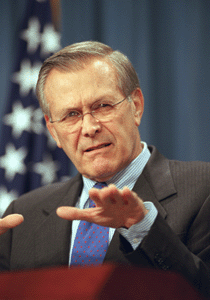
WASHINGTON (Reuters) - Defense Secretary Donald Rumsfeld was asked recently to explain why he is taking such heat after enjoying "rock-star popularity" not too long ago among his admirers following U.S. military campaigns in Iraq and Afghanistan.
"Well, that's life, isn't it?" Rumsfeld told reporters.
"Life's a roller coaster."
In the roller coaster ride of Washington politics, Rumsfeld appears to be on a downward trajectory, according to U.S. officials and analysts.
They cite as evidence President Bush's formation of an interagency Iraq Stabilization Group headed by Condoleezza Rice, the White House national security adviser, to coordinate policy in Iraq, until now largely an in-house operation for Rumsfeld's Pentagon.
"You have to view this as just taking Rumsfeld down a notch," Brookings Institution defense analyst Michael O'Hanlon said. "It certainly reflects a little bit less confidence in Rumsfeld. I think it would be pretty hard to portray it any other way. ... Rumsfeld's star has dimmed just a little."
Rumsfeld has exerted considerable muscle in molding U.S. national security and foreign policy, often reaching into realms ordinarily left to other parts of the government such as the State Department and the CIA.
His detractors inside and outside the administration are wondering whether Rumsfeld's frosty relations with Congress, alienation of U.S. allies, bruising battles with Secretary Colin Powell's State Department and stubborn refusal to change course in postwar Iraq are finally catching up with him.
"I wonder how long he's going to have his job," said one administration official, speaking on condition of anonymity. "He's become a bit of a political liability."
The White House has given Rumsfeld a public expression of confidence, although that does not always guarantee the safety of a Cabinet secretary's job.
Republican consultant Charlie Black said he did not think Bush was dissatisfied with Rumsfeld or poised to fire him, but did not rule out Rumsfeld leaving the administration if Bush is re-elected in November 2004.
"From everything I see and observe and hear from people, I think he's perfectly safe," Black said.
No one doubts Rumsfeld's continuing clout. Even with the organizational change, instituted amid mounting public concern about the cost of efforts in Iraq in terms of U.S. money and lives, the White House said the Pentagon retains primary responsibility in Iraq policy.
A HUMBLING EXPERIENCE
Rumsfeld initially displayed annoyance over the announcement of Rice's Iraq Stabilization Group and said Bush never talked to him about it beforehand, then later clarified that he did not believe the White House was going behind his back to diminish his power. O'Hanlon said Rumsfeld's public complaints only drew attention to the situation "and he essentially contributed to his own humbling."
Even before the U.S.-led invasion that toppled President Saddam Hussein, Bush assigned Rumsfeld, rather than Powell, the lead role in postwar Iraq. But the six months since the fall of Baghdad have been difficult ones, with the 130,000 U.S. troops in Iraq facing continued guerrilla attacks while ordinary Iraqis complain about lingering lawlessness in some places and slowness in restoring basic services.
Critics have questioned the quality of the Pentagon's postwar planning, anticipation of problems and speed in addressing them. In fact, some House of Representatives Republicans, displeased with Rumsfeld's progress in Iraq, recently contemplated giving Powell rather than Rumsfeld control over the $20.3 billion Bush is seeking for Iraqi reconstruction.
Defense analyst Charles Pena of the Cato Institute said if things were going really well in Iraq, the White House would not be making any changes.
"But what's driving the train is an election a year away," Pena said.
"The White House is looking at the poll numbers. The president's approval rating, not just on Iraq but everything else, has been in steady decline since May 1 (when he declared major combat over in Iraq). Whereas previously Iraq and the war on terrorism were seen by the political operators in the White House as what would win the president re-election, they are now seen as what could lose this election for the president."
Defense analyst Loren Thompson of the Lexington Institute said Rumsfeld's actual policy influence has not receded.
Thompson said the White House, despite assuming more responsibility for Iraq decisions, has made no policy changes. He noted U.S. policy will continue to be administered on the ground in Iraq primarily by the Defense Department.
And Thompson said Rumsfeld remains very much in harmony ideologically with Bush and Vice President Dick Cheney on national security issues -- much more so than Powell.
The Administration takes away the media lightning rod, and they consider it a defeat for Rummy. They are being played like a violin.
It's too bad we have this Ministry of Propaganda instead of an actual news media. The anti-Bush, anti-Republican ax-grinding never ceases with these guys. |
The only real difference I see is that on FR, a good portion of the posts on the Bush/Powell issue had posters jumping up and down proclaiming the truth of the reports and that Powells days were numbered...
The media jumping on and exaggerating small internal Administration conflicts (unavoidable inter-personal conflicts inherant to any organization) is another transparent bid to weaken this dynamic Administration's efforts on all fronts.
The Bush Administration is a winner, because Rummy, as a member of this administration, is a winner. He continues to be the right man at the right time in American history. The neo-left doesn't like that.
Tough.
Disclaimer: Opinions posted on Free Republic are those of the individual posters and do not necessarily represent the opinion of Free Republic or its management. All materials posted herein are protected by copyright law and the exemption for fair use of copyrighted works.
 This has all the earmarks of a Media Bullshit Campaign, similar to the barrage of stories we got earlier this year about the "rift" between Bush and Powell. Hardly a day went by for weeks when we didn't hear about the "rift," and about Powell's imminent resignation.