Just make sure you clean the dried soup out of them before you use them:
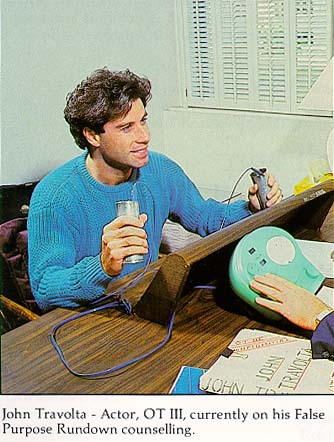
I paid ten grand to know!
Ten grand?! What, did you have a coupon?
I figure getting "clear" has to be closer to $100,000.
Posted on 09/21/2003 12:39:16 PM PDT by TomB
IT WAS WITH some astonishment that I read this week that a Dutch court ruled on September 4 that writer Karin Spaink could keep the Scientology materials on her Web site. The original case, in which this is the third ruling, began in the Pleistocene era in Internet terms – nine years ago. I had no idea it was still doing the Jarndyce vs. Jarndyce thing.
I spent much of 1994 – when the Web was Usenet, the king was CompuServe, and the browsers were all Mosaic – reading the newsgroup alt.religion.scientology, which I spotted while wandering around Usenet looking for things to write about. I figured the then-prevailing demographic of Netheads – sf fans, iconoclasts, science students – would have an, er, interesting time arguing with Scientologists. The details of the "flame war with real bullets" were published in Wired.
Spaink's particular part of Scientology versus the Net was fairly typical of the time. Budding Scientologists pay for each level of enlightenment they achieve. Eventually, as they reach the highest level, the materials they study are secret -- it is said that the contents could damage or even kill the insufficiently prepared. One of the key skeletons of contention between Scientology and the Net, therefore, was the fact that members of the newsgroup began posting some of these documents, effectively putting the contents in the public domain. Some interesting technology was developed in the quest to keep the documents available online: a specialized search engine that would find them, wherever they were on any given day as they moved from host to host. In any event, the CoS began issuing cease-and-desist letters and suing anyone who posted these documents openly. Many, of course, used the pioneering Finnish anonymous mailserver, anon.penet.f.
But the fact is that these documents were already available openly through at least one source: a court in California where a disaffected Scientologist, Lawrence Fishman, had read them into the record of his 1993 case. The Fishman affidavit, as it's known, was public record for two years, until the Church of Scientology succeeded in getting it sealed on the grounds that it contained "trade secrets" – that is, the secret documents. Spaink has links to both the affidavit and a summary of and quotes from other secret documents known as OT-II and OT-III (OT stands for "Operating Thetan"). Three Dutch courts in nine years have now ruled that it is legal for Spaink to post these materials on her site and that neither she nor her ISPs are guilty of copyright infringement. Scientology is required to pay her legal costs.
"The courts damned Scientology for the secrecy surrounding OT2 and OT3." Spaink posted to alt.religion.scientology shortly after the September 4 ruling, "and says that Scientology – which they call an 'organisation', not a 'church' – uses that secrecy to wield power over its members, and furthermore states that Scientology is attempting to overthrow democratic values."
Because most of what's being written now about copyright and the Net focuses on music and the RIAA's prosecution of 12-year-old girls (to be followed in another year or two by the same stories about TV shows and movies) it's easy to forget that Scientology was the first to litigate in this particular area.
It was Scientology that first went after ISPs to demand they control the materials their subscribers posted, and Scientology that first attacked online anonymity by obtaining a court order requiring the Finnish anon.penet.fi server to uncloak the real identity of one of its users. Julf Helsingius, who was later given an EFF Pioneer Award for his efforts, closed the server after that, on the grounds that if he could not guarantee anonymity it was worthless.
Ironically, as Spaink writes on her Web site, the Dutch court's ruling was based on testimony given in a similar case in Sweden, the prosecution of Zenon Panoussis, who tried to argue that the secret documents were open to everyone under the Swedish Constitution because he had filed copies with the courts and the Swedish Parliament. Ironic, because Panoussis lost that case in 2001.
The question raised by these cases, and of Keith Henson, Grady Ward, and others, is where you draw the line between freedom of speech and what the CoS likes to call "copyright anarchists". Spaink is pretty clearly motivated by her belief in freedom of speech as an inalienable right; she also hosts anti-abortion The Nuremberg Files that was ordered offline despite being pro-choice herself. Some of the other Net critics seem to be driven more by a belief that exposing the inner workings of the CoS is in the public interest and, perhaps, simply liking a good fight. The CoS's own view of these folks as "anti-religious extremists" is clear.
Judges have not always agreed – Judges Kane and Brinkema in Colorado and Virginia respectively, have ruled that the documents' availability from multiple sources outside the CoS mean they are not trade secrets, even though they are protected by copyright. This is, of course, part of what the Net critics were trying to achieve: ready accessibility to information about what Scientologists are ultimately taught so prospective members can make an informed choice. Copyright terrorists or public-spirited citizens? You decide. µ
You mean when individual pages took 20 seconds to load? Or free porn? ;-)
Acutally, the wild old days of the web were a lot of fun.
You are absolutely correct. The net of 2003 is a wonderful thing, but the net of the early 1990s had a lot of unique and special qualities that have largely disappeared.
Though the mills of God grind slowly, yet they grind exceeding small;
Though with patience He stands waiting, with exactness grinds He all.-- Longfellow, Retribution.
Just make sure you clean the dried soup out of them before you use them:
I paid ten grand to know!
Ten grand?! What, did you have a coupon?
I figure getting "clear" has to be closer to $100,000.
Oh come all ye Grateful Deadheads to the concert.
Oh come Grateful Deadheads and camp in the street.
Bring rolling papers, don't forget your sleeping bags.
Oh come get us some floor seats.
We followed them for four weeks.
Oh come get us some floor seats, to see the Lord.
Come all ye hippies, throwbacks to the '60's.
Paint flowers on your van and don't wash your feet.
Wear your bell-bottoms and your tie-dyed t-shirts.
Oh come let us adore them. We quit our day jobs for them.
Oh come let us adore them. Garcia's the Lord.
After divorcing her, he married Mary Sue Whipp, the subsquent breakinee, in September 1952.
In the interim, Mrs Hubbard #1, neé Mary Louise "Polly" Grubb, had divorced Habbard, so his third marriage, unlike his second, was actually legal.
Disclaimer: Opinions posted on Free Republic are those of the individual posters and do not necessarily represent the opinion of Free Republic or its management. All materials posted herein are protected by copyright law and the exemption for fair use of copyrighted works.