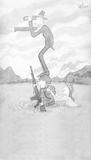
`Arrogant behavior' comes back to haunt USAfter thumbing its nose at the UN, the Bush administration is finding it hard to enlist international support now that it needs help in stabilizing Iraq
DPA
Monday, Jul 21, 2003,Page 9
 |
India last week rejected a US appeal for 17,000 troops, and key allies like France and Germany say they won't send troops without backing from the UN Security Council.
With the pullout of some US soldiers delayed, and the Pentagon even contemplating adding to the 148,000 strong force in Iraq, the US and Britain face mounting challenges in Iraq with little military assistance from other countries.
The difficult position in which the US-led coalition now finds itself in Iraq, analysts say, can be traced to the months leading up to the war, when the US failed to secure the support of key countries and made it clear it would handle former president Saddam Hussein alone if it had to.
"The fact is that the failure to gain international community consensus for the war in Iraq is now responsible for the coalition not having what the United States and Iraq needs to develop politically, economically and socially," said retired Army general William Nash, who is now senior fellow at the Council on Foreign Relations.
The Pentagon has been scrambling to find countries willing to assist the already strained US occupation. Only Poland and Spain -- two countries that backed the invasion -- have offered significant military support with logistical support from NATO.
US Secretary of Defense Donald Rumsfeld, increasingly under pressure from Congress to put differences aside and enlist NATO, told lawmakers last week he would welcome the help of other countries, including Germany and France, two nations that bitterly opposed the war.
But so far those calls have gone unheeded, in part because of the "arrogant behavior" exhibited by Bush's administration in the months leading up to the war, says Leon Fuerth, who served as former vice president Al Gore's national security adviser.
"The [Bush] administration needlessly offended people and scared people with its behavior," said Fuerth, now a professor of international relations at George Washington University, in a phone interview.
Bush administration officials, however, assert the US had multilateral support for the war, pointing to a list of some 50 countries that offered a variety of political or logistical support, including Poland and Spain.
But most of those countries have not provided, as the military says, "boots on the ground."
The US is reviewing its options, including the possibility of widening the UN role in Iraq, passing another resolution that explicitly asks nations to provide troops, or pursuing a collective role for NATO.
US Secretary of State Colin Powell said Wednesday he has been talking to UN Secretary General Kofi Annan about a new UN mandate, but added they were only preliminary discussions.
The deteriorating situation in Iraq requires the US involve other countries, said Zbigniew Brzezinski, who served as former president Jimmy Carter's national security adviser.
Brzezinksi said the diplomacy before the war has come back "to haunt us" and the Bush administration must quickly bring an international approach to governing Iraq and a greater role for NATO.
"Unless the United States moves more quickly to do two things -- grant much more authority to the Iraqis much sooner and to internationalize the overall occupation -- we will not have the kind of international support needed militarily and financially," Brzezinski said in an interview.
Regardless of the bitterness over the war, many countries seem willing to put aside those differences and join the effort to secure Iraq's future and alleviate the burden on the US, he said.
While the US explores options, there is debate within the Bush administration on which course to take. While US diplomats see the benefits of a wider UN role, the Pentagon has been reluctant to involve the UN in military operations, and certainly would not be willing to put US troops under a UN command.
Jack Spencer, a national security analyst at the conservative Heritage Foundation, said he also believes the US must soon bring the UN and NATO into the fray, but rejects assertions the US should have gotten more international support before invading Iraq.
"Had we waited around to build a military coalition we would not have gotten this war over as quickly as we did with the relatively few numbers of casualties," he said.
