Skip to comments.
Last flight of 6-story Roton forced to abort
Antelope Valley Press ^
| May 11, 2003
| ALLISON GATLIN
Posted on 05/11/2003 7:23:26 PM PDT by BenLurkin
It was to be "The Last Flight of the Roton," but the flight was not nearly as long as organizers hoped.
The last vestige of an attempt to create a low-cost space-launch system, the Roton ATV was headed from its birthplace at the Mojave Airport for display at Classic Rotors, a helicopter museum located at the Ramona Airport.
But like many flight experiments before it, this one ended in disappointment Saturday morning.
The effort to carry the six-story, cone-shaped vehicle, created by Rotary Rocket, beneath an Army helicopter ran into unexpected difficulties once airborne and the two never left the airfield.
Moreover, the CH-47 Chinook helicopter suffered damage to the underside of its body when it deposited the Roton on the airport tarmac.
"It's back to the drawing board," said Mark DiCiero, operations director for Classic Rotors. "We just have to figure out a way to carry it in a different way.
"That's just something to tackle."
A small crowd gathered at first light Saturday morning to witness the unusual move, as the massive vehicle was rolled out from its hangar and towed by a pickup truck to a spot on the flightline where the helicopter would be able to pick it up.
Once it was secured, the twin rotors of the heavy-lift Chinook spun to life, and the helicopter was soon hovering above the Roton.
Witnesses on the ground could see a member of the flight crew reach through an opening in the belly of the CH-47 and use a long hook to snag the rigging atop the vehicle.
After a few tense moments, the helicopter slowly rose, pulling the Roton off the ground. Dangling the Roton beneath it, the Chinook headed north across the airfield. As it did, the massive rocket began swaying increasingly side-to-side.
While those planning the move had anticipated that the Roton would rotate in flight, no one had expected the side-to-side movement.
It proved to be too severe for the helicopter to handle, and the crew returned to the flightline to set down the Roton.
All together, the pair was airborne about 20 minutes.
"I wouldn't have expected it," said Dwayne McQuade, helicopter pilot in command. "With its shape, I expected it to fly true."
In planning for the flight, organizers were concerned with the vehicle's rotation while hanging by its nose. To counter this, a small parachute was attached to one leg, with a weight on the opposite side to provide additional balance.
"From that standpoint, it was a success," DiCiero said.
Another unforeseen problem came once the Roton vehicle was safely back on the ground. As the helicopter was disengaging its hook from the vehicle, it bobbled briefly and the rotor head atop the Roton pierced the sheet metal underside of the Chinook.
The damage was not structural and the helicopter is still safe to fly, although "it might be a bit drafty back there," McQuade said.
The Army CH-47 Chinook heavy-lift helicopter from Fort Hood, Texas, was enlisted to carry the Roton nearly 200 miles from Mojave to its new home.
"This will be a first," said Maj. Andrew D. Doehring, one of the Army Reserve pilots transporting the Roton, as preparations were made Friday for the flight.
The size and shape of the vehicle is the unusual part of this mission, he said. The weight - about 10,000 pounds - is actually a little lighter than their normal "nonstandard external loads."
"The awkward size makes for the 'wow' portion of it," Doehring said.
Among those who turned out at dawn Saturday morning were several former members of the Rotary Rocket team, many of whom are now the force behind another Mojave-based rocket venture, XCOR Aerospace.
"I'm really pleased it's going to a museum and will be cared for," said Aleta Jackson, one of Rotary Rocket's first employees and now with XCOR Aerospace. "It's kind of sad it's leaving Mojave, but we're pleased it's got a good home … and will be seen and appreciated."
The Roton atmospheric test vehicle was a proof-of-concept vehicle for an envisioned space-launch system in which the cone-shaped craft would return from orbit and land like a helicopter.
To test the landing and hover capabilities of the design, the ATV was built with rotor blades atop the cone, making it "the world's tallest helicopter," said Terry Robinson, program director for Classic Rotors.
The blades were removed for the move, and are already at the museum.
A nonprofit, all-volunteer effort, Classic Rotors is one of only four museums in the world devoted to helicopters, he said, and the only one with aircraft in flying condition.
"We dream about growing our museum," Robinson said, constantly on the lookout for new specimen for the collection.
Robinson learned of the Roton through a web site and thought "we've got to have that Rotary Rocket!"
He tried in vain to reach the now-defunct company, headquartered in Redwood City.
The trail seemed cold until he read that XCOR Aerospace had bought much of Rotary Rocket's intellectual property.
He was able to contact the company's founders through XCOR and secure donation of the vehicle.
By that time, several museums had expressed interest in the vehicle, but none could figure out how to transport it.
"Everybody's just given up on it," Robinson said.
The vehicle's enormous size - more than 60 feet tall and 30 feet wide at the base - makes transport by road or rail impossible.
Classic Rotors' solution was to enlisted the aid of the Army to carry the Roton beneath a heavy-lift helicopter.
"They took one look at the picture and thought, 'Whoa! that would be cool!' " Robinson said.
The Army is able to provide such service through its Innovative Readiness Training program. This allows the service to provide assistance to nonprofit organizations while performing its own training missions.
In this instance, the team from Fort Hood already was scheduled for a mission to Seattle, and simply added the Mojave stop to its trip.
"This is totally something that supports our mission," Doehring said.
"It's kind of a goodwill project," he said. "It shows the military is available for the community."
Once set up outside the Classic Rotors hangar, the Rotary Rocket will be the tallest structure in Ramona, Robinson said.
"This will put us on the map," he said.
Eventually, the museum hopes to set up the display so that visitors are able to enter the cone and see the cockpit set up as if ready for a flight.
"We want to give it the respect it deserves," Robinson said.
Rotary Rocket raised eyebrows when it set up shop at the Mojave Airport in 1998 with the introduction of the Roton Rocket - conceptually a reusable launch vehicle that could carry small payloads into orbit, return to Earth and be prepared for another launch the next day.
The company ran into difficulty raising enough capital to get the unconventional project off the ground and liquidated much of its assets in a January 2001 auction.
The cone-shaped Roton would use rotary blades to slow its decent from orbit and to land, much like a helicopter.
The Roton atmospheric test vehicle was the first step in developing the Roton Rocket. It was constructed to test the ship's flying ability in the atmosphere and was incapable of space flight.
The ATV made three flights at Mojave Airport in 1999, where hover tests showed the company's concept of a helicopter-style of landing of a cone-shaped spacecraft would work.
TOPICS: Business/Economy; Culture/Society; News/Current Events; Technical; US: California
KEYWORDS: aerospacevalley; antelopevalley; commercial; goliath; rotaryrocket; roton; space; tourism; xcor; xprize
Navigation: use the links below to view more comments.
first 1-20, 21-22 next last
 "GETTING READY - The Roton Rocket was to be flown beneath an Army helicopter to a museum in Ramona Saturday. The last flight of the Roton, an attempt to build a low-cost space-launch system, was aborted Saturday."GENE BRECKNER/Valley Press
 I'm no engineer, but this always seemed to me to be darn awkward way of addressing the problem. Too many moving parts.
1
posted on
05/11/2003 7:23:27 PM PDT
by
BenLurkin
To: BenLurkin
Once again the government is lying to us. This is the ship the Cone Heads came to Earth in.
2
posted on
05/11/2003 7:32:11 PM PDT
by
U S Army EOD
(Served in Korea, Vietnam and still fighting America's enemies on Home Front)
To: BenLurkin
Isn't this lateral movement the sort of thing that a gyroscope could solve easily?
3
posted on
05/11/2003 7:35:12 PM PDT
by
strela
("Use up the Irish!" "Its MY Island!")
To: BenLurkin
They're going to wind up putting it on a truck.
It sounds like the rocket has a problem in that it is too light. If it weighed more, it would hang low and the air wouldn't affect it too much. But with light objects, the turbulent airflow from the helo rotors moves the rocket too much.
To: BenLurkin
I've read the article 2X I'm unsure whether or not the CH-47
was US ARMY Aircraft or a Commerical Aircraft.
Plase clarify if you can.
5
posted on
05/11/2003 7:46:35 PM PDT
by
TaMoDee
To: TaMoDee
The CH-47 is the CHinook helicopter.
6
posted on
05/11/2003 7:53:33 PM PDT
by
PackerBoy
To: PackerBoy
CH stands for Cargo Helicopter. It has nothing to do with Chinook, it just worked out that way.
7
posted on
05/11/2003 8:16:27 PM PDT
by
U S Army EOD
(Served in Korea, Vietnam and still fighting America's enemies on Home Front)
To: TaMoDee
I'm guessing it another case of "Your Tax Dollars at Work". The articles said the CH-47 was from Fort Hood (Killeen, TX)
There are few Commercial Helicopter companies that would have done this and I bet none would have used a chinook. I bet a Sikorsky (maybe they are all Evergreen, now?) Skycrane would have handled it better.
8
posted on
05/11/2003 9:24:38 PM PDT
by
UNGN
(I've been here since '98 but had nothing to say until now)
To: PackerBoy
All U.S. Army helicopters have an American Indian tribe name
The Chinook are a Pacific North West tribe near Boeing in Seattle who made the CH 47’s
To: *Space
Commercial space ping.
10
posted on
05/11/2003 9:46:25 PM PDT
by
anymouse
To: BenLurkin
Glad that the Roton ATV is going to be properly displayed in a museum, although Romona is pretty remote to get many visitors. Hopefully this article run during a time that NASA is feeling heat from Congress over the Columbia shuttle crash investigation and the Orbital Space Plane hearings will remind the public of the sad tale of Rotary Rocket's untimely death.
11
posted on
05/11/2003 10:12:05 PM PDT
by
anymouse
To: PackerBoy
You are very wrong. Here's a partial list the letter soup in front of the "H" as in Helicopter stands for:
C = Cargo as in CH-47
A = Attack as in AH-1
U = Utility as UH-1
M = MultiMission as in MH-47
O = Observation as in OH-58
The airships are given names as Chinook, Apache, BlackHawk, etc,etal, and whatever.
Got it?
12
posted on
05/12/2003 9:21:11 AM PDT
by
TaMoDee
To: UNGN
You are right in that a Skycrane would have been a better missson aircraft choice. I watched one set a high line tower in place on a clift top just as pretty as you please.
If it was a Ft Hood CH-47 then it's possible that's the first time the crew ever attempted anything of that cone's configuration. Disaster in the making.
13
posted on
05/12/2003 9:35:40 AM PDT
by
TaMoDee
To: TaMoDee
As I recall the "Flying Crane" was tagged the Tarhe by the army. Never caught on and the tropps still called then flying cranes.
14
posted on
05/12/2003 9:36:45 AM PDT
by
FRMAG
To: TaMoDee
Check above. I think you are chewing out the wrong guy.
To: U S Army EOD
I know that. I was trying to provide a pneumonic memory device to make it easier to remember.
Sheesh. You guys are sure touchy about your choppers.
To: PackerBoy
a pneumonic memory device Pneumatic? Neurotropic? Numismatic?
17
posted on
05/12/2003 3:02:50 PM PDT
by
RightWhale
(Theorems link concepts; proofs establish links)
To: BenLurkin
18
posted on
05/12/2003 3:28:14 PM PDT
by
AgThorn
(Continue to pray for our Troops!!)
To: BenLurkin
 |
Roton profile
Roton flight sequence
|
Family:
VTOVL.
Country: USA.
Status: Development.
The Roton™ was a piloted commercial space vehicle design intended to provide rapid and routine access to orbit for both its two-person crew and their cargo. The Roton was a fully reusable, single-stage-to-orbit (SSTO) Vertical Take-off and Landing (VTOL) space vehicle designed to transport up to 3200 kg to and from a 300 km / 50 degree inclination earth orbit. The Roton was planned in 1998 to reach commercial service in the year 2000 with a target price per flight of $7 million. The cargo envelope for the vehicle was 3.66 m in diameter and 5.08 m in height.
The original Roton design was to use an innovative novel rotary engine harking back to the Aerojet Rotojet design of World War II. Later this was changed to a version of NASA's Fastrac Engine using Kerosene and Liquid Oxygen propellants. Several would be required to provide the necessary thrust at take-off. Roton would have a height of 19.5 m, a diameter of 6.7 m and a maximum gross lift-off weigh of under 180 tonnes. Using the Fastrac engines, Roton would have to have an empty weight under 5 % of its gross takeoff mass - a very challenging figure for an expendable rocket, let alone the additional mass of the crew, rotor system, and thermal protection system.
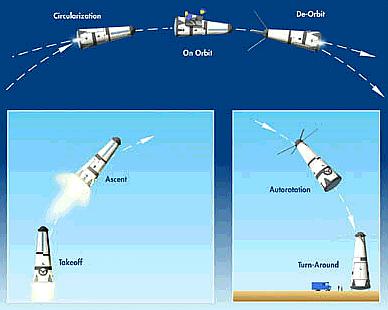
The Roton would takeoff vertically like a conventional rocket powered by a novel rotary engine burning liquid oxygen and jet fuel. The launch system infrastructure for the Roton was expected to be minimal with only a towing truck, standard refuelling equipment and support lines, a blast pad, and a small launch platform. The Roton would lift-off under command of the crew and would fly to orbit from the Mojave, California launch site, using standard GPS and inertial navigation flight control systems. The launch path of the vehicle would be very steep, travelling only 28 km downrange at an altitude of 30 km. Following the main engine cut-off at about 130 km, the Roton would circularise its orbit using its orbital manoeuvring engines. In orbit the vehicle had a maximum stay time of 72 hours.
Once its payload was deployed, the Roton returned to Earth via a nose-mounted rotor. The rotor recovery system was lightweight and provided a slow, pilot-controlled approach to the landing site. The rotor system consisted of a set of four rotor blades, a rotor hub and nose cap. During launch, the blades were folded down along the sides of the vehicle and before re-entry they were deployed and angled upward away from the nose. During the hypersonic and supersonic phases of flight, the base of the vehicle produced most of the drag while the rotor remained windmilling behind the vehicle, stabilising it until it reached subsonic speed. Use of water in an active-cooling system was considered. The rotor would then be spun up and the blades entered a helicopter-style autorotation flight mode. While in this mode the Roton was able to glide with the pilot’s direction to a precision landing point. The vehicle’s rotors would be equipped with tip rockets so that the Roton can touchdown softly under rotor power. After landing the vehicle will undergo minor maintenance and checkout procedures to prepare it for its next flight. In order to meet the target operational cost goals of this project, the Roton is being designed to operate much like a commercial aircraft.
From the outset, the Roton was also designed to return from space with a fully loaded payload bay. Therefore if a spacecraft was damaged or malfunctioned prior to deployment, it could be returned for repair. Rotary Rocket expected a market to develop whereby satellite operators, manufacturers, and insurance companies send rescue missions to repair or retrieve damaged or outdated satellites. In addition to this service, the Roton’s low cost of operation and payload-return capability would also allow for the development of an orbital materials processing industry. The vacuum and zero-g environment of space provides ideal conditions to manufacture a variety of materials as well as conduct research.
The Roton large-scale Air Test Vehicle began flight tests in 1999 to demonstrate the autorotation and rotor capabilities. Thereafter technical challenges and lack of sufficient investment seemed to stall the project.
SpecificationsLEO Payload: 3,200 kg. to: 300 km Orbit. at: 50.0 degrees. Total Mass: 180,000 kg. Core Diameter: 6.7 m. Total Length: 19.5 m. Launch Price $: 7.00 million. in 1999 price dollars.
Roton Chronology
- 1999 -
Back to Index
Contact Mark Wade with any corrections, additions, or comments.
Last update 26 June 2002.
Definitions of Technical Terms.
Conditions for use of drawings, pictures, or other materials from this site. [note to Freepers sysop: conditions met].
© Mark Wade, 2002 .
19
posted on
05/12/2003 3:34:44 PM PDT
by
AgThorn
(Continue to pray for our Troops!!)
To: PackerBoy
But nobody ever gets EOD right with the exception of Elvis Presly in his movie "Girls, Girls, Girls".
20
posted on
05/12/2003 5:21:02 PM PDT
by
U S Army EOD
(Served in Korea, Vietnam and still fighting America's enemies on Home Front)
Navigation: use the links below to view more comments.
first 1-20, 21-22 next last
Disclaimer:
Opinions posted on Free Republic are those of the individual
posters and do not necessarily represent the opinion of Free Republic or its
management. All materials posted herein are protected by copyright law and the
exemption for fair use of copyrighted works.
FreeRepublic.com is powered by software copyright 2000-2008 John Robinson

