Skip to comments.
Secretary Rumsfeld Town Hall Meeting at Prince Sultan Air Base
Dept of Defense ^
| 4/30/03
| Rumsfeld
Posted on 04/30/2003 10:11:29 AM PDT by Hipixs
Presenter: Secretary of Defense Donald H. Rumsfeld |
|
Tuesday, April 29, 2003 |
Secretary Rumsfeld Town Hall Meeting at Prince Sultan Air Base
(Town hall meeting at Prince Sultan Air Base, Al Kharj, Saudi Arabia.)
Voice: Good morning!
This wing and this coalition have been flying combat missions over Iraq for the last 12 years. In Operation Iraqi Freedom along we put over 3,000 sorties into the pipe. As we pause now to reflect on what it is we've accomplished we're very honored to have with us today the secretary of defense of the United States of America. Ladies and gentlemen, I'm honored to welcome Secretary Donald Rumsfeld.
(Applause, cheers.)
Rumsfeld: Thank you very much.
General Waters, thank you so much for those kind words. General Moseley, Mr. Ambassador, and troops. The men and women of the U.S. armed forces, the coalition partners that are here from, as I understand it, the United Kingdom and Australia. I thank you each. I think probably the most fun I have as secretary of defense is being able to look all of you in the eye and tell you how much you're appreciated, how much we value what you do, and how proud the American people are of you.
(Applause.)
What you have accomplished for the Iraqi people, for this region, and indeed for the world is truly remarkable.
Think about it. Six weeks ago the Iraqi people lived in fear and desperation. The freedoms that we all enjoy in our countries for them were nothing but a distant dream. Death squads roamed their streets. Innocent civilians were beheaded in public squares, tortured in prisons. The regime denied its people food and medicine to build weapons to threaten the world. And today, just six weeks later the regime is no longer in power, the prisons are empty, executions in public squares have stopped, the statues of Saddam Hussein have been pulled down --
(Applause.)
Wasn't that a sight?
(Applause.)
The terrorists are on the run. Senior leaders of the deposed regime are being rounded up every day. And most important, the Iraqi people are free.
(Applause.)
That is a remarkable transformation. And what made it possible is the same thing that has made success possible in every other war. The courage, the determination, and the dedication of the men and women in uniform from our coalition countries.
All volunteers. People who stepped forward and volunteered to put their lives at risk to defend our freedom.
Each of you here today can take enormous pride in what's been accomplished. The skill with which you planned it, the tenacity with which you fought it, and the humanity with which you prosecuted it.
You have much to be proud of, but as you all know our work is not over. We are certainly grateful to all of you for your efforts. But we're also grateful for your families as well.
Let me close by just saying a word about the families. It can often be harder to be the one left behind than the one who's leaving. Especially when a loved one is leaving for a conflict.
In wartime military families endure extended periods of separation, not knowing in many instances where their loved ones are, what they're doing, whether they're safe, or indeed whether they'll come home. Those burdens on each of your families has carried during the course of this war, and they've carried those burdens for our country, for the cause of freedom.
So we are grateful and proud of their service as well as your service. Let there be no doubt.
So I thank you for all you've done and all you do for our country. I thank your families and your loved ones. And may God bless each of you and all of them.
Thank you very much.
(Applause.)
Before I look for an opportunity to shake some hands and say thank you personally, are there microphones for some questions? Who has the mics? I can see one back there. Who has a question?
Q: Sir, Sergeant Bubba from the Frisco team deployed here.
We've been here, many of us, on numerous occasions for the past 12 years. What do you foresee in the future for an American presence in the Southwest area?
Rumsfeld: The question is about the U.S. presence in the region and we're in the process, General Franks and I have been talking about our arrangements in his Central Command. We're also looking at our arrangements in Europe and in Asia as well and attempting to refashion it and rebalance those arrangements so that we're organized for the future. Needless to say the Saudis here have been enormously hospitable to us. It's been wonderful. It's been, as you say, 12 years with Operation Southern Watch.
Now that the Iraqi regime has changed, we're able to discontinue Operation Northern Watch and Operation Southern Watch and those forces will be able to be moved to other assignments and other requirements around the world.
We do intend to maintain a continuing and healthy relationship with the Saudis. We look forward to exercises and training and working with them on their military. But we will have the opportunity to move some forces out because of the change and the end of operations -- the successful end, I should say, of Operation Southern Watch.
Q: Sergeant Gelber from the 116th Air Control Wing in Warner Robbins.
I'd like to know with all that we've accomplished what is our next biggest challenge as you see it?
Rumsfeld: The challenge -- Let me put it this way.
We are in the 21st Century which is notably different than the 20th Century because there are terrorists states, there are an increasing number of states that have weapons of mass destruction -- chemical, biological, and increasingly nuclear. There are relationships between terrorists states that have those weapons and terrorist networks. And the third piece of that puzzle is that there are a large number of ungoverned areas in the world. Countries or portions of countries that are really not under the control of the governments.
Now that combination creates a situation that means that we are going to be facing a different set of problems. We're less likely to be facing large armies, navies and air forces, and more likely to be experiencing the kinds of circumstances we did in Afghanistan and in other parts of the world.
I think the biggest problem we've got as a country -- And let me, before I say that, our country is capable of living in that world. Let there be no doubt. We're going to be just fine. We do not have to give up our freedoms. We do not have to withdraw from the world. There are countries that are not friendly to our country and there are terrorists that are not helpful and attempt to kill innocent men, women and children. But to react to that by tucking in and living underground and not being free and not being willing to say what we believe should be said or practice freedom of religion or the ability to go where we want and do what we wish. That would be wrong to think that we have to change our way of life, and we don't.
But I see the single biggest problem facing us, and indeed the world, is how do we manage to interdict and stop the movement of weapons of mass destruction from country to country and terrorist organization to terrorist organization?
In previous periods we've worried about relatively conventional weapons killing hundreds or thousands of people with chemical and biological and potentially nuclear weapons. There's the risk of killing tens of thousands of people and hundreds of thousands of people. And the only way we can deal with that successfully, it seems to me, is to provide the leadership in the world so that other technologically advanced countries and like-thinking nations, democratic nations, come together and fashion sanctions that will in fact work.
We would not have had to go to war in Iraq if the industrialized world and the like-thinking nations of the world, the democratic nations of the world had successfully imposed sanctions on that country. And that is what we need to do, it seems to me, and we need to provide that kind of leadership and see if we can't be more successful in the future.
Q: Mr. Secretary, Maj. Pennington.
We've seen the significant role that the Guard and Reserve have played in this conflict. How do you foresee that role in the drawdown and also in future conflicts for the Guard and Reserve?
Rumsfeld: The Guard and the Reserve have played just a spectacular role. There is no question about that. The total force concept works.
What we need to do better is to see that the people who have been called up repeatedly in recent years, and that's true. There have been certain skills and certain disciplines that have been called up more often than others. What we need to do is to see that we get back on active duty people who can perform those functions so that we do not have to reach into the Guard and the Reserve year after year after year for the same people. We need to have a better balance in the active force of those skills so that when there is a real need we can call up the Guard and we can call up the Reserves, or elements of them, and they can do exactly what was done in the case of Operation Iraqi Freedom.
What we cannot do is to call people up so often and put so great a burden on the Guard and Reserve that they end up not, we end up not being able to attract and retain the people we need.
We have to fashion our personal policies -- the pay, the retirement, the medical benefits, the way the Guard and Reserve are handled, so that we are successful in attracting and retaining the kinds of skills and talents and dedication and professionalism that you see here in this room.
(Applause.)
Q: Sir, (Inaudible.), Royal Air Force.
What's your view of the new relationship between the United States of America and the new Europe and maybe the new NATO [North Atlantic Treaty Organization]? (Laughter.)
Rumsfeld: The new NATO, when I was ambassador to NATO back in 1972, a long time ago, there were 15 countries. Today there are 19 and very soon there will be 26. The new countries have been the countries that have cone in from the East, the former Warsaw Pact countries in large measure, as well as Spain and some others.
NATO's a different place now and the center of gravity has in fact shifted from where it was when it was a relatively small organization of 15 countries, to a larger, much larger organization of some 26 countries.
One of the wonderful things that happened to NATO is by adding these new nations they have brought in a group of people who have very recently lived with and suffered under repressive regimes, the communist regimes. They're people who value freedom very highly. They're people who have looked to the West and to NATO over many decades and aspired to be a part of that. So they bring an energy to the NATO organization that I think is enormously important and beneficial and will add to a revitalization of that institution if we're able to manage that many countries. It is not an easy thing. It's a very different thing when you're dealing with a smaller number of countries than it is with 26. But so far in my view it's been a very good thing and I think the energy and the idealism they bring is going to add a new strength to the North Atlantic Treaty Organization.
Q: Mr. Secretary, can you comment on the Air National Guard and Reservists, when they would rotate back to their home duty station?
Rumsfeld: I missed the last part. The Air National Guard and the Reservists --
Q: When they would rotate back to their home duty station.
Rumsfeld: Well, I don't know. (Laughter.) I learned early on if you don't know, say you don't know. It's going to vary unit to unit, and needless to say we're in the process now of drawing down a number of naval elements have already been moved out of the area of responsibility. Increasingly the air components that are not going to be needed, for example, for Operation Southern Watch or for Operation Iraqi Freedom will be moved back to their home bases.
The pace that that will happen and with some ground forces as well, but the pace that that will happen will depend in large measure on General Franks and his assessment of the circumstance in Iraq and how confident we are that we can move from combat operations towards stability and security operations, and we feel that that is coming along very well.
There are still pockets of resistance, as you know. There are still people being wounded and killed in Iraq. But the level of conflict has been dramatically reduced. So I think we can all expect that you're going to see a general drawdown.
What units will be at what point in that drawdown I guess is up to the experts.
Q: Airman First Class Doyle from the 77th Aircraft Maintenance Unit, Shaw Air Force Base.
I was just wondering, we didn't hear much in the news about the air power during the war. Do the American people know about the role we played?
Rumsfeld: They do indeed. The American people watched the important role that was played by the Air Force to be sure, but also Naval air and Army air and Marine air and coalition air. They had an opportunity to not only see the power and the ability, the skill, that we were able to refuel aircraft and provide intelligence and surveillance and to put power on a specific target, but they also had an opportunity to see the precision with which it was done. And the respect for that is broad and deep. So you can be sure that that knowledge is there.
Thank you.
A couple more questions.
Q: Secretary of Defense, Senior Airman Shoftner, Medical Services. I have a question.
What is the future pace of AEFs [Air Expeditionary Forces]?
Rumsfeld: Adjustments in the rotation cycle?
Q: Correct.
Rumsfeld: I don't know. That's really -- (Laughter.) I look to General Moseley. There's the man. If I were you, I'd buttonhole him. (Laughter.) I would buttonhole him when it's over because he's the one who advises General Franks on that.
Q: Yes, sir. Major Fewks (sp). I'm one of the permanent party here at Prince Sultan.
If you could please comment on the search for Scott Speicher.
Rumsfeld: The question involves the search for Scott Speicher who was shot down back in the Gulf War, I guess almost 13 years ago, 12 years ago.
From the outset, as you all know, the United States as well as our coalition partners put great emphasis on missing in action and prisoners of war, and from the very outset of this conflict, indeed for the past 12 years the United States has made a considerable effort to try to gain information about Captain Speicher.
From the beginning of the conflict, teams of people were assigned to pursue every single lead that could be found. Prisons where we heard reports he might have been have been examined and investigated. Every day that goes by there is the hope that something additional will be learned. But regrettably, we have not at this stage developed any active leads that I would be able to report that would be considered hopeful. But we intend to keep pursuing it and I know that the teams that are working on that are aggressive and serious in attempting to do so.
Q: Good afternoon, Captain J.D. Holmes from Transportation.
Sir, the embedded media obviously played a big role in this conflict and I was wondering if you were pleased with the results and what you foresee as the future interaction between media and military members.
Rumsfeld: When it was proposed to me and to General Franks and to General Myers, the chairman of the joint chiefs of staff, that we break the mold and put literally hundreds of people from the media, U.S. and worldwide, in with all kinds of elements -- Air Force, Army, Navy, Marines, ships, planes, ground units, special operations units. We thought a good deal about it and we decided to roll the dice and take a risk and do it.
Now that it's over there are several things one can say about it. One is that the people who watch television and read the press around the world, without having embedded people with the units what they were seeing were people who were analyzing and opining on this and opining on that but were not physically present.
The problem with the embedded media is that they could not look at the broad picture. They looked at a slice of what was happening. If they were on a ship or a plane or on the ground they saw reality. They saw a narrow piece of what was taking place, but it was true, it was accurate, it was not an opinion, it was not a guess. It was exactly what was taking place.
I think it's the blend of that, the accurate slices mixed in with the analysts who tried to put things into a context, but they were required, these analysts, to take account of the real life slices that they were, everyone was seeing on television.
So their opinions and the context they used to consider things was considerably different because of the hundreds of these press people who were embedded with the units.
There's something else that happened and I can't prove this but when I was a young man, it was shortly after World War II, my father had been in the Navy, I knew hundreds of people in the service. I was in the Navy. Most of my generation served in the military. When I went to Congress in 1962 I would guess that 80 percent of the members of Congress had served in the military. Today that's not the case. We have an all volunteer force and a relatively small fraction of the people in our societies have ever served in the military. A lot of people don't know people who serve in the military.
What happened as a result of having all of these hundreds of people embedded with you and with your friends and colleagues in different services, is that they had a chance, the media people, and they're mostly young, the ones who were embedded, they had a chance to see you and to work with you and to learn what you do, how you're equipped, how you're trained, how brave you are. Who knows? I expect that over the coming five, ten, fifteen, twenty years, those hundreds of people who were embedded will go off into their careers having had that experience. They'll be better people for it, they'll be more knowledgeable, they'll be more respectful of what you do and more confident in you, and I think that's a good thing.
So all in all I'd say we made a whale of a good decision.
Thank you very much. I wish you well.
(Applause.)
TOPICS: Foreign Affairs
KEYWORDS: iraqifreedom; pictures; rumsfeld; rumsfeldpinglist; saudiarabia; townhall; transcript

US Secretary of Defense Donald Rumsfeld (front R) sits in his C-17 aircraft at Prince Sultan Air Base, Saudi Arabia before flying into Iraq(AFP/POOL/File/Luk Frazza)

US Secretary of Defence, Donald H. Rumsfeld, left, speaks British officer Major General Robin Brimms, Wednesday April 30, 2003, at Basra Airport, Iraq. Rumsfeld arrived in Iraq Wednesday to thank U.S.-led coalition troops for toppling the government of Saddam Hussein, becoming the first top American civilian official to visit the country since the regime change. (AP Photo/Angus Beaton/MoD Pool

US Secretary of Defence, Donald H. Rumsfeld, right, is briefed by British Commander Brigadier Graham Binns, left, from the 7th Armoured brigade, 'The Desert Rats', Wednesday April 30, 2003, during his visit to Basra Airport, Iraq. Rumsfeld arrived in Iraq Wednesday to thank U.S.-led coalition troops for toppling the government of Saddam Hussein, becoming the first top American civilian official to visit the country since the regime change. Person at center is unidentified. (AP Photo/Angus Beaton/MoD Pool)

U.S. Secretary of Defence, Donald H. Rumsfeld , right, is briefed by British officer Major General Robin Brimms, left, Wednesday April 30, 2003, at Basra Airport, Iraq. Rumsfeld arrived in Iraq Wednesday to thank U.S.-led coalition troops for toppling the government of Saddam Hussein, becoming the first top American civilian official to visit the country since the regime change. Others are unidentified. (AP Photo/Angus Beaton, Pool)

U.S. Secretary of Defence, Donald H. Rumsfeld , left, is briefed by British officer Major General Robin Brimms, right, Wednesday April 30, 2003, at Basra Airport, Iraq. Rumsfeld arrived in Iraq Wednesday to thank U.S.-led coalition troops for toppling the government of Saddam Hussein, becoming the first top American civilian official to visit the country since the regime change. Others are unidentified. (AP Photo/Angus Beaton, Pool)

US Secretary of Defence Donald Rumsfeld (L) greets Sergeant Scott Shaw (R) from Glenrothes Fife at Basra International Airport.(AFP/MoD POOL/Angus Beaton)

U.S. Defense Secretary Donald Rumsfled (L) speaks with Major General Robin Brimms, Commander of the British land forces, during a visit to Iraq's second city of Basra to meet commanders of Washington's British allies running the south of the country, April 30, 2003. Rumsfeld later flew to Baghdad and told the Iraqi people U.S.-led forces wanted to help them make the transition from 'tyranny to freedom' and then leave.

U.S. Secretary of Defense Donald Rumsfeld (L) greets Lance Corporal Carl Walker from 216 Parachute Signals Squadron while visiting UK Forces at Basra International Airport April 30, 2003. Rumsfeld held a meeting with Jay Garner, the retired general in charge of U.S. efforts to rebuild the country and launch a democratic government in Baghdad later in the day. REUTERS/Angus Beaton/MOD/Handout
1
posted on
04/30/2003 10:11:29 AM PDT
by
Hipixs
To: *Rumsfeld ping list; lawgirl; Howlin; mystery-ak; mtngrl@vrwc; kayak; swheats; ladyinred; ...
| To find all articles tagged or indexed using Rumsfeld, click below: |
| |
click here >>> |
Rumsfeld |
<<< click here |
|
| (To view all FR Bump Lists, click here) |
2
posted on
04/30/2003 10:12:56 AM PDT
by
Hipixs
To: Hipixs
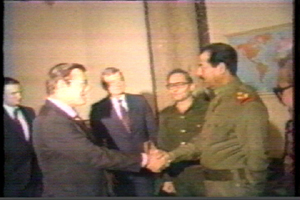
Rummy and Saddam, during happier times...
3
posted on
04/30/2003 10:27:34 AM PDT
by
JohnGalt
(They're All Lying)
To: Hipixs
..and see when you pounce on the stupid media questions and don't let them up for air to frame the debate with their defeatist leading questions, you will succeed in wars and make complete fools of them.
Robin: Wow Sir, I wish we had you in the Falkens.
4
posted on
04/30/2003 10:33:05 AM PDT
by
PeoplesRep_of_LA
(Press Secret; Of 2 million Shiite pilgrims, only 3000 chanted anti Americanisms--source-Islamonline!)
To: PeoplesRep_of_LA
5
posted on
04/30/2003 10:39:10 AM PDT
by
My2Cents
("Well....there you go again.")
To: JohnGalt
Must be tough logging onto to FR posting all the time on here John seeing that not only does almost everyone disagrees with you, but they usually ignore you.
Then again, in your world that means you're winning!
Keep the faith, any day now Paleocons will take "back" the party from the Zionist dupes!
6
posted on
04/30/2003 10:39:25 AM PDT
by
PeoplesRep_of_LA
(Press Secret; Of 2 million Shiite pilgrims, only 3000 chanted anti Americanisms--source-Islamonline!)
To: PeoplesRep_of_LA
If you are still posting here in 2008, maybe you'll have a point, but I know cheerleaders for the Ivy League ruling class come and go and generally lack the sense of humor that is necessary to continually derive enjoyment from an anonymous posting board of 'conservatives.'
7
posted on
04/30/2003 10:44:47 AM PDT
by
JohnGalt
(They're All Lying)
To: PeoplesRep_of_LA
bump
To: JohnGalt
You've been trying this for 5 years? Now that IS humorous! No wonder people don't seem to bother with your antagonism on here. I am new at this.
Gee, those 5 years have been continually tough on the Birchers. At least at the beginning when Clinton was in office you could conspiratorialize his Admin and not be defeated by growing conservatives voices as well as reality too...
I hate it, but have to say Ra Ra ruling class. Don't you know that THEY will put me in jail if I didn't and-somebody's coming...
9
posted on
04/30/2003 10:54:59 AM PDT
by
PeoplesRep_of_LA
(Press Secret; Of 2 million Shiite pilgrims, only 3000 chanted anti Americanisms--source-Islamonline!)
To: PeoplesRep_of_LA
You think I am a Bircher? That is a first. I met a couple of Birchers back in the 'heady' Impeachment days; they thought I was a Republican stooley. Now you are calling me a Bircher...I must be doing something right.
My opus from last October...you might enjoy it, maybe not...
http://www.freerepublic.com/focus/f-news/774101/posts?q=1&&page=51
10
posted on
04/30/2003 10:59:40 AM PDT
by
JohnGalt
(They're All Lying)
To: JohnGalt
Don't give me this chuck n jive "Haven't seen no Birchers 'round here n long time" business.
Yesterday, You (on thread written by the John Birch Society): JBS would logically write about the ascendancy of "conservative" personalities who don't criticize the Bush Administration when it comes to staying within the constraints of the Constitution.
Did you think I would forget? That I was just throwing out adjectives for fun? Of course I knew you were going to deny that, I doubt you're a paying member-that doesn't mean you don't sound exactly like them. I don't contribute to the Zionist-Puppeteering-America either, doesn't mean I won't be ideologically linked with their cabal by what I post.
11
posted on
04/30/2003 11:12:54 AM PDT
by
PeoplesRep_of_LA
(Press Secret; Of 2 million Shiite pilgrims, only 3000 chanted anti Americanisms--source-Islamonline!)
To: PeoplesRep_of_LA
And that makes me a Bircher?
The closing of the conservative mind continues unabated...
12
posted on
04/30/2003 11:22:27 AM PDT
by
JohnGalt
(They're All Lying)
To: JohnGalt
The closing of the conservative mind continues unabated...If you don't mind, I prefer terms like "mind-numbed robot" and "Republican shill" or the one your side started in the Frum Wars "Bush's Amen Choir" is fast becoming my favorite.
Saying that my mind is presently closing rather than past tense closed doesn't capture the full depth that these so called "conservatives" have fallen.
The Birchers are wannabes. Save us JohnGalt! No one else can do it but you!
13
posted on
04/30/2003 11:34:25 AM PDT
by
PeoplesRep_of_LA
(Press Secret; Of 2 million Shiite pilgrims, only 3000 chanted anti Americanisms--source-Islamonline!)
Disclaimer:
Opinions posted on Free Republic are those of the individual
posters and do not necessarily represent the opinion of Free Republic or its
management. All materials posted herein are protected by copyright law and the
exemption for fair use of copyrighted works.
FreeRepublic.com is powered by software copyright 2000-2008 John Robinson
