Posted on 04/28/2003 4:50:57 PM PDT by blam
Did KZN coelacanths all come from one mom?
April 28 2003 at 07:16AM
By Tony Carnie
Underwater scientists exploring the ocean depths off South Africa have plucked a "missing link" fish scale from one of several prehistoric coelacanths for genetic paternity tests.
The scale was removed from the rare fish at Sodwana, KwaZulu-Natal, using a tiny dart gun and a remote-controlled, robotic arm mounted on the German mini-submarine Jago earlier this week.
The Jago, owned by the Max Planck research institute, is part of an international expedition to learn more about the coelacanth population of Sodwana Bay.
Several more scales will be removed and examined in German and South African laboratories to determine the unique genetic codes which reveal which fish is "dad" or "mom", uncle/aunt, sister/brother or, possibly, great-grandmother.
These fish crawled on to land millions of years ago and evolved into mammals So far only 14 coelacanths have been found off Sodwana and previous genetic scale tests show they are similar to their coelacanth cousins in the Comores and Indonesia.
Now, by pulling scales from several KwaZulu-Natal fish, scientists will be able to investigate a new theory that the small Sodwana population is descended from a single, pregnant female which drifted down the Mozambique Channel from the Comoros.
According to South African fish expert Tony Ribbink, it is possible that the pregnant female arrived in South African waters and liked what it saw off Sodwana.
There are several deep-water canyons and rocky cave hiding places in the area, which provide ideal living conditions.
The Sodwana coelacanths were discovered by a team of divers almost three years ago and the first detailed scientific study was mounted last year.
Coelacanths are rarely seen near the surface except at full moon That expedition confirmed the presence of at least 12 coelacanths. This week, the scientists confirmed the presence of at least one more coelacanth.
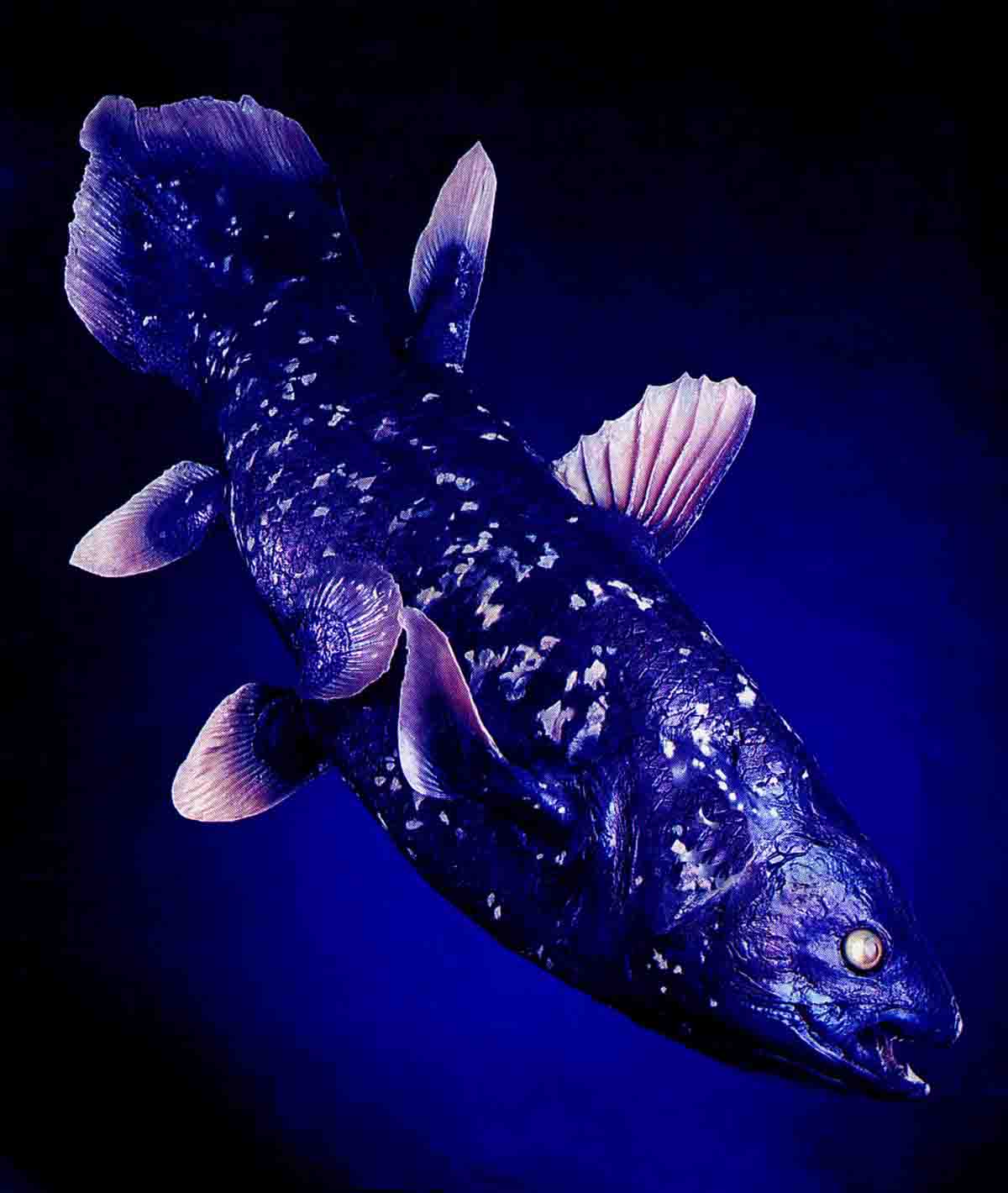
They can recognise each fish individually by studying the unique pattern of white spots and other markings on their sides.
Coelacanths have previously been described as "missing link" fish because of their limb-like fins, and the belief that these fish crawled on to land millions of years ago and eventually evolved into mammals.
According to Mary Pieters of KZN Wildlife at Sodwana Bay, the researchers also fitted a radio tracking device to one of the coelacanths - which seem to spend much of their lives far below the ocean surface.
Pieters said a radio tracking experiment this week had revealed that the fish dived to a depth of 133m before returning to a cave about 108m below the surface.
In other parts of the world, fishermen have told researchers that coelacanths are rarely seen near the surface except at full moon.
Apart from the Sodwana group, the presence of coelacanths has been confirmed off the Comores Islands in the Indian Ocean and in Indonesia.
The single scale recovered in Sodwana this week was cut in half, with one portion sent to Germany and the other to the South African Institute for Aquatic Biodiversity in Grahamstown.
I'll go find a picture.
Heeeeeere fishy fishy fishy....

Trilobite Of The Week
Disclaimer: Opinions posted on Free Republic are those of the individual posters and do not necessarily represent the opinion of Free Republic or its management. All materials posted herein are protected by copyright law and the exemption for fair use of copyrighted works.