Skip to comments.
Aged vessel has a new owner (more US United States news)
Philadelphia Inquirer ^
| 4/16/2003
| Henry J. Holcomb
Posted on 04/16/2003 7:19:54 AM PDT by sjersey
The SS United States, once the fastest passenger liner afloat, has been saved from the scrapyard - at least for a time.
The vessel was decommissioned in 1969, when jets replaced ships as the preferred way to cross the Atlantic. For seven years, it has been rusting away in South Philadelphia, owned by a real estate tycoon who dreamed of restoring it.
The 990-foot-long ship has a new owner - Norwegian Cruise Lines of Miami, a unit of Star Cruises of Malaysia. The company, the world's fourth-largest cruise line, confirmed yesterday that it had purchased the vessel for an undisclosed price as part of a new strategy to run part of its fleet under an American flag.
To sail again, the storied vessel still must overcome what one maritime lawyer called "convoluted and controversial" political and financial obstacles.
The new owner had to buy the ship before many details of its plan were worked out because it was about to be scrapped.
But it is confident it can develop a market for the old vessel. Unlike foreign-flagged ships, the SS United States could carry passengers between U.S. seaports - such as one-way trips between Philadelphia or New York and Florida or cruises that stop at multiple U.S. ports.
Foreign-flagged vessels must return passengers to the U.S. port where they boarded. If the intinerary includes other ports, one must be foreign.
Metro Machine Corp., a Philadelphia yard with experience overhauling complex Navy ships, was quick to say that it would aggressively bid on the massive conversion project, which would include new engines, a radically redesigned interior and addition of such modern amenities as stateroom balconies and a swimming pool.
"There is almost nothing on a ship that we cannot do ourselves or bring in a subcontractor to do for us... . The work we've been doing on Navy ships is probably more complex than what needs to be done to the United States," said John Strem, senior vice president of Metro Machine.
Metro's yard here includes Drydocks 2 and 3 of the old Philadelphia Naval Shipyard. It is next to the new Kvaerner Philadelphia Shipyard, which is building new cargo ships and not seeking conversion work.
Three of the drydocks here, two of which Metro has leased, are among only a half-dozen in the nation big enough for the SS United States.
Colin Veitch, chief executive of Norwegian Cruise Lines, said he would prefer to build a new ship from scratch, but the only way to get an American-flag ship is to refurbish an old one. "But American yards haven't built a cruise ship in 50 years," he said.
His company's American-flag strategy began last year when Congress gave it permission to complete two failed cruise ship projects, started at the Ingals Shipyard in Mississippi, in Europe. These vessels, the first of which is to sail next year, can then be operated by NCL as American-flag vessels in the Hawaii trade.
The law also allows NCL to reflag one foreign-built ship for Hawaiian cruising.
Earlier this year NCL bought another old ship, the 50-year-old Independence, sitting idle in San Francisco after its owner went bankrupt.
The cruise line was forced to move quickly to preserve its option of also converting the United States because its owners were seeking bids from a scrapyard.
The United States has been owned since the mid-1990s by Edward A. Cantor, a North Jersey real estate developer who once dreamed of turning the vessel into a floating casino or hotel.
He died last year, and his heirs were not interested in pursuing his dream.
The vessel had a scrap value of $7 million in 1996, when it was towed to Philadelphia from an asbestos removal project in Turkey.
To operate under the Jones Act as a U.S.-flag ship, work on the hull, superstructure and major components would have to be done in this country, said maritime lawyer Sandra Knapp of Chester Springs.
The vessel also would have to be 75 percent owned by U.S. citizens and operated by a U.S. subsidiary of the Malaysian-owned Norwegian Cruse Lines.
NCL's Veitch said he would not begin seeking U.S. investors until his new Hawaiian ships are proved successful. "We have a lot of work to do. We're really just at the beginning of a long process," he said.
Cantor considered several uses. The first was a complete conversion, including replacing the labor-intensive steam propulsion system with modern engines, at cost of $350 million. Another would have converted the ship into a dockside hotel or casino for about $300 million.
Unable to interest public agencies or private investors in such a venture, he held onto the ship and had been paying an estimated $1,000-a-day docking fee at South Philadelphia's Pier 82 ever since.
TOPICS: Miscellaneous
KEYWORDS: florida; okaloosacounty; reef; ship; ssunitedstates
1
posted on
04/16/2003 7:19:54 AM PDT
by
sjersey
To: sjersey
Deals that keep American ship yards open and operating are good, IMO.
2
posted on
04/16/2003 7:38:46 AM PDT
by
BenLurkin
(Socialism is slavery.)
To: BenLurkin
I remember (just) my father taking me to see her & the Queen Elizabeth in dock at the same time. Quite a sight.
3
posted on
04/16/2003 7:44:57 AM PDT
by
1066AD
To: sjersey
SS United States is a beuatiful ship and most any fate is preferable to the "ship breakers."
But it has so little in common with the floating party barge cruise ships of today; it's hard to imagine any conversion being successful.
4
posted on
04/16/2003 7:50:49 AM PDT
by
5by5
To: 5by5
Agree, she was built for the north Atlantic run, not tropical seas ! I suppose she could be gutted & rebuilt but the one wonders if it wouldn't be cheaper to start from scratch. Still, give 'em points for trying.
5
posted on
04/16/2003 7:59:09 AM PDT
by
1066AD
To: sjersey
I saw the United States in New York Harbor in 1965 and was quite impressed.
To: sjersey
I fear that when they rebuild her, they will remove those mighty engines that propelled her to 40+ knots, and replace them with some fuel efficient diesels that will let her mope across the seas at an unimpressive 15+ knots.
To: HalfFull
Bump for the vessel my grandfather helped build....still the most beautiful ship I've ever laid eyes on.
8
posted on
04/16/2003 8:51:48 AM PDT
by
Al B.
To: sjersey
fyi


"The largest, fastest, most luxurious passenger liner ever built in the United States captured the Transatlantic "Blue Riband" on her maiden voyage July 3,1952 making the eastbound crossing in 3 days 10 hours 40 minutes."
A Historical Overview by Mike Alfano
The SS United States was the brainchild of one of the world's foremost marine architects, William Francis Gibbs. His dream was to build a passenger ship that was faster, safer and more technologically advanced than anything else afloat. It was truly a construction project that challenged conventional thinking. In 1952, his dream became a reality when the SS United States crossed the North Atlantic in 3 days, 10 hours and 42 minutes averaging 35.59 knots (65.48 km/hr or 40.96 mph). The design characteristics encompassing the United States read straight out of a James Bond novel, many remaining classified by the Navy well into the late 70's:
* Her 241,000 horsepower engines allowed her to reach a top speed of 43 knots (79.12 km/hr or 49.48 mph)* at 990'6" in length, she is the largest passenger vessel ever built in the United States.
* Materials in construction included over 2,000 tons of aluminum; she has a power-to-weight ratio that has never been equaled.
* She could steam 10,000 miles without stopping for fuel or supplies.
* The ship was totally fireproof, being constructed completely of non-flammable materials (publicists were so fond of pointing out that the only wood on board were in her pianos and the chopping blocks).
The SS United States' $79 million construction cost was heavily underwritten by the federal government. After the wartime success of Britain's Queen Mary and Queen Elizabeth, as troop transports, the Navy wanted a superliner of their own that could be easily converted to troopship duty. Such was the case when the British government called on the liner Queen Elizabeth 2 to transport British troops to the Falkland Islands in 1982. The United States was constructed so that in just one day, she could be converted into a troop transport capable of carrying over 15,000 men. She could outrun anything afloat and steam non-stop anywhere in the world in less than 10 days. Although she was briefly on stand-by during the Cuban Missile Crisis in 1962, she was never called to troop-ship duty.
Throughout her brief 17-year career, the United States held a near perfect schedule and never experienced an engineering failure. By comparison, the Queen Elizabeth 2 experienced recurring engine troubles that dated as far back as her builder's sea trials in 1969. It was so plagued with turbine troubles that after being adrift at sea without power on more than two occasions, her troublesome steam turbines were finally replaced with diesel units in 1986.
Toward the end of the sixties, the jumbo jet invasion finally took its toll on the famous trans-Atlantic superliners. On frequent sailings, the ship's 1000-plus crew often outnumbered paying passengers. In November 1969, faced with on-going union troubles and declining profits, the United States was sent to the Newport News Shipbuilding and Drydock Company in Newport News, Virginia for her annual overhaul. As fate would have it, her boilers were never fired again. As the years passed, she remained docked in Norfolk, Virginia with little hope of revival.
The Pentagon, which was largely responsible for her construction, was, ironically, largely responsible for her demise. Because of the ship's highly secret design specifications, one of the stipulations that was incurred by the government was that the ship could never be sold to foreign interests. In the late 1970's Norwegian Caribbean Cruise Lines was looking for a large vessel that it could convert to cruise service. After being turned down by the Maritime Administration to purchase the SS United States, the company purchased the idled superliner France from the French government, rechristened her Norway, and returned her to service as the world's longest cruise ship.
In 1973 the Maritime Administration installed an extensive dehumidification system throughout the United States, leaving it virtually airtight. The system proved remarkably well when an unfaded copy of the New York Times from November 1969 was found in a lounge, ten years later. It was evident at this point that the government had no future plans for the United States. Once the proud flagship of a nation, the Maritime Administration now saw the SS United States as a liability on their balance sheet. In 1978, the Maritime Administration accepted a bid of $5 million from Seattle-based United States Cruises Inc. who planned to return the ship to service as the world's first condominium-style cruise ship. The ship's new owner, Richard H. Hadley, planned to finance the $150 million refit by selling cabins on a time-share basis. Brochures were printed, press releases issued and even contracts with shipyards signed, but nothing ever came to pass. Unable to pay the mounting dockage fees, in February 1992, United States Cruises Inc. was forced into bankruptcy. U.S Mar-shoals seized the ship and filed a court motion to sell the ship at auction.
The ship's fate was sealed. After a failed attempt at returning her to service, the ss United States, it seemed, would wind up at the ship breakers somewhere in the far east. A stay of execution was granted when Fred Mayer of Marmara Marine Inc., purchased the ship at auction for $2.6 million. Mayer, chairman of Commodore Cruise Lines, emigrated to the United States in the mid-60's aboard the ss United States. He and his partners, one of which was a wealthy shipyard owner in Istanbul, Turkey, negotiated a plan with Cunard who would operate her as a running mate to the Queen Elizabeth 2. The ship would sail between New York and Southampton in the summer months while the winter months would be spent cruising the tropics. In June 1992, the ship departed U.S. waters in tow, for Istanbul, Turkey, where once financing was secured workers would restore the ship to her former glory.
Originally designed as a fireproof ship, asbestos was used extensively in the ship's interior construction. An asbestos compound called Marinite was used in favor of plywood. The ship was loaded with it and if she were to sail in the 90's, the compound would have to be removed. Workmen began the arduous process of stripping the ship's interior right down to her metal bulkheads. As was the case ten years earlier, attempts to secure government assistance in the project proved unsuccessful. Furthermore, faced with corporate restructuring, Cunard was no longer interested in operating another ship, especially one the size of the United States. It was thought that she would never see U.S. waters again, but in July 1996 the SS United States returned to her homeland, but this time to Philadelphia, where the dormant Navy yard would reopen with the task of restoring the superliner to it's long lost former glory. As before, financing for the enormous project failed to materialize. The ship remains idle, awaiting the final chapter of her story.
* It is now known that the SS United States achieved speeds exceeding 44 knots, or 50mph (footnote by the SS United States Foundation).


How she looks today^
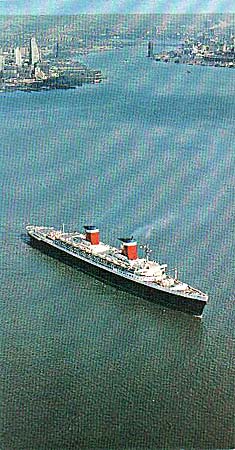
And in her glory years ^
I hope she gets a new lease on life. Sad, she's been docked for about twice as long as she ever was at sea....
To: AnalogReigns
It is now known that the SS United States achieved speeds exceeding 44 knots, or 50mph (footnote by the SS United States Foundation).Besides her 44-knot top speed, she could also do 20 knots in reverse:

10
posted on
04/16/2003 9:06:49 AM PDT
by
Al B.
To: 1066AD
Well, NCL operated the Norway (ex ss France) for many successful years in the cruise trade, so I expect they know what they're getting into.
To: sjersey
It would be nice to see the Navy yard used for more than a holding pen for mothballed WWII ships (it's packed with cruisers and/or destroyers, and there was even an old carrier there a few months ago).
12
posted on
04/16/2003 2:21:15 PM PDT
by
Windcatcher
("So what did Doug use?" "He used...sarcasm!")
Disclaimer:
Opinions posted on Free Republic are those of the individual
posters and do not necessarily represent the opinion of Free Republic or its
management. All materials posted herein are protected by copyright law and the
exemption for fair use of copyrighted works.
FreeRepublic.com is powered by software copyright 2000-2008 John Robinson