|
|
|
|
|
|
 |
FreeRepublic , LLC PO BOX 9771 FRESNO, CA 93794
|
|
|
|
Posted on 04/08/2003 12:01:02 PM PDT by Rockitz
A U.S. Air Force Titan 4 rocket has lifted off from Cape Canaveral carrying a 10,000-pound, $800 million satellite that will serve as an orbiting switchboard for secure communications between senior U.S. leaders and military forces around the world. Liftoff occurred at 9:43 a.m. EDT (1343 GMT). Follow the complete flight in our mission status center.
Still waiting for final Centaur burn and payload insertion about 2pm PST.
|
|
|
|
|
|
|
|
FreeRepublic , LLC PO BOX 9771 FRESNO, CA 93794
|
|
|
|
It sounded like a train about to rumble down our street, and we're several miles away.
The rumbling seemed to continue for a good 10 minutes....
Finally,, it occurred to me what I was hearing.

Titan IV launch

Milstar
From publicly accessable source: http://www.af.mil/news/factsheets/Milstar_Satellite_Communicati.htmlUSAF Fact Sheet
Milstar Satellite Communications SystemMission
Milstar is a joint service satellite communications system that provides secure, jam resistant, worldwide communications to meet essential wartime requirements for high priority military users. The multi-satellite constellation will link command authorities with a wide variety of resources, including ships, submarines, aircraft and ground stations.Features
Milstar is the most advanced military communications satellite system to date and represents the future of the U.S. communications capability. The operational Milstar satellite constellation will consist of five satellites positioned around the Earth in geosynchronous orbits. Each mid-latitude satellite weighs approximately 10,000 pounds (4,536 kilograms) and has a design life of 10 years.
Each Milstar satellite serves as a smart switchboard in space by directing traffic from terminal to terminal anywhere on the Earth. Since the satellite actually processes the communications signal and can link with other Milstar satellites through crosslinks, the requirement for ground controlled switching is eliminated under nominal operating conditions. The satellite establishes, maintains, reconfigures and disassembles required communications circuits as directed by the users. Milstar terminals provide encrypted voice, video, data, teletype or facsimile communications. A key success of Milstar is providing interoperable communications among the users of Army, Navy, and Air Force Milstar terminals.
Geographically dispersed mobile and fixed control stations provide survivable and enduring operational command and control for the Milstar constellation.
Background
The first Milstar satellite was launched Feb. 7, 1994 aboard a Titan IV expendable launch vehicle. The first two Milstar satellites have a low data rate payload while the remaining three satellites add an increased capacity with a medium data rate payload. The Milstar constellation will be complete with the launch of the final satellite in 2003.
The Milstar system is composed of three segments: space (the satellites), terminal (the users) and mission control. Air Force Space Command's Space and Missile Systems Center at Los Angeles Air Force Base, Calif., is responsible for development and acquisition of the Milstar space and mission control segments. The Electronics Systems Center at Hanscom AFB, Mass., is responsible for the Air Force portion of the terminal segment development and acquisition. The 4th Space Operations Squadron at Schriever AFB, Colo., is the front line organization providing real-time satellite platform control and communications payload management.
General Characteristics
Primary function: Survivable global military communications system
- Primary contractor: Lockheed Martin Missiles and Space
- Power plant: Solar panels generating 8,000 watts
- Weight: About 10,000 pounds (4,536 kilograms)
- Orbit altitude: 22,250 nautical miles (inclined geostationary orbit)
- Payload:
- Low data rate communications (voice, data, teletype and facsimile) at 75 bps to 2,400 bps (Block I and II)
- Medium data rate communications (video, voice, data, teletype, facsimile) at 4.8 kbps to 1.544 bps (Block II only)
- Launch vehicle: Titan IVB/Centaur upper stage
- Unit Cost: $800 million

I want one of those terminals.
Would you settle for nationwide terrestrial packet radio capability?
SkyTel 2Way [wireless, nationwide] messaging featureshttp://www.skytel.com/products/blackberry_internet.htm
- Fully interactive - write, send, receive and respond to email and messages right from the unit
- Contacts can send you messages from the SkyTel website's Send a Message page
- Your callers can dial a toll-free SkyTel number to send a message
- Greet callers in your own voice - just like you do with your voice mail or answering machine. You can change your personal greetings as often as you like
- Your contacts can also download free SkyTel Access® software for their modem-equipped computers. Ideal for those who don't have an Internet connection
- Your SkyTel service lets you make a phone call without a phone - send a message from your unit to any U.S. phone number. The "call" will be read in a digitized voice
- And all calls to the SkyTel system are free, whether sending a message or calling Customer Service
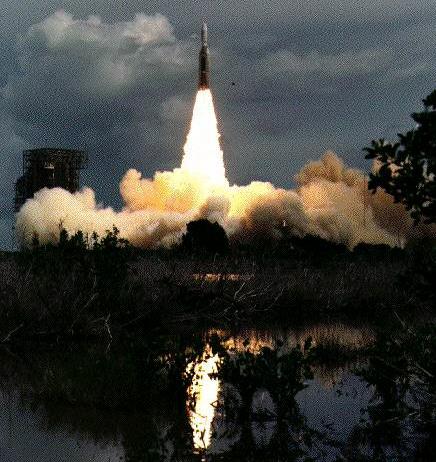
Another Titan IV launch.
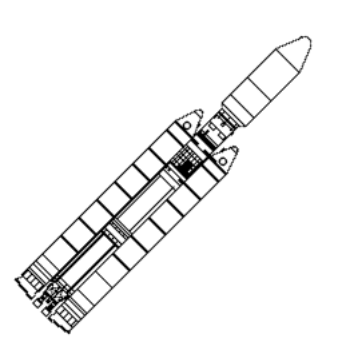
Schematic of Titan IV.
Pics courtesy of www.astronautix.com
There is only *one* bitstream that I know that has that number associated with it - a "DS1" circuit commonly hauled over a "T1" line (with a raw 'bit rate' of 1.544 Mbps including 8000 bps for 'supervision' and 'synchonization bits') ...
Disclaimer: Opinions posted on Free Republic are those of the individual posters and do not necessarily represent the opinion of Free Republic or its management. All materials posted herein are protected by copyright law and the exemption for fair use of copyrighted works.