
Posted on 03/25/2003 11:32:24 AM PST by NYer
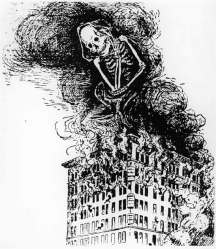
NEW YORK (AP) _ Ninety-two years after a sweatshop fire killed 146 young girls and women and triggered widespread labor reforms, the factory site was dedicated as a city landmark Tuesday. ``It was one of the worst industrial disasters, not just in New York City's history but really in the history of the whole country,'' Mayor Michael Bloomberg said at the ceremony which unveiled a commemorative bronze wall plaque. ``It was horrific and worst of all it was largely preventable.''
The neo-Renaissance-style building in Greenwich Village, a national historic landmark since 1991, was not heavily damaged and today is used as classrooms by New York University. But early in the 20th century, it housed the Triangle Shirtwaist factory in the top three of its 10 floors.
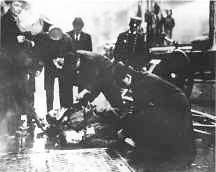
At about 4:30 p.m. on March 25, 1911, a fire broke out in the eighth floor cutting room and spread rapidly as it consumed thousands of pounds of fabric. Panicked workers _ Jewish, Police and Italian immigrants between the ages of 13 and 23 _ tried to escape. But some of the doors were locked _ a tactic the factory's bosses used to keep employees at their sewing machines. Other exits were blocked and there were no sprinklers. Within 15 minutes, dozens of women inside the factory were dead, while stunned eyewitnesses watched as others jumped to their deaths, their skirts ablaze.
Vincent Maltese, 68, who lost two aunts, ages 14 and 18, and a grandmother in the fire, attended the dedication Tuesday. ``It's only right that we remember. If it hadn't been for people like my family, there would be no protection at all,'' said Maltese, a retired court officer from Queens.
The factory fire, the worst of its kind in New York City history, prompted adoption of some of the era's most stringent workplace safety laws and crystallized efforts to unionize garment workers. It also forced lawmakers to begin enforcing strict building codes after years of negligence by corrupt politicians. ``It was sort of a Watergate of the time, a scandal that led to huge changes in the city,'' said Andrew Coe, a contributor and editor of F.D.N.Y: An Illustrated History of the Fire Department of the City of New York.
Several hundred people, including students, union workers and firefighters, attended Tuesday's ceremony. In a symbolic gesture, the fire department raised a ladder to just below the fire floors _ the highest a ladder was able to extend in 1911 _ and tolled a bell as the name of each victim was read aloud and a white carnation placed at the base of the building.
Laura Ferro, a ninth grader at Clarkstown High School in Rockland County who had won a competition with her classmates for a social studies project on the Triangle Shirtwaist fire, said, ``We focused on what came out of this tragedy: the first minimum wage laws and the first workers' safety laws.''
The blaze, a symbol of management's mistreatment of labor, is still invoked by labor activists and politicians. Last July, when the state Senate approved a bill to allow State University and City University of New York campus stores to refuse to sell clothing produced in sweatshops, Guy Velella, a Bronx Republican, said that the bill was ``built on the foundation of the Triangle Shirtwaist fire tragedy.''
AP-ES-03-25-03 1348EST

Sweatshop workers.
Most, if not all, great public tragedies have this political element present as an accomplice to death, as much as the "Greedy Businessman". The failure of US agencies charged with national security was evident on 9/11.
All she wanted was safe working conditions - not a stranglehold on business owners.
I agree with you. Unions first duty to its members is safe working conditions, then adequate compensation for labor. However, unions are just as human as business and government, and are subject to the same human failing.
Thanks for posting this. A worthwhile reminder and a fitting memorial to the innocent that perished.
The practice of using natural products to color easter eggs is, of course, de rigueur these days, championed by none other than Marth Stewart.
As for your great grandmother's employment at the Triangle Shirtwaist factory, how truly remarkable. Did you follow the link that I posted? It captures the entire story, frame by frame.
And yes, the introduction of unions to protect the workers was an important movement, in its day. Now it all about greed. Sadly, many "workers" are now losing their jobs as a result of that greed. I suppose with time, this concept will be reemerge in some new form.
Again, thank you for your post! It was so informative and moving.
I can imagine that you treasure that picture! What a blessing that it was taken and that you have it.
I'm a history buff and love this stuff - although it's tempered with sadness for the souls who have gone before us and who endured more hardship than most of us can ever imagine.
PS. Just got a "new" Taylor Caldwell for the collection!
A young man at a window helped a girl to the window sill; then he held her out, deliberately, away from the building, and let her drop. He seemed cool and calculating. He held out a second girl in the same way and then let her drop. Then he held out a third girl. They didn't resist. I noticed that they were as unresisting as if he was helping them onto a street car instead of into eternity.
How exciting!! Which one? Ebay is probably one of the best resources in locating her books.
Disclaimer: Opinions posted on Free Republic are those of the individual posters and do not necessarily represent the opinion of Free Republic or its management. All materials posted herein are protected by copyright law and the exemption for fair use of copyrighted works.