Summary
With the fraud scandals of Enron, WorldCom, and other corporate giants roiling the stock market, along comes Amtrak to announce a shutdown unless it gets an emergency $200 million cash infusion. But the government should stop subsidizing the failed national rail service, which has wasted billions of tax dollars, and allow the market to punish mismanagement with bankruptcy—exactly as it is doing with the corporate malefactors.
Posted: Friday, August 02, 2002
Amtrak: The Federal Government’s Own Corporate Financial Scandal
By Mr. Barrett Kalellis
ISSN: 1093-2240
With the mismanagement and fraud scandals of corporate giants Enron, Global Crossing, Tyco, ImClone, Arthur Andersen and WorldCom roiling the stock market, along comes Amtrak, America’s national railroad, to grab headlines by announcing an imminent shutdown unless it gets $200 million in cash infusions to continue operations.
Like those corporate miscreants, Amtrak has for years used creative accounting to disguise its financial problems, hiding operating expenses as capital costs, as well as misled the public about its effectiveness and performance. Amtrak’s failure to secure more of the growing transportation market, coupled with high costs, poor management and abysmal productivity, result in a metaphorical gun held to the heads of American taxpayers: “Continue to subsidize us or we will pull the trigger.”
Created by an act of Congress in October 1970, Amtrak started as a federally chartered corporation authorized to operate virtually all intercity passenger routes in the United States. It was supposed to reverse over two decades of continuous operating deficits incurred by privately run passenger railroads. At the time, promising to be a profit-making enterprise, it was given $40 million in initial funding, along with $100 million in loan guarantees.
With 30 years of failure under its belt, Amtrak has received nearly $25 billion in taxpayer dollars, with no prospect in sight of ever breaking even. Under the Amtrak Reform and Accountability Act of 1997, Congress mandated the rail service to be self-sufficient by December 2002, or come up with a liquidation plan. But late last year, Senate leaders blocked Amtrak from even doing a liquidation study of itself.
Politics, in fact, has reared its ugly head in most of Amtrak’s woes. Although the Northeast commuter corridor is profitable, most other national routes are not. Yet if a politician wants to keep a particular stop in his state, guess what happens?
Typical of many government-run operations, there is waste, inefficiency, and reluctance to make hard restructuring decisions because no private owners are involved—no incentive exists to rationalize operations to make them more profitable and to make wiser investments for the money spent.
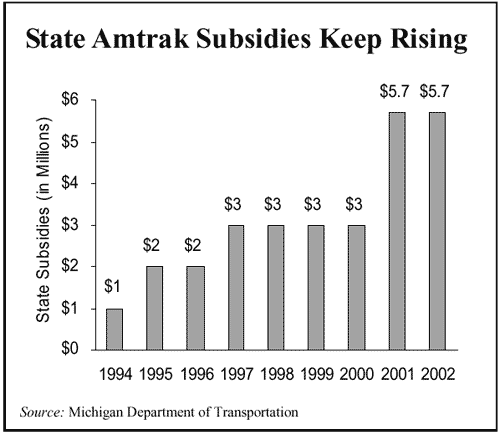
As with many states, Michigan has poured money into the Amtrak sinkhole to keep two routes alive: Port Huron – Grand Rapids – Chicago and Toronto – Chicago. The cost has more than quadrupled in less than a decade, from $1 million in 1994 to a whopping $5.7 million this year.
In a policy analysis published by the Cato Institute last November, scholars Joseph Vranich and Edward Hudgins conclude that under the current paradigm, Amtrak is doomed to perpetual failure. The analysts discovered that the more money Amtrak receives in subsidies, the greater its financial difficulties.
Others argue that Amtrak should be given special funds to develop high-speed rail programs like those in Japan and other countries, to compete with airline travel. Congressional legislative initiatives would allow Amtrak to float bond proposals in the amount of $12 billion, along with matching funds provided by certain states, to develop and market “high-speed” train routes. The Cato study’s authors, however, claim that this would be essentially a con job, as Amtrak would use the money to retrofit trains to go from 40 mph to 50 mph—hardly “high-speed” by international standards.
Amtrak has politicized America’s train routes to meet the pork barrel needs of legislators—for example, promising high-speed service between Texarkana, Ark., and Dallas, where virtually no market exists. Yet even with a price tag of billions, the Cato study concludes that Amtrak high-speed trains will draw “only an infinitesimal number of passengers from other modes of transportation.”
Successful Amtrak reform would follow the lead of 40 other nations, where private operators have competitively bid for publicly owned rail systems and devolved franchised rail service to more efficient regional authorities. Liquidation of current Amtrak assets could be patterned after past military base closings; thus, unprofitable Amtrak routes could be jettisoned while promising ones are preserved and nurtured, particularly short-distance routes in high population areas.
If honest accounting practices had been enforced with Amtrak, it would have gone bankrupt years ago. As a government-owned enterprise, even with endless subsidies, it will never be solvent. With so many public-private ownership opportunities available, there is simply no need for a national railway service.
#####
(Barrett Kalellis is a writer, newspaper columnist, and adjunct scholar with the Mackinac Center for Public Policy. Permission to reprint in whole or in part is hereby granted, provided the author and his affiliation are cited.)