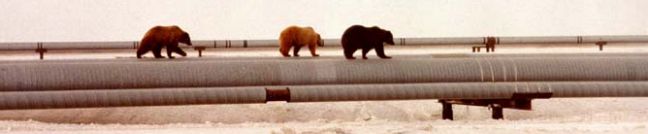
I couldn't find that pic, but these show the wildlife in the area who don't mind the pipeline at all.


Posted on 03/29/2002 1:00:54 PM PST by Temple Owl
Alaska animals vulnerable to oil drilling?
By Hil Anderson
UPI Chief Energy Correspondent
LOS ANGELES, March 29 (UPI) -- Despite the harsh climate of Alaska's rugged Arctic National Wildlife Refuge, the animals that live there may not be hardy enough to withstand the opening of their pristine habitat to oil exploration. Top A new study issued Friday by the U.S. Geological Survey concluded that the populations of caribou, musk oxen, polar bears and other species that call the remote ANWR home could suffer declines unless human activities in their ranges are restricted, particularly during breeding seasons.
The report, which came out while Congress was adjourned for Easter, made no recommendations on the controversial plan to allow oil drilling in a portion of the ANWR, but it warned that the animals that inhabit the area -- designated as the 1002 Area -- were vulnerable to having their lives and futures disrupted by the arrival of man and machine.
There was no immediate comment on the report from the Bush administration or the environmental community, but the report will likely be used to challenge the claims of drilling proponents that petroleum extraction can be carried out in a manner that causes minimal disruptions to wildlife.
The Bush administration has pressed for the opening of the 1002 Area of the ANWR as necessary to meet growing energy demand in the United States and reduce dependence on overseas crude supplies.
"It's time to decide how we are going to fuel our economy and to what country we are going to become indebted," Sen. Frank Murkowski, R-Alaska, said last week "We're going to have to decide where we're going to get our oil."
While the oil industry says it has the technology to leave virtually no environmental "footprint" in the ANWR, the USGS report cautioned that the migratory heard of caribou known as the Porcupine Caribou Herd that uses part of the 1002 Area as a breeding ground was particularly fragile.
"The PCH has less capacity to accommodate ... stresses than other Alaska barren-ground herds," the USGS said in its summary of the report. "Any absolute effect of petroleum development would be expected to have a larger relative effect on the Porcupine caribou herd than on the other herds."
Scientists concluded that the 1002 Area was the best calving area available to the Porcupine herd and that if the animals were disturbed or felt threatened, they would find little in the way of an alternative home since nearby areas lack the vegetation needed as a food supply for mothers and their young.
"Empirical relationships between calf survival, forage available to females in the annual calving grounds, and predation risk derived from 17 years of ecological data predict that June calf survival for the PCH will decline if the calving grounds are displaced, and that the effect will increase with displacement distance from the 1002 Area," the report summary said.
Risks also exist for the muskoxen that call the 1002 Area home year-round. The animals, which number under 250 individuals and are on the decline, must conserve their energy during the winter if they are to have a successful summer breeding season and would not do well if they were forced to move any large distance through deep snow.
"Musk oxen in the refuge are vulnerable to disturbance from activities associated with petroleum exploration and extraction due to their year-round residency, their small population numbers and their need to conserve energy throughout the long winter if they are to successfully reproduce," the report said.
The mighty polar bears also use the coastal area of the ANWR to raise their young. While considered a relatively resilient species, the USGS advised strict management of human activities in the areas where bear dens exist. The report also warned that migrating snow geese could face threats from an increased number of aircraft in the area.
None of this has happened in the other areas of Alaska where drilling has taken place so wouldn't it be more truthful to say "probably wouldn't", "unlikely", and "not previously demonstrated"?
If there's an agenda, people will lie about it....and liberals doubly so.
Arctic Drilling a Threat to Wildlife - Environmental Whackos in our government
Only if they get in the way of the drill bit.
An animal herd that lives north of the Arctic Circle is fragile? Sweet Jesus give me a break.
I can't believe that there are people who put any credence in this folderol.
Sheeeesh!!!!!
Guess what. Their pristine habitat has been open to oil exploration for decades. Remember Prudhoe Bay? Remember PET4, the WW I naval coal reserve? As if there is a square foot of Alaska that hasn't already been stepped on or picked at.
I couldn't find that pic, but these show the wildlife in the area who don't mind the pipeline at all.
As the Audobon Society, or the Nature Concervancy (among others) has proven, it'll work in ANWR. Let's just give the environmentalists and incentive, and the decision to sink wells in ANWR will be made before you can say pristine wilderness. Furthermore, they'd probably agree to allowing use of 10 times the land area currently being suggested.
With the upcoming debate about ANWAR I thought I could give you some inside information. I've worked in Prudhoe Bay, Alaska for thirteen years, three weeks on, three weeks off. To start with, the oilfield is a small community. Most of the people I work with have worked in other oilfields and in other countries. Between myself and the people I work with, we've worked in them all. Prudhoe Bay is the cleanest oilfield in the world. To begin working on the slope you need two days of classes on the environment and safety. Maximum speed limit is 45mph, my drivers license was checked four times just last hitch and two random UA's last year with a chance of a least four more this year. My truck has a drive-right recorder that records speed and abrupt stops and is downloaded every month to be analyzed. The drilling rigs for the most part run on electricity unless they are on remote exploratory wells. Exploratory wells are only drilled during the winter and early spring months when ice roads can be made from snow and water to reach remote locations. In the summer you can't tell that they were out there. The trucks and heavy equipment wear what we call diapers to keep any oil drips from the roads and drilling pads. Smaller vehicles must put drip pans under the motor blocks when parked. During refueling there must be a spill containment placed under the nozzle. Spills of one gallon or more of any kind of fluid but fresh water must be reported ASAP. This includes seawater which is used in well displacement. Drilling pads are built like a saucer so any major spills will flow to the center of the pad. Before the rig is moved in, a thick spill containment pad called herculite is placed on the ground. There is more pollution run off in your local Wal-mart parking lot after a good rainstorm than spilled on the North Slope. Safety meetings are held everyday and before every new task that is about to take place with reviews of the procedures and hazards of the task. Wildlife has the right of way no matter what. I've seen two rigs one coil tubing unit, one E-line unit, and two slickline units be shut down because a polar bear walked on pad. We couldn't start any activity until the bear was clear of the location. The porcupine caribou herd migrates through Prudhoe Bay every summer, some ten thousand animals walk through the field without any trouble or human harassment. Risk job loss if you feed or harass any wildlife. I've seen them all; they go about there business as though we're not there. Mosquitoes harass them more than any human or human activity. My point is if every oilfield in the world worked under the same restrictions and guidelines, the worlds environment would not only be cleaner, oil in the US would be $50.00 a barrel. I should also tell you I am not an oil company employee I work for a service company. I could go on and on about the rules and regulations but this letter would be too long. If you have any questions about this feel free to ask.I know the emailer and have heard him speak of this for most of those 13 years, and received several images of local habitat (bears) that are left undisturbed until they vacate the area (without influence from "the visitors").
Disclaimer: Opinions posted on Free Republic are those of the individual posters and do not necessarily represent the opinion of Free Republic or its management. All materials posted herein are protected by copyright law and the exemption for fair use of copyrighted works.