So now you know the "Rest of The Story."
Posted on 08/22/2026 6:27:34 PM PDT by Stanwood_Dave
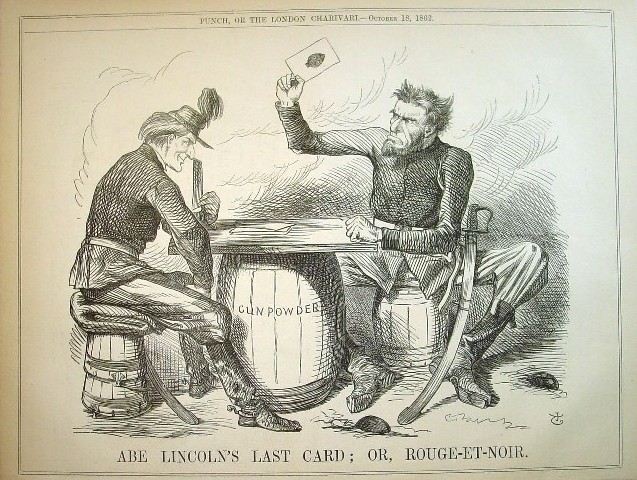
The very 1st {first} Race Card being played, in October 18th, 1862, against Abraham Lincoln
So now you know the "Rest of The Story."
This is not the first time the race card was played.
The British Empire played the race card against the U.S. as a response to the Declaration of Independence.
The illustration clearly shows him calling a spade a spade, but I don’t see a racial connotation in it. Different era thing?
Abe Lincoln's Last Card; or, Rouge-et-Noir" is an 1862 political cartoon by John Tenniel published in the British satirical magazine Punch. It critically portrays Abraham Lincoln as a desperate gambler playing a final, risky card following his preliminary Emancipation ProclamationTenniel is most well known for illustrating Alice in Wonderland and Through the Looking Glass . Rouge-et-Noir was and is a notoriously addictive gambling game, associated with dissipation and financial ruin.
Histories I have read generally say that the Emancipation Proclaimation was intended to prevent England, and possibly France, from recognizing the Confederacy. Prior to Gettysburg and Vicksburg, and the outcome of the 1864 election, the prospects that this nation might long endure were not bright, and even as today, if we fail we must be the author and executioner of our own downfall.
They offered to free our slaves. We objected and listed it as a "cause" in our Declaration of Independence.
Not just the Federal revenue streams, but the entire 700 million per year in trade with the South was at risk.
It was the protectionist laws that forced the Southern states to purchase goods from the North (at excessively high prices) and with secession, all those laws would have been nullified, and the South would have been free to purchase lesser costing and better quality European goods instead.
The North stood to lose 100s of millions of dollars in value if the South could trade freely with Europe.
The war was over these loses of money, and not some abstract idea of "preserve the Union."
The North fought for money, and nothing else.
Careful. Statements like that will bring in a bunch of northerners to argue with you.
DiogenesLamp said: "They offered to free our slaves."
Corrected: "They offered to free all our slaves."
The Empire offered no such freedom to all slaves circa the U.S. revolution and in fact, rejected freeing all slaves as they could have done at the time of Somersett V. Stewart.
The Empire did not want slavery eradicated at that time. Somersett was their chance. The Empire failed.
The Empire only wanted to free select slaves for its militaristic gambit known as Dunmore's which the Empire felt could (it was thought) benefit the Empire in order for it to keep hold of 13 of its 30 slave colonies which it was losing at the time.
And I still stand by the original statement. The Empire played the race card against us as a response to the Declaration.
We listed British efforts to offer freedom to our slaves as a "cause".
"He has excited domestic insurrections amongst us"
Well with that being said,
You lied.
Plain and simple.
Plain and simple.
Well you are gonna have to help me out here. What particular thing is it that you think I have lied about?
The very 1st {first} Race Card being played, in October 18th, 1862, against Abraham Lincoln
The race card portrayed in Punch was the Preliminary Emancipation Proclamation issued September 22, 1862. It was issued by Abraham Lincoln, not against Abraham Lincoln.
Collected Works of Abraham Lincoln, Vol 5, pg. 433-436, Preliminary Emancipation Proclamation, September 22, 1862
Col. John B. Baldwin's Sworn TestimonyRegarding His Interview With Abraham Lincoln on 4 April 1861
Excerpted from pp. 101-104.
Washington, D.C., February 10, 1866
John B. Baldwin sworn and examined by Mr. Howard:
* * *
Question. Did you make a journey to Washington before the firing on Fort Sumter?
Answer. I did. I came here on the night of the 3d of April, 1861; I was here on the 4th day of April, 1861.
Question. Did you have an interview with President Lincoln?
Answer. I did have a private interview with him, lasting perhaps an hour.
Question. Do you feel at liberty to state what transpired at that interview?
Answer. I do sir; I know of no reason why I should not.
Question. Have the goodness to state it.* * *
Said I, “Sir, I beg your pardon, for I only know of you as a politician, a successful politician; and possibly I have fallen into the error of addressing you by the motives which are generally potent with politicians, the motive of gaining friends. I thank you that you have recalled to me the higher and better motive of being right; and I assure you that, from now on, I will address you only by the motives that ought to influence a gentleman.”
Question. You drew a distinction between a politician and a gentleman?
Answer. Yes, sir; he laughed a little at that. He said something about the withdrawal of the troops from Sumter on the ground of military necessity.
Said I, “That will never do, under heaven. You have been President a month to-day, and if you intended to hold that position you ought to have strengthened it, so as to make it impregnable. To hold it in the present condition of force there is an invitation to assault. Go upon higher ground than that. The better ground than that is to make a concession of an asserted right in the interest of peace.”
“Well,” said he, “what about the revenue? What would I do about the collection of duties?”
Said I, “Sir, how much do you expect to collect in a year?”
Said he, “Fifty or sixty millions.”
“Why, sir,” said I, “four times sixty is two hundred and forty. Say $250,000,000 would be the revenue of your term of the presidency; what is that but a drop in the bucket compared with the cost of such a war as we are threatened with? Let it all go, if necessary; but I do not believe that it will be necessary, because I believe that you can settle it on the basis I suggest.”
He said something or other about feeding the troops at Sumter. I told him that would not do. Said I, “You know perfectly well that the people of Charleston have been feeding them already. That is not what they are at. They are asserting a right. They will feed the troops, and fight them while they are feeding them. They are after the assertion of a right. Now, the only way that you can manage them is to withdraw from the means of making a blow until time for reflection, time for influence which can be brought to bear, can be gained, and settle the matter. If you do not take this course, if there is a gun fired at Sumter — I do not care on which side it is fired — the thing is gone.”
“Oh,” said he, “sir, that is impossible.”
Said I, “Sir, if there is a gun fired at Fort Sumter, as sure as there is a God in heaven the thing is gone. Virginia herself, strong as the Union majority in the convention is now, will be out in forty-eight hours.”
“Oh,” said he, “sir, that is impossible.”
Said I, “Mr. President, I did not come here to argue with you; I am here as a witness. I know the sentiments of the people of Virginia, and you do not. I understand that I was to come here to give you information of the sentiments of the people, and especially of the sentiments of the Union men of the convention. I wish to know before we go any further in this matter, for it is of too grave importance to have any doubt of it, whether I am accredited to you in such a way as that what I tell you is worthy of credence.”
- - - - -
SUPPORTING SOURCES:
[ONE]
The picturesque hills of New England were dotted with costly mansions, erected with money, of which the Southern planters had been despoiled, by means of the tariffs of which Mr. Benton spoke. Her harbors frowned with fortifications, constructed by the same means. Every cove and inlet had its lighthouse, for the benefit of New England shipping, three fourths of the expense of erecting which had been paid by the South, and even the cod, and mackerel fisheries of New England were bountied, on the bald pretext, that they were nurseries for manning the navy. The South resisted this wholesale robbery, to the best of her ability. Some few of the more generous of the Northern representatives in Congress came to her aid, but still she was overborne; and the curious reader, who will take the pains to consult the "Statutes at Large," of the American Congress, will find on an average,-a tariff for every five years recorded on their pages; the cormorants increasing in rapacity, the more they devoured. No wonder that Mr. Lincoln when asked, "why not let the South go?" replied, "Let the South go! where then shall we get our revenue?"
Admiral Raphael Semmes, Memoirs of Service Afloat, During the War Between The States, Baltimore: Kelly, Piet & Co., 1869, p. 59.
[TWO]
When asked, as President of the United States, "why not let the South go?" his simple, direct, and honest answer revealed one secret of the wise policy of the Washington Cabinet. "Let the South go!" said he, "where, then, shall we get our revenue?"
Albert Taylor Bledsoe, Is Davis a traitor; or, Was secession a constitutional right previous to the war of 1861?, Baltimore: Innes & Company, 1866, pp. 143-144.
[THREE]
Another effort was made to move Abraham Lincoln to peace. On the 22nd, a deputation of six members from each of the five Christian Associations of Young Men in Baltimore, headed by Dr. Fuller, and eloquent clergyman of the Baptist church, went to Washington and had an interview with the President. He received them with a sort of rude formality. Dr. Fuller said, that Maryland had first moved in adopting the constitution, and yet the first blood in this war was shed on her soil; he then interceded for a peaceful separation, entreated that no more troops should pass through Baltimore, impressed upun Mr. Lincoln the terrible responsibility resting on him - that on him depended peace or war - a fratricidal conflict or a happy settlement."But," said Lincoln, "what am I to do?"
"Let the country know that you are disposed to recognize the Southern Confederacy," answered Dr. Fuller, "and peace will instantly take the place of anxiety and suspense and war may be averted."
"And what is to become of the revenue?" rejoined Lincoln, "I shall have no government, no resources!"
Robert Reid Howison, History of the War, excerpted in Southern Literary Messenger, Vol. 34, Issue 8, August 1862, Richmond, VA., pp. 420-421.
[FOUR]
"But," said Mr. Lincoln, "what am I to do?" "Why, sir, let the country know that you are disposed to recognize the independance of the Southern States. I say nothing of secession; recognize the fact that they have formed a government of their own; that they will never be united again with the North, and and peace will instantly take the place of anxiety and suspense, and war may be averted.""And what is to become of the revenue?" was the reply. "I shall have no government - no revenues."
Evert A. Duyckinck, National History of the War For the Union, Civil, Military and Naval. Founded on official and other authentic documents, New York: Johnson Fry & Co., 1861, Vol. I, p. 173.
[FIVE]
In 1861, if the erring sisters had been allowed to go in peace, was not the disturbing question of the hour: Whence is to come national revenue? Had not this very consideration much to do with the policy of coercion?"Thus," said Mr. Lincoln, "if we allow the Southern States to depart from the Union, where shall we get the money with which to carry on the Government?"
James Battle Avirett, The Old Plantation: How We Lived in Great House and Cabin Before the War, New York: F. Tennyson Neely Co., 1901, p. 18.
[SIX]
It seems obvious that Lincoln's concern over secession, "What then will become of my tariff?" was a serious matter.
When in the Course of Human Events, Charles Adams, 2000, p. 27.
Footnoted to: Robert L. Dabny, Memoir of a Narrative Received of Colonel John B. Baldwin, in Secular (1897; reprint, Harrisburg, VA.: Sprinkle, 1994), 94, 100.
[SEVEN]
The meeting was reported in the Baltimore Sun 23 Apr 1861 edition.
[EIGHT]
The quote from Lincoln re: Revenues (meeting with Dr. Fuller) is also substantiated by Benson Lossing, in his "Pictorial Field Book of the Civil War: Journeys Through the Battlefields in the Wake of Conflict", Johns Hopkins Univ Press (Reprint edition), 1997, Vol. 1, p. 420 (reprinted 1997)
Still another embassy, in the interest of the secessionists of Baltimore, waited upon the President. These were delegates from five of the Young Men's Christian Associations of that city, with the Rev. Dr. fuller, of the Baptist Church, at their head. The President received them cordially, and treated them kindly. He met their propositions and their sophisms with Socratic reasoning. When Dr. Fuller assued him that he could produce peace if he would let the country know that he was "disposed to recognize the independence of the Southern States -- recognize the fact they they have formed a government of their own; and that they will never again be united with the North," the President asked, significantly, "and what is to become of the revenue?"
Said earlier:
"They offered to free our slaves."
No. They did not offer to free all "our" slaves.
(Post 9 for full context.)
It is a lie to say that Dunmore’s freed all the slaves.
How could this be hard for you?
Your point is trivial.
You guys have deified Dunmore's for bizarre if not creepy reasons and blown it up making it larger than life, thinking you can use it as a cudgel.
Don't get mad the flimsy balloon got popped. Good to see you realizing you do not have a cudgel after all.
Dunmore's was a militaristic gambit and nothing more.
I do not know what you are talking about. I guess it makes sense to you though.
You brought up Dunmore’s in the first place when it had no relation to the thread, I didn’t bring it. That’s the creepy and bizarre part. If you don’t want people pointing out the creepy and bizarre part about it, don’t be creepy and bizarre.
The thread was, “first” race card as if it was Lincoln. I simply pointed out that no, the first time the race card was played for or against anybody in an American context was by the British Empire calling (pretty much) Americans racists.
They did that junk to us basically before the country was less than 6 months old.
Disclaimer: Opinions posted on Free Republic are those of the individual posters and do not necessarily represent the opinion of Free Republic or its management. All materials posted herein are protected by copyright law and the exemption for fair use of copyrighted works.