Skip to comments.
Is Social Security still taxable? Here's what you need to know about the recent tax law.
Fidelity ^
| 07/22/2026
Posted on 07/22/2026 9:41:34 AM PDT by SeekAndFind
Key takeaways
- Social Security income continues to be subject to federal income tax.
- A new senior deduction means only about 12% of seniors will pay taxes on their benefits.
- Nine states impose some income tax on Social Security.
Is the income you receive from Social Security taxable? With the recent tax law, Social Security income continues to be taxable, but an additional deduction for seniors may help offset what is owed.
Under the recent law, taxpayers age 65 or older—and their spouses, if filing jointly—can each claim a $6,000 deduction for tax years 2025–2028. This senior deduction is reduced by 6% (but not below zero) for adjusted gross income that exceeds $75,000, or $150,000 for joint filers.
With the new deduction, only about 12% of seniors will pay taxes on their Social Security benefits, according to a White House Council of Economic Advisors analysis.
Some also will pay state income taxes, if they live in one of the few states that doesn’t exempt Social Security benefits.
Let's look at the formula for federal income tax and the states that still tax Social Security income.
Social Security and federal income tax
The IRS uses a “combined income formula” to determine if you must pay taxes on your benefits. Combined income includes typical forms of income such as wages, interest, dividends, pension payments, and taxable distributions from traditional 401(k)s and IRAs (less adjustments), as well as nontaxable interest and half of Social Security benefits.
Whether you will have to pay federal income tax on your Social Security benefits depends on your combined income:
- If you file as an individual:
- Up to $25,000: No tax
- $25,000–$34,000: Up to 50% of your benefits may be taxed.
- More than $34,000: Up to 85% of your benefits may be taxed.
- If you file a joint return:
- Up to $32,000: No tax
- $32,000–$44,000: Up to 50% of your benefits may be taxed.
- More than $44,000: Up to 85% of your benefits may be taxed.
Tip: There are ways to save on taxes in retirement. Read Viewpoints on Fidelity.com: 2 ways to save on Social Security income tax.
Do states tax Social Security income?
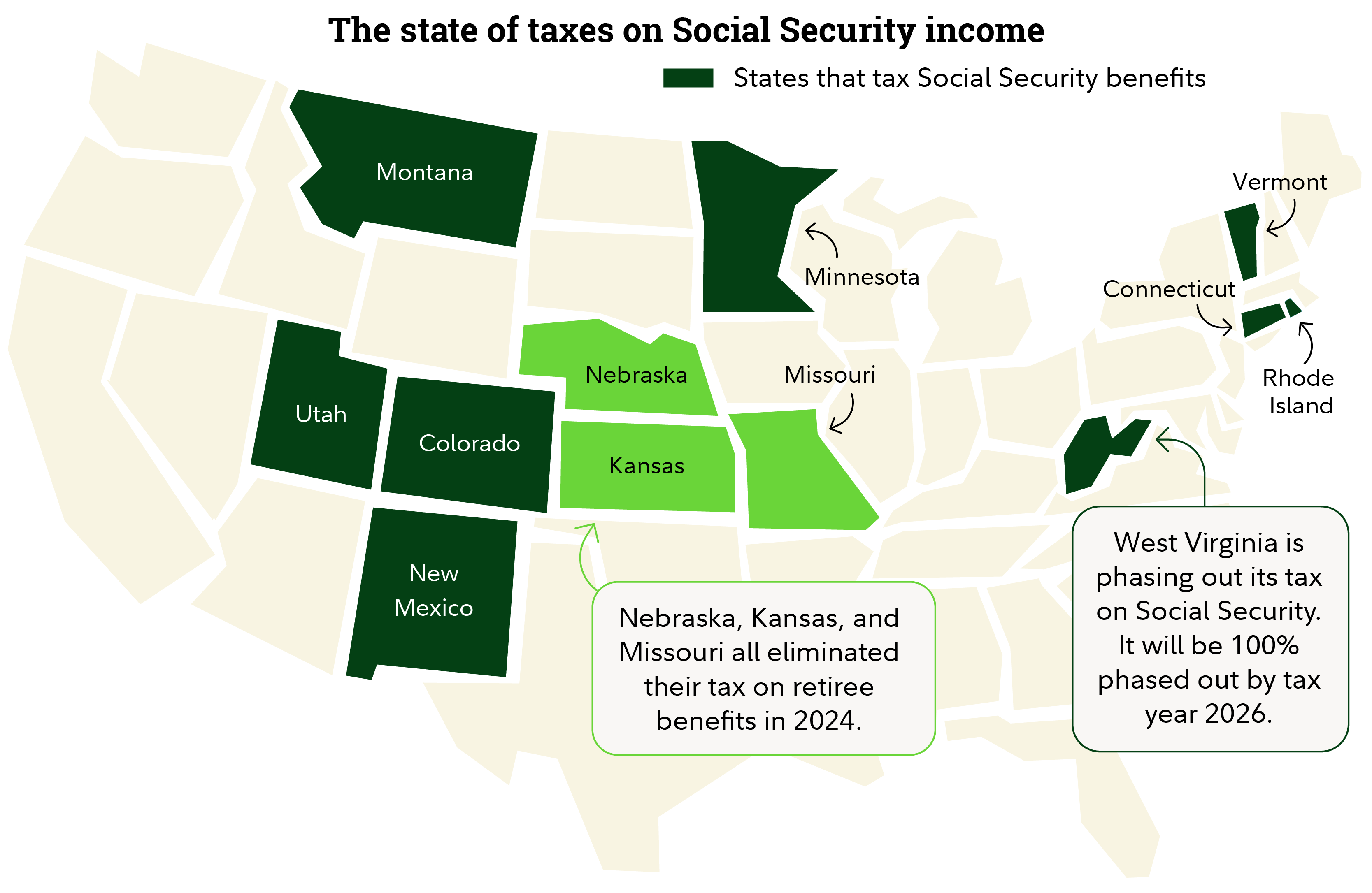
Most states do not tax Social Security income. But some portion of your benefits may be subject to state tax if you live in one of these 9 states: Colorado, Connecticut, Minnesota, Montana, New Mexico, Rhode Island, Utah, Vermont, or West Virginia. The rules vary widely from state to state. Some states may allow you to exclude federally taxable Social Security benefits for state income tax purposes based on your adjusted gross income, or AGI, so keep this in mind when reviewing the information below.
Quick refresher: What is adjusted gross income? Your AGI is income for the year after you subtract amounts—or “adjustments”—that are not taxable. The IRS uses your AGI as a starting point for calculating how much income tax you owe for the year.
Here's a closer look at how those states tax Social Security benefits for 2024:
Colorado
- Under 65: Up to $20,000 of federally taxable Social Security benefits are not taxed by the state of Colorado. Beginning in 2025, individuals ages 55–64 will be able to deduct all federally taxable Social Security income if their AGI is $75,000 or less for an individual and $95,000 or less for a couple filing jointly. Above those thresholds, $20,000 of federally taxable Social Security income may be excluded.
- 65 and older: No state taxation of federally taxable Social Security benefits.
Connecticut
Up to 25% of benefits may be taxed above these thresholds:
- Single filers: Federally taxable Social Security benefits are not taxable in Connecticut if AGI is below $75,000.
- Married filing jointly: No tax if AGI is below $100,000.
Minnesota
- Single or head of household filers: Federally taxable Social Security benefits are exempt from Minnesota state income tax if AGI is $82,190 or below for 2024. Starting at $82,191 in income, federally taxable Social Security benefits receive a partial exclusion from Minnesota state income tax, and at $118,191 and above, all federally taxable benefits are subject to state tax.
- Married filing jointly: Federally taxable benefits are exempt if AGI is at or below $105,380. Starting at $105,381 in income, federally taxable Social Security benefits receive a partial exclusion from Minnesota state income tax, and at $141,381 and above, all federally taxable benefits are subject to state tax.
Montana
- Social Security benefits are taxed as they are at the federal level.
New Mexico
- Single filers: No tax on federally taxable benefits if AGI is below $100,000.
- Married filing jointly: No tax on federally taxable benefits if AGI is below $150,000.
Rhode Island
The following apply once residents reach their full retirement age (66 or 67, depending on year of birth):
- Single filers: No tax on federally taxable Social Security benefits if income is below $104,200.
- Married filing jointly or qualifying widow(er): No tax on federally taxable Social Security benefits if income is below $130,250. If only one spouse has reached retirement age and both are receiving Social Security benefits, only the percentage of taxable Social Security benefits attributable to the spouse who has reached full retirement age are exempt from taxation.
Utah
- Single filers: Federally taxable Social Security benefits are taxed if modified adjusted gross income (What is MAGI?) exceeds $45,000. A state tax credit may reduce the amount of income tax paid.
- Married filing jointly: Federally taxable Social Security benefits taxed if MAGI exceeds $75,000. A state tax credit may reduce the amount of income tax paid.
Vermont
- Single filers: Federally taxable Social Security benefits are not taxable in Vermont if AGI is $50,000 or below. Federally taxable Social Security benefits are partially exempt from state income tax if AGI is above $50,000 and less than $60,000. If AGI is $60,000 and above, federally taxable benefits are fully taxable in Vermont.
- Married filing jointly: Federally taxable Social Security benefits are not taxable in Vermont if AGI is below $65,000. Federally taxable Social Security benefits are partially exempt from state income tax if AGI is above $65,000 and less than $75,000. If AGI is $75,000 and above, federally taxable benefits are fully taxable in Vermont.
West Virginia
West Virginia is one of the latest states to phase out taxes on Social Security benefits. Single filers with AGI at or below $50,000 and married filers with AGI at or below $100,000 can exclude 100% of federally taxable Social Security benefits from West Virginia state income tax. If they have AGI above their respective thresholds, they can deduct the following percentages of federally taxable Social Security benefits until they are fully exempted for all income levels in 2026:
- 2024: 35% exempt
- 2025: 65% exempt
- 2026: 100% exempt
State and federal income tax rules can be confusing, especially as they can change year to year. That’s just one of the things that can make managing taxes through retirement complicated. Working with a tax professional can help you better understand the potential tax impacts of any planning decisions.
TOPICS: Business/Economy; Government; News/Current Events
KEYWORDS: socialsecurity; taxes
Navigation: use the links below to view more comments.
first 1-20, 21-40, 41-47 next last
To: SeekAndFind
The incentive here is to not make any money.
2
posted on
07/22/2026 9:45:40 AM PDT
by
Jim W N
(MAGA "by restoring the Gospel of the Grace of Christ (Jude 3) and our Free Constitutional Republic!)
To: Jim W N
Exactly right you are. People like me who worked long hours and saved and invested lose this deduction because of income.
3
posted on
07/22/2026 9:52:32 AM PDT
by
Bobbyvotes
(Work is best form of worship to Gods.. per Bhagavad at ratio Geeta, the Hindu sacred book. )
To: SeekAndFind
I love being taxed twice for the same money they stole from me.
To: Bobbyvotes
Same here, it irks me when Trump repeatedly makes the blanket statement—no taxes on Social Security,,,same with no taxes on tips and no taxes on overtime,,,,,,they are ALL ‘means tested’!
5
posted on
07/22/2026 10:00:40 AM PDT
by
volare737
( Diversity is something to be overcome, not celebrated. )
To: volare737
My husband is turning 62 and will be drawing this fall, he will be taxed on social security and I believe it expires by the time he turns 65. I think it is disgusting to be taxed on a tax.
To: Jim W N
The incentive is not to pay income taxes - thereby not donating to the IRS.
It’s in the code- just not altogether.
It is possible!
7
posted on
07/22/2026 10:09:30 AM PDT
by
RebelTXRose
(Our Lady of Fatima, Pray for us! PRAY THE ROSARY!later)
To: ThisLittleLightofMine
I was self employed most of my life. That means I paid the employers half and the employees half of the SS taxes. And since I live in Minnesotastan they tax me on it now that I am collecting.
To: SeekAndFind
I already paid state and federal income taxes on that 6.2% they pulled from my paychecks for Social Security. Why do we have to pay income taxes on what we get from SS? Do welfare recipients pay federal income taxes on welfare payments or bennies? Another government incentive to just not work.
To: shelterguy
Yes small business owners get the shaft.
To: SeekAndFind
Social Security continues to underperform what most people could have gotten if they’d been allowed to keep and invest their Social Security taxes themselves. And to add insult to injury, they tax benefits derived from previous taxes. There should be zero taxes on Social Security benefits.
To: ThisLittleLightofMine
Minnesota also had a deal for years where I had to pay into the unemployment fund even though I would never be able to collect as the owner of a business.
13
posted on
07/22/2026 10:18:05 AM PDT
by
2nd amendment mama
(Self Defense is a Basic Human Right!)
To: volare737
Me too.
But It was the Republican Congress who debased the Campaign Promises, it (BBB) was the best they could/would pass. Lip service. Granted, they only had razor-thin majorities and were playing by Democrat “pay-for” (static analysis) rules. And We Are All Socialists Now (In Congress). Trump takes the W and moves on.
Without fraud/graft there would have been plenty of pay-for but that is protected even when exposed.
To: SeekAndFind
We obviously do not have the will to fight them and they know it. So, it just gets worse amd worse.
15
posted on
07/22/2026 10:19:26 AM PDT
by
MeneMeneTekelUpharsin
(Freedom is the freedom to discipline yourself so others don't have to do it for you.)
To: Bobbyvotes
To: SeekAndFind
This tax change was a massive disappointment for a lot of seniors who were assured that their SS would not be taxable. I helped one senior couple with their taxes who were floored to find out that they’d still owe thousands in taxes because they had taxable income.
This points to a deeper flaw in the system: the TRIPLE taxation of Social security.
- The tax itself
- The fact that federal taxes are figured BEFORE the deduction
- The fact that benefits are taxable in many cases.
This needs to be remedied, if gutless Republicans would grow a spine and insist on it at the same level that Democrats do with their onerous tax legislation.
17
posted on
07/22/2026 10:26:38 AM PDT
by
fwdude
(Why is there a "far/radical right," but damned if they'll admit that there is a far/radical left)
To: SeekAndFind
These birthright citizens that live all their lives outside the US and pay no taxes still get social security ?
To: SeekAndFind
19
posted on
07/22/2026 10:39:03 AM PDT
by
Faith65
(Isaiah 40:31)
To: SeekAndFind
That 12% who still pay Federal taxes on SS was true the year they made the rule. Last year. It is not true any more. And it will be less and less true every year. 12% will go up to 25% in a few years as inflation continues.
20
posted on
07/22/2026 10:42:39 AM PDT
by
poinq
Navigation: use the links below to view more comments.
first 1-20, 21-40, 41-47 next last
Disclaimer:
Opinions posted on Free Republic are those of the individual
posters and do not necessarily represent the opinion of Free Republic or its
management. All materials posted herein are protected by copyright law and the
exemption for fair use of copyrighted works.
FreeRepublic.com is powered by software copyright 2000-2008 John Robinson