Posted on 06/06/2026 2:46:02 AM PDT by tlozo
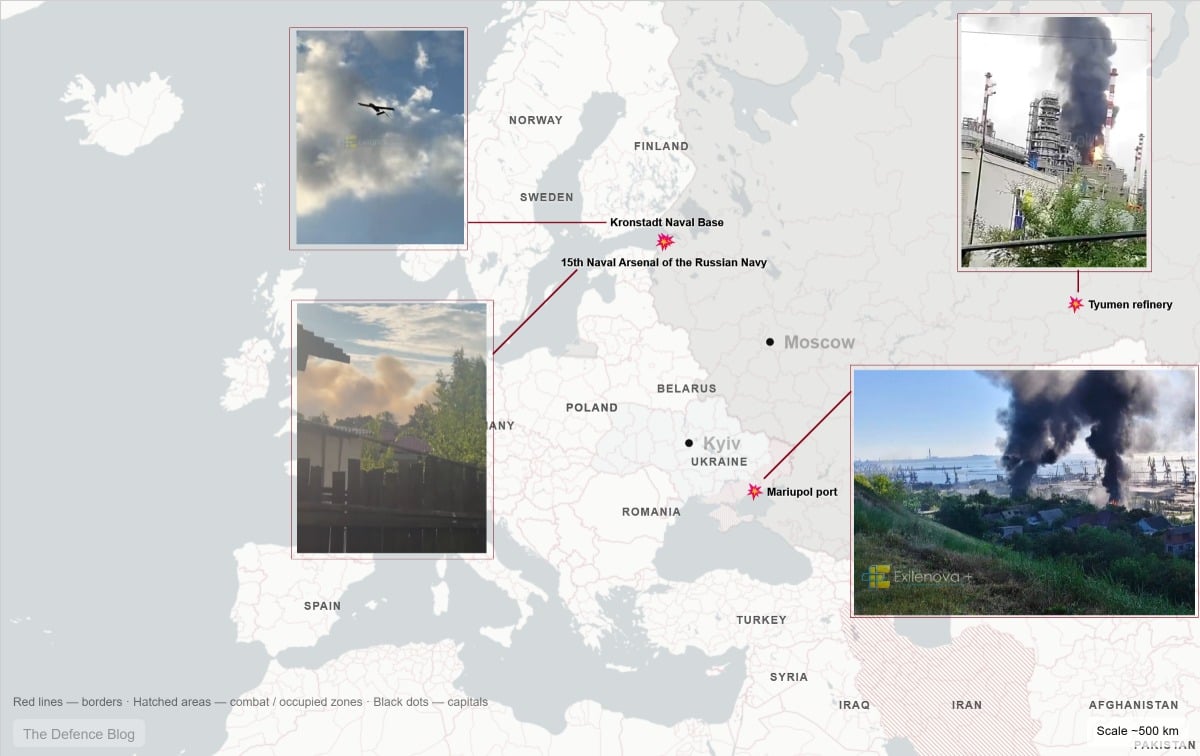
Ukraine launched one of its largest drone offensives of the war overnight into June 6, sending more than 400 unmanned aircraft deep into Russian territory and striking targets that included a naval weapons depot near Saint Petersburg, an oil refinery in Siberia, a port in Russian-occupied Mariupol, and munitions warehouses in the Leningrad region.
Russia’s Defense Ministry claimed its air defenses shot down 376 of the incoming drones, a figure that, if accurate, still left dozens reaching their intended targets across a geographic spread stretching from the Baltic coast to western Siberia.
The attacks came on the final day of the St. Petersburg International Economic Forum, Russia’s most prominent annual event for projecting economic strength and attracting foreign investment, held in the hometown of President Vladimir Putin. The forum, often described as Russia’s answer to the World Economic Forum in Davos, Switzerland, serves as a platform for the Kremlin to present an image of economic resilience and business normalcy despite three years of war and sweeping Western sanctions. Smoke visible from the Saint Petersburg area, reported by local residents on social media, provided an unwelcome backdrop to that message for the second consecutive day, following a June 3 attack in which Ukrainian drones struck the St. Petersburg oil terminal and set fire to the Russian guided-missile corvette Boikiy at the Kronstadt naval base.
The June 6 attack targeted the Kronstadt Marine Plant, a Russian naval shipyard located approximately 30 km (19 miles) west of Saint Petersburg on Kotlin Island in the Gulf of Finland, according to reports verified by the open-source intelligence community Exilenova+, which confirmed attack footage and photographs circulating on social media. The Kronstadt Marine Plant has served as a repair and maintenance facility for Russian Baltic Fleet vessels for decades, making it a legitimate military target under the laws of armed conflict. Its location within the broader Kronstadt naval complex, which also houses the 15th Naval Arsenal of the Russian Navy at Bolshaya Izhora in the Leningrad region, a strategic installation that stores, repairs, services, and disposes of naval munitions, torpedoes, and missile weapons for the Baltic Fleet, places the June 6 strikes in a coherent operational pattern aimed at degrading Russia’s Baltic naval logistics chain.
Exilenova+ verified reports of detonations at storage facilities in Bolshaya Izhora in the Leningrad region, consistent with secondary explosions typical of munitions warehouse strikes where stored warheads or propellants ignite after an initial impact. The 15th Naval Arsenal at that location is one of the Russian Navy’s most significant logistics nodes on the Baltic, and damage to its storage capacity would have direct implications for the operational readiness of Baltic Fleet vessels that depend on it for ordnance resupply and weapons maintenance.
In Tyumen, a major city in western Siberia approximately 2,000 km (1,243 miles) from the Ukrainian border, the Antipinsky Oil Refinery caught fire, according to reports corroborated by Exilenova Plus. The Antipinsky refinery is one of Russia’s largest privately owned petroleum processing facilities, with a design capacity exceeding 9 million tonnes of crude oil per year and production lines covering gasoline, diesel fuel, and other petroleum products for the Russian domestic market. Striking it requires drones capable of flying extraordinary distances, and the Antipinsky attack, if fully confirmed, would represent one of the deepest penetrations of Russian territory achieved by Ukrainian strike drones since the war began, underscoring the continuous improvement in range and navigation resilience that Ukraine’s drone program has demonstrated across four years of development under combat conditions.
In occupied Mariupol, the port complex on the Sea of Azov that Russia seized in May 2022 after a prolonged siege, Exilenova Plus verified strike footage and photographs showing attacks on port infrastructure. Mariupol’s port serves as a key logistics hub for Russian forces in southern Ukraine, handling supplies, equipment, and fuel moving to and from the front lines in the Donetsk region. Targeting it disrupts the rear-area supply chains that sustain Russian ground operations in one of the most active sectors of the entire front.
The scale and geographic distribution of the June 6 attack reflect a deliberate strategic logic that Ukraine has been refining throughout the war. Rather than concentrating drone strikes on a single high-value target, Ukrainian planners have learned to disperse simultaneous attacks across multiple regions, forcing Russia’s air defense network, which includes a finite number of interceptor missiles, electronic warfare assets, and scramble-capable fighter aircraft, to divide its attention and resources across a vast front. Russia’s claimed intercept figure of 376 drones, if accurate, required an enormous expenditure of air defense missiles in a single night, depleting stocks that take time and industrial capacity to replenish.
Russia’s Defense Ministry said air defenses downed 376 drones over Russia, with air raid alerts issued across multiple western Russian regions and occupied territories throughout the night, and explosions were reported in Tula Oblast and Sevastopol in occupied Crimea, suggesting that the geographic reach of the attack extended well beyond the confirmed strike locations. Moscow Mayor Sergey Sobyanin claimed that at least 12 drones were downed approaching the Russian capital, indicating that Ukraine directed elements of the overnight launch toward Moscow as well, maintaining pressure on Russian air defenses in the capital region simultaneously with strikes on targets hundreds of kilometers away.
The June 3 attack that preceded this one had already set a high threshold for the current campaign. Ukrainian President Volodymyr Zelenskyy confirmed that Ukrainian forces struck the St. Petersburg oil terminal, military facilities at the Kronstadt naval base including setting fire to the Russian guided-missile corvette Boikiy in dry dock, and a defense industry enterprise in the Tambov region, with Russia’s Defense Ministry claiming 354 drones were downed in that operation. Two mass drone attacks in three days, targeting overlapping strategic categories of naval infrastructure and energy production, points to a sustained operational campaign rather than opportunistic one-off strikes.
– Ukrainian drones have not only embarrassed Putin by spoiling his celebrations this year but also and more importantly called into question the long-standing assumption that Russia’s enormous size is an asset that represents “the ultimate guarantee of the state’s invulnerability,” Sergey Medvedev says.
In fact, the Radio Liberty commentator says, as the drone attacks have highlighted, “Russia’s immense territorial bulk … is transforming from an asset into a liability [because] it is virtually impossible to shield or defend” all of it (svoboda.org/a/drony-protiv-imperii-sergey-medvedev-o-territorialjnom-proklyatii/33771956.html).
Russia’s oil and gas infrastructure, its transportation routes, and its defense industries are all dispersed and all are now at risk, Medvedev says. Exclaves like Kaliningrad are even more so, but “even heavily protected areas like Moscow and St. Petersburg are no longer invulnerable.”
“As a result,” he continues, “we have a country burdened with excessive, unprofitable and indefensible territory which it can’t continue to drag further into the 21st century” and like the dinosaurs in the past, “Russia will not survive to the end of this century with its heavy and clumsy territorial body.”
https://windowoneurasia2.blogspot.com/2026/06/ukrainian-drones-transforming-russias.html
Ukraine is inviting its own destruction.
1st “Nobody cares” is a rediculus absolute, you don’t care, that is fine, but the fact that this person and myself do disproves your “nobody cares” assertion.
2nd Russia invaded Ukraine, twice and it is someone else who started the war😂, just like Poland stated WW eleven (🤣) by attacking poor innocent Nazi germany😎
Perfect Russian talking points, I will leave out my opinion of your intelligence 😂
Great news! A bad night for the vodka swillers. Taiwan better start massive drone production to hold back the ChiComs.
“Russia’s Defense Ministry claimed its air defenses shot down 376 of the incoming drones, a figure that, if accurate...”
Color me skeptical.
CC
Stay on Kiev for now, but make sure Crimea is next.
So throwing in your lot with corrupt midget Putin. All because he looks anti-globohomo.
“Russia’s immense territorial bulk … is transforming from an asset into a liability [because] it is virtually impossible to shield or defend” all of it.”
Frederick the great said that he who defends everything defends nothing.
CC
Did you forget the little details that Donbas is Ukrainian territory and that Russia seized it in 2104? It is Russia who started this war in 2014 with the seizure of Donbas and Crimea.
Clown, Ukraine did not start a war in Donbas before Russia’s seizure of Crimea in 2014. After 2014 Ukraine and Russian forces shelled each other in the Donbas region.
Eet ees special military operation.
Don’t call it a war, because that makes Dyadya Volvo very angry.
Mighty Ukraine can never be lost! Russia has lost its Mojo. Ukraine will humble them hard—with the help of Labor UK and general Stalmer.
NATO countries attacking Russia again. This won’t end well.
Disclaimer: Opinions posted on Free Republic are those of the individual posters and do not necessarily represent the opinion of Free Republic or its management. All materials posted herein are protected by copyright law and the exemption for fair use of copyrighted works.