Skip to comments.
Renewable energies overtook global electricity demand last year, led by solar growth in China, India
AP ^
| 21st April 2026
| Alexa St john
Posted on 04/21/2026 4:39:59 AM PDT by Cronos
Record growth in solar, especially in China and India, was a driving factor for clean energy sources surpassing the world’s strong demand for electricity in 2025, according to a new global power analysis.
Clean power generation grew 887 terawatt hours last year, exceeding overall global electricity demand growth of 849 terawatt hours, according to a report by energy think tank Ember, released after midnight Tuesday London time.
Ember analyzes electricity data from 215 countries, and studied 2025 data for 91 countries, which the firm says represents 93% of global demand.
Overall, the share of renewables — including solar, wind, hydropower and other clean energies — hit more than one-third of the world’s electricity mix for the first time in modern history last year, growing 33.8% to 10,730 terawatt hours.
..In another historical first, coal power saw its share fall below one-third of global generation, dropping 0.6% to 63 terawatt hours.
(Excerpt) Read more at apnews.com ...
TOPICS: Business/Economy; China
KEYWORDS:
Navigation: use the links below to view more comments.
first 1-20, 21-40, 41-53 next last
1
posted on
04/21/2026 4:39:59 AM PDT
by
Cronos
To: Cronos
Literally do not believe it. Also just how reliable was it?
2
posted on
04/21/2026 4:42:27 AM PDT
by
Skwor
To: Cronos
China and India! Hahahahahahaha!
3
posted on
04/21/2026 4:43:00 AM PDT
by
HYPOCRACY
(Wake up, smell the cat food in your bank account. )
To: Skwor
Check out both Ms. St. John and her reporting.
Nuff said.
4
posted on
04/21/2026 4:46:02 AM PDT
by
mewzilla
(Swing away, Mr. President, swing away! 🇺🇸 🏴)
To: HYPOCRACY
So it really won’t hurt China and India if their access to Iran’s oil is disrupted.
Right?
To: Fresh Wind
Correct. They can just build another dam and make some more solar panels. They got this...
6
posted on
04/21/2026 4:50:03 AM PDT
by
HYPOCRACY
(Wake up, smell the cat food in your bank account. )
To: Skwor; HYPOCRACY
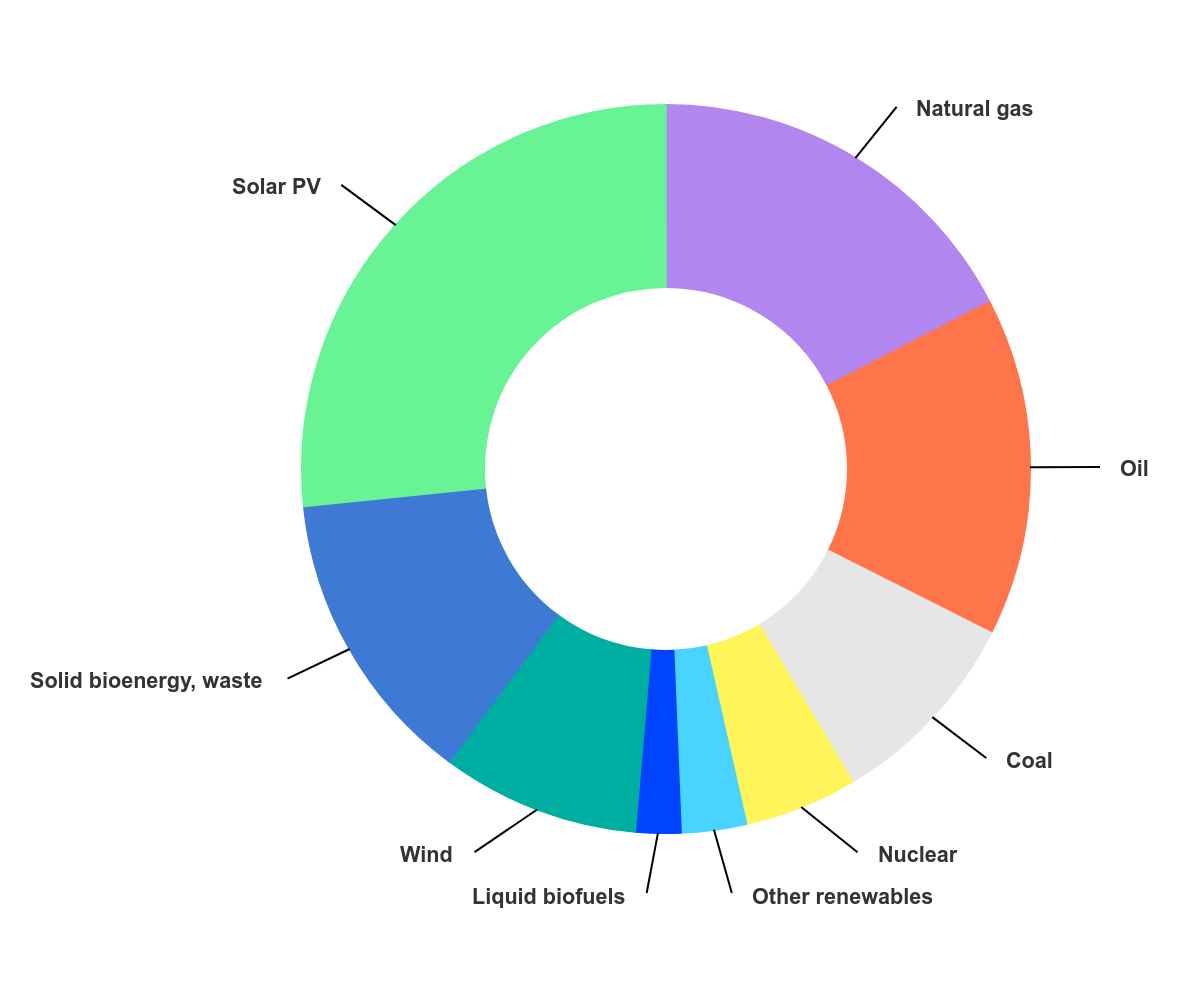
Solar remains closely followed by natural gas, which still accounts for 17% of all new growth but renewable sources and nuclear now meet nearly 60% of all growth in energy demand,
While overall energy demand continues to increase, demand for oil and gas slowed down markedly in 2025, global oil demand slowed to 0.65 million barrels per day (mb/d), half of the average rise seen over the past decade, with growing demand for EVs contributing to the slowdown.
Meanwhile, while demand for gas still increases, it is rising at much slower rates. In 2025, global demand for gas grew by 1%, compared to 2.4% in 2024, the IEA said, with demand from Asia and the Pacific dropping significantly.
While overall carbon emissions continue to rise, emerging markets have now hit a crucial turning point with emissions in China dropping for the first time, due to the nation's drastic rollout of renewables and structural declines in energy intensive industries, the IEA stated.
Similarly, India's energy-related CO2 emissions were flat for the first time since the 1970s, largely due to cyclical effects from a strong monsoon combined with structural growth in renewables.
In contrast, emissions in developed markets continued to increase, with US coal demand growing by 10% in 2025, driven by higher use in the electricity sector, which accounts for almost 90% of US coal consumption, the IEA said.
7
posted on
04/21/2026 4:50:26 AM PDT
by
Cronos
(Strange women lying in ponds distributing swords is no basis for a system of government.)
To: Cronos
No need to comment beyond noting “AP”.
Science is NOT their friend.
Nor is accuracy.
8
posted on
04/21/2026 4:50:55 AM PDT
by
Da Coyote
To: Fresh Wind
No, it will definitely hurt them.
The goal is to reduce dependency as one can’t fully eliminate it
9
posted on
04/21/2026 4:52:04 AM PDT
by
Cronos
(Strange women lying in ponds distributing swords is no basis for a system of government.)
To: Cronos
Check out the sponsors.
Ember is an energy think tank that aims to accelerate the clean energy transition with data and policy. Ember is the trading name of Ember Energy Research CIC, a Community Interest Company registered in England & Wales #06714443. ‘Ember’ is a trademark held at the United Kingdom and European Union Intellectual Property Offices. All content is released under a Creative Commons Attribution Licence (CC-BY-4.0). Website powered by 100% renewable electricity.
https://ember-energy.org/
10
posted on
04/21/2026 4:52:05 AM PDT
by
Libloather
(Why do climate change hoax deniers live in mansions on the beach?)
To: Cronos
AP, you just know everything they put out is slanted to the left.
11
posted on
04/21/2026 4:58:46 AM PDT
by
Rlsau1
To: Da Coyote
To: Skwor
It’s not dispatchable power, and much of the time it isn’t putting out as much as 25% of the rated capacity. Reliable grids require dispatchable power.
If this stuff were so easy to do, why isn’t there a demonstration project on a good sized island, using all wind and solar? That tells you everything you need to know.
13
posted on
04/21/2026 5:19:52 AM PDT
by
FreedomPoster
(Islam delenda est in )
To: Skwor
“Overtook demand ‘ is a weasel phrase. The article counts the rated capacity of renewables rather than what they typically produce which is only 25 percent of capacity - we call this “nighttime “
14
posted on
04/21/2026 5:20:44 AM PDT
by
brookwood
(First the left said it was OK to steal. Next they said it was OK to )
To: Cronos
This graph is the share of new installations . Solar and wind peoduce about 10 percent of global energy . Why the shilling?
15
posted on
04/21/2026 5:23:23 AM PDT
by
brookwood
(First the left said it was OK to steal. Next they said it was OK to )
Comment #16 Removed by Moderator
To: Fresh Wind
If India & China are happy, fine for them. However, I get a different picture for those “renewable energy” figures for most of the world & there are solid reasons for it as I understand. What about that big blackout they had in Spain due to “renewable energies”? There was a very good explanation for that on these pages not long ago. I understand that germany has also had it’s share of problems with :renewable energy” also. It’s just not suitable where large power sources are needed considering the extra expense.
It takes more than just a windmill or a solar collecter to furnish reliable 60cycle AC power.
17
posted on
04/21/2026 5:30:57 AM PDT
by
oldtech
To: brookwood; Oneder
the less oil they use, the less oil we use, the less power the middle eastern countries and Russia have.
18
posted on
04/21/2026 5:34:46 AM PDT
by
Cronos
(Strange women lying in ponds distributing swords is no basis for a system of government.)
To: Skwor
Maybe China can come get their windmills. We have to get rid of them somehow.
To: oldtech
on 28 April 2025, a series of rapid voltage spikes (“cascading overvoltages”) and oscillations in southwestern Spain triggered widespread disconnections of generators and transmission‑line protections, dropping some 31 GW of load in minutes
The Spanish grid operator, Red Eléctrica (now Redeia), and an ENTSO‑E expert panel found that bottlenecks, poor coordination of voltage/reactive‑power control, and failure of some traditional plants (gas, coal, nuclear) to stabilize the system were central to the collapse.
At the time of the blackout, solar provided about 59% and wind about 12% of Spain’s electricity, with nuclear and gas providing the rest;
grid‑operator data and technical reports show that renewable plants were disconnected automatically because of the grid disturbance, not because they created it.
Independent groups such as SolarPower Europe and the Spanish think tank Fundación Renovables stress that the blackout was a system‑stability and grid‑management failure, not proof that “renewable energy is unreliable” in simple terms.
In short, the big Spain blackout was not caused by renewable energy per se, but by a complex grid‑stability failure in a system that happens to have a very high share of solar and wind; the real lesson has been about grid design, voltage control, and better coordination between all generation types, not about scrapping renewables.
20
posted on
04/21/2026 5:37:24 AM PDT
by
Cronos
(Strange women lying in ponds distributing swords is no basis for a system of government.)
Navigation: use the links below to view more comments.
first 1-20, 21-40, 41-53 next last
Disclaimer:
Opinions posted on Free Republic are those of the individual
posters and do not necessarily represent the opinion of Free Republic or its
management. All materials posted herein are protected by copyright law and the
exemption for fair use of copyrighted works.
FreeRepublic.com is powered by software copyright 2000-2008 John Robinson