
Posted on 04/06/2026 10:51:31 AM PDT by Angelino97
Based on the CPI, inflation is relatively cool. Don't be fooled. It's much higher than advertised, and you can see it clearly if you look at the right data.
When talking heads on CNBC or Fox Business talk about inflation, they always reference the Consumer Price Index (CPI). This metric measures the price changes in a “basket of goods.” This gives a fair approximation of price inflation (although intentionally understated), but it doesn’t give us a good gauge on the trajectory of inflation as historically economically defined.
Inflation isn’t just “rising prices.” Historically, inflation was defined as an increase in the quantity of money and credit. In other words, inflation (properly defined) isn’t caused by “oil price shocks" or greedy corporations hiking prices. It is caused by money printing.
A generally rising price level is one symptom of this monetary inflation. This will be reflected by the CPI. However, rising consumer prices aren’t the only manifestation of this phenomenon. Monetary inflation also drives asset price inflation. Much of the stock market gain in recent years was due to inflation. This is also one of the reasons the price of gold keeps climbing.
The point is that it’s very important to distinguish between price inflation and monetary inflation. Mainstream financial pundits and many economists fail to do so, and it creates a great deal of confusion.
What Is the Real Inflation Rate?
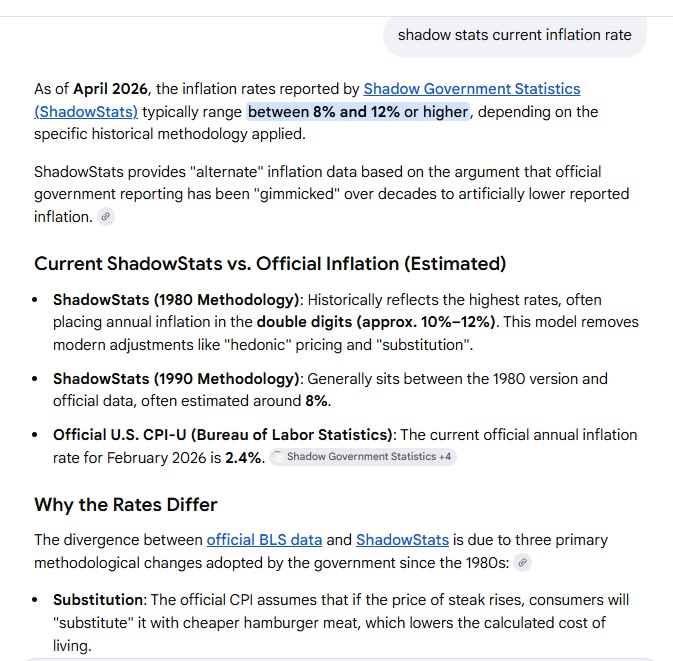
Based on the CPI, the annual inflation rate is currently 2.4 percent. Pundits call this the "inflation rate," but it really only tells us that the price of this government-created basket of goods has gone up 2.4 percent in the last 12 months.
This is viewed as only a slightly elevated "inflation rate," given the 2 percent goal. (Never forget that it is the stated policy to devalue your purchasing power by 2 percent every year.)
However, if we use the economic definition of inflation as an increase in the money supply, the inflation rate is much higher – double the CPI.
Based on the Fed’s M2 data, the money supply has increased from $21.61 trillion in February 2025 to $22.67 trillion in February 2026.
That represents a 4.9 percent increase.
In other words, we have an actual inflation rate of nearly 5 percent.
Inflation Is Heating Up
Based on the trajectory of the money supply, inflationary pressure is increasing, not abating (oil prices notwithstanding).
After peaking in April 2022, the money supply began to decline as the Fed hiked rates that year. The money supply bottomed in October 2023 and began increasing again. The money supply is now well above the pandemic peak.
And money creation has accelerated over the last several months. In fact, the money supply is growing at the fastest rate since July 2022, in the early stages of the tightening cycle.
This undercuts the notion that monetary policy is “tight.”
While it may be too tight for an economy dominated by a massive Debt Black Hole, it is not tight by historical standards, which is exactly why the money supply is increasing.
The Chicago Fed’s National Financial Conditions Index confirms this. As of the week ending March 20, the NFCI stood at -0.48. That negative number represents historically loose financial conditions.
Interestingly, the NFCI never went positive, even during the peak of the Fed’s tightening cycle.
We also see this loose monetary policy in the increase in the Fed’s balance sheet.
This reveals that the central bank has relaunched quantitative easing (QE). Although you will never hear the term “quantitative easing” uttered by any Fed official, the central bankers quietly resumed QE in December.
So, it is true that inflation is heating up. It has been for quite a while. But it’s not fundamentally about the Iran War or rising oil prices.
The conflict will undoubtedly increase prices on a wide range of goods and services. It will exacerbate economic pain. And it could tip the world into a recession. But even if the war ends tomorrow and oil prices crash, we’ll still have an inflation problem because the government will continue to print money.
In fact, if they can convince you that the inflation threat is over when the oil price drops, they’ll be able to crank up the inflation machine even higher.
After all, they’ll need to print more money to support the borrowing and spending necessary to fight this war (on top of all the other spending).
Don’t be tricked by rosy CPI prints and financial media talking heads. Watch the money supply and plan accordingly.
That has NEVER been the definition of inflation. The Quantity Theory of Money, MV=PQ, ties real output of the economic system (Q) to the money supply. Given that the velocity of money (V, or the rate that money "turns over" in the system) is virtually constant, it shows that inflation is tied to changes in the money supply (M, usually defined as M1 + M2) relative to changes in real output (Q). Your statement above is simply wrong. Indeed, the entire article is either wrong, or very misleading.
Inflation is an artificially created
phenomena.
Created by Government to increase it’s
power.
I own 5 acres of land. In Hawaii.
Its value has dramatically increased
over the last 25 years.
it has the same grass, the same soil,
the same bugs as it did 25 years ago,
but it’s taxable value has dramatically
increased.
The government gets more money.
I don’t get more services from
the government.
I hate Democrats.
The value of land is determined by how much someone will pay for it.
The value of money is determined by how much stuff people will give for an amount of money.
Value is subjective, not objective.
There is not a lot of privately owned land in Hawaii. The population of Hawaii has increased dramatically in 25 years, therefore it is likely there is a much higher demand for land now than there was 25 years ago.
So many ways to explain inflation. Young people don’t understand, because they haven’t experienced what us old-timers have seen over many decades.
We used to get by on a low sales tax for goods, maybe 3 or 4 percent. If a local gov’t is doing what they’re supposed to do, then 4 percent of increased price of purchases and retail activity should bring in enough funding. 4 percent of X dollars, where now it is 10 or 20 times X dollars. But no, the greedy bastards kept raising sales tax to where it is hovering around 10 percent. Same goes for state and federal gov’t, greed made them tax at ever higher percentages with tacked on fees and regulations.
Inflation is greed!
Yes, but if you sold your land, you would get more money than you would have 25 years ago.
That question has been asked for decades.
We discussed it in Econ classes in the 70s.
You and me both. I mumble that under my breath every day. I hate Democrats!
though loosely related, each variable can be independently manipulated by separate forces not part of that equation. Perhaps the most effective force not mentioned is Emotional: V is effected by emotional trefes that waft from consumption to saving. P can be driven by completion, scarcity, political initiatives, worldwide calm or strife, technology, Disaster , etc. Q can be driven by emotional rravtion to all the events that drive P and more. Each of those variables represents an extremely diverse collection of agents, and effects tha are difficult, perhaps impossible to manipulate on a coordinated economy-wide basis. Only 1: M has a singular point of control: The Fed. It is the only single point of direct economic pressure that moves the equilibrium of the equation to a new solution through a single, intrinsically valueless, entity: debt (its level and cost). So, yes, the money supply is indeed the most consequential, and perhaps the only independent variably in that equation.
Well, I could have presented the Saint Louis Fed model, but most readers might have problems solving its 375 simultaneous equations. I’ve used the St. Louis model, but only when teaching the graduate level monetary theory course. The Quantity Theory is a good starting point for intro macro economic discussions and most intro econ texts use it. The simpler version is better for the intro level and I think most readers here would be more comfortable with that. Also, M is not the only point of control in the equation. Just look at the Covid period if you think P doesn’t affect things. Ask yourself this: What happens in the near term if real output increases by 3% and M increases by the same amount. What happens to P?
But the people that work for the services provided get more money than they did 25 years ago.
How the heck do they pay for everything that cost’s so much more today?
I lived on Maui from ‘91 to 2013 so I’m familiar with what has happened with RE in the Island’s. I was finally able to pick-up a piece of land in 2008 but had to walk away from that when the market crashed a couple of years later.
I live in the Park City area now - talk about insane housing prices! I purchased a home in 2015 and it has increased by almost 2.5x.
Dump those Big Government, Damed-up, Golden Parachutes in the so called “market” into the economy, and watch what happens.
Inflation is here, plus termed in. ✖️
bump
At least one economics writer does not substitute CPI increase for inflation. CPI can be and annually is manipulated to keep it lower than reality. You can’t do that with the measure of actual inflation which is simply the increase in the money supply.Actually there can be increasing inflation even as prices in general go down if productivity increases faster than new money is “printed.”
What you ask, is again an absurd reduction. The impact on P depends on other factors besides M Timing is a key factor. The reasons Q increased are also factors. Q doesn’t increase in isolation.
But I’ll play:
If Q and M increase identically and simultaneously, then P depends on V. If the stimulus that increased Q and M is a response to disaster and people start hoarding goods, then both V and P will increase. If people start hoarding money, then V and P will both decrease. If there is no other consequential input the equilibrium would likely allow P to remain constant. That, of course demands an initial condition of equilibrium that is never true.
In that sec Ari however Q never increases independently ; but M can and often does.
I can remember 3% sales tax in Florida. I can also remember campaigns to raise the rate by claiming that as many more tourists are coming to Florida, the services must be expanded so the sales tax rate must be raised. But the tourists pay their own way by increasing purchases and thus providing more sales tax to the state by their being here.
Think again. V hasn’t changed much since the advent of credit cards. Also, I presented the question with two givens and V virtually constant for the last 30 years. I didn’t ask for what caused P and M to increase; just that it did. Given that, you don’t need to hedge your answer.
All in all, I do believe that M, controlled by the Fed is indeed the dominant, if not the primary source of all so-called “inflation”. It is the only truly independent variable and is controlled by a single source. Perhaps you might wish to respond to that context.
Disclaimer: Opinions posted on Free Republic are those of the individual posters and do not necessarily represent the opinion of Free Republic or its management. All materials posted herein are protected by copyright law and the exemption for fair use of copyrighted works.