Posted on 01/24/2026 8:06:15 PM PST by DoodleBob
When Christian Bryson needs quick weather information, like for this weekend's massive snowstorm, he doesn't wait for the 5 p.m. local newscast. Instead, he turns to Ryan Hall.
"It's as if he's sitting in the living room with you tracking the storm," said Bryson, a 21-year-old meteorology student at the University of Tennessee at Martin.
Hall, who goes by "Ryan Hall, Y'all" on his social media platforms, calls himself a "digital meteorologist" and "The Internet's Weather Man." His YouTube channel has over 3 million subscribers. Hall did not respond to a request to comment about his platform.
Hall is part of an increasingly popular genre of social media weather accounts that share information leading up to extreme weather, and then livestream for their viewers, sometimes for hours at a time. Overall, Hall offers solid information and is a good communicator with a few technical omissions, experts told NPR. But the weather genre online spans a wide range of sources — from amateurs with no science background to accredited meteorologists.
Experts say that while weather influencers can help fill an information gap, platforms like TikTok, Instagram, and X tend to prioritize engagement and likes over accuracy. That means extreme weather updates on social media are often sensationalized or lack context, says Gary Lackmann, a professor of atmospheric science at North Carolina State University.
"They're not going to the National Weather Service web page, they're just looking at what's in their feed," Lackmann said. "Once you start clicking on viral extreme weather stuff, then the algorithm is going to just feed you more and more."
Lackmann, who is also head of NC State's department of marine, earth and atmospheric sciences, said in 2024 during Hurricane Helene, a weather disaster that swamped western North Carolina, killing 108 people, he started to see more and more people getting their weather information from social media
He says that, in the face of extreme weather events, people need credible and authoritative sources such as the NWS.
But with social media, sometimes "you get some kid who wants to get a lot of shares and likes and be an influencer on social media," he said.
Matthew Cappucci, a senior meteorologist for the weather app MyRadar, has personal experience with both worlds. He worked for years at the Washington Post as a meteorologist, and now posts weather forecasts on the internet.
Cappucci said his success on Facebook, Instagram, and X shows how rapidly people are shifting from getting their weather information from traditional news outlets versus social media.
"Within two months, I was able to reach 60 million-plus people on social media, just on Facebook," Cappucci said
Bryson, the 21-year-old, said Hall and other credible weather influencers use language that non-meteorologists understand and they can share information at any time of the day.
"The fact that it's available at your fingertips," Bryson said. "I could go to Ryan Hall at 4 p.m. I'm eating my dinner and get the information that I need."
There are positives to having meteorologists and credible weather sources on social media, Lackmann said. He's seen local weather influencers in North Carolina help disperse information from official outlets.
"There's a real need for that kind of localization and personalization of weather information," Lackmann said.
Aaron Scott, an assistant professor of meteorology at the University of Tennessee at Martin, said digital meteorology, a relatively new certification program that encompasses all forms of digital media, has an important place in the new media landscape.
"People do trust them, and they have built rapport," Scott said. "Sometimes that can make the difference if someone's going to actually go take shelter from a tornado or not."
Scott's department at UT Martin is now offering a digital meteorology class dedicated to teaching students how to engage with an online audience.
Cappucci also sees the positives with his own content. Social media allows for more flexibility than on-air television, he said. He pushes back on climate misinformation or weather conspiracy theorists.
But all three experts interviewed by NPR see the downsides in the way social media algorithms push the most sensationalized — not always the most accurate — information to the forefront.
"The brightest colors, the most outlandish information will always get more following than actual truthful information," Cappucci said.
Cappucci said the ability to make increasing amounts of money on social media can also lead to inaccurate weather information.
"As TV viewership wanes and as salaries come down, it's easier to make up that money by posting crazy stuff online," Cappucci said.
Meteorologists use a number of different numerical models as they predict the possible outcomes of an extreme weather event. Because of this, people can "cherry-pick" one model and sensationalize a forecast, Lackmann said.
"You cry wolf too often, and people won't take proper precautions when there really is a high probability of an extreme event," Lackmann said.
Meteorologists and other weather professionals are grappling with how to navigate the new media landscape and prioritize accurate information, the experts said.
Cappucci said the ability to make increasing amounts of money on social media can also lead to inaccurate weather information.
"As TV viewership wanes and as salaries come down, it's easier to make up that money by posting crazy stuff online," Cappucci said.
Meteorologists use a number of different numerical models as they predict the possible outcomes of an extreme weather event. Because of this, people can "cherry-pick" one model and sensationalize a forecast, Lackmann said.
"You cry wolf too often, and people won't take proper precautions when there really is a high probability of an extreme event," Lackmann said.
Meteorologists and other weather professionals are grappling with how to navigate the new media landscape and prioritize accurate information, the experts said.
NWS has increased its social media presence, Lackmann said. Experts at the American Meteorological Society have discussed a social media certification that extends beyond the digital media certification currently available.
Scott said how the field will grapple with social media, and now AI-generated media, is "a huge question mark."
"That's the million-dollar question," Scott said. "How do we make it? Do we have some type of badging system where you're certified, you're not? Then, who decides that?"
The only weather influencer I looked at was Yanet Garcia.
Almost stopped reading at NPR.. then I saw the words ‘how much should we trust them’ ...
...
Trust in NPR? - 0
Trust in anything NPR questions whether to trust?- more than 0
Pre thread title, how does a individual influence the weather?
If we have people who can influence the weather, I say we pay them to make it better.
… and THAT settles THAT!
Who has done that for twenty years? You can go to the National Weather Service weather.gov. You can go to the Weather Channel with their naming every dew and wind. You can go to something like WeatherBug.
I don’t trust the global warming propagandists at the weather channel.
Is a “weather influencer” what we used to call The Medicine Man?
Or go to FR!

I can definitely feel a warm front coming on.
We watch 2 or 3 different YouTube weather guys: Ryan Hall, Max Velocity, and watch Michigan Storm Chasers (husband isn’t a fan). We prefer them. Even our local NOAA person is not as accurate.
NPR, are you feeling well? Is everything OK? You don’t seem like yourself today. You had 35 paragraphs about the weather but I saw no reference to climate apocalypse. Do you need a checkup from Dr. Mann and his hockey stick?
Excellent point.
I remember that.
Max Velocity
Every day es muy caliente.
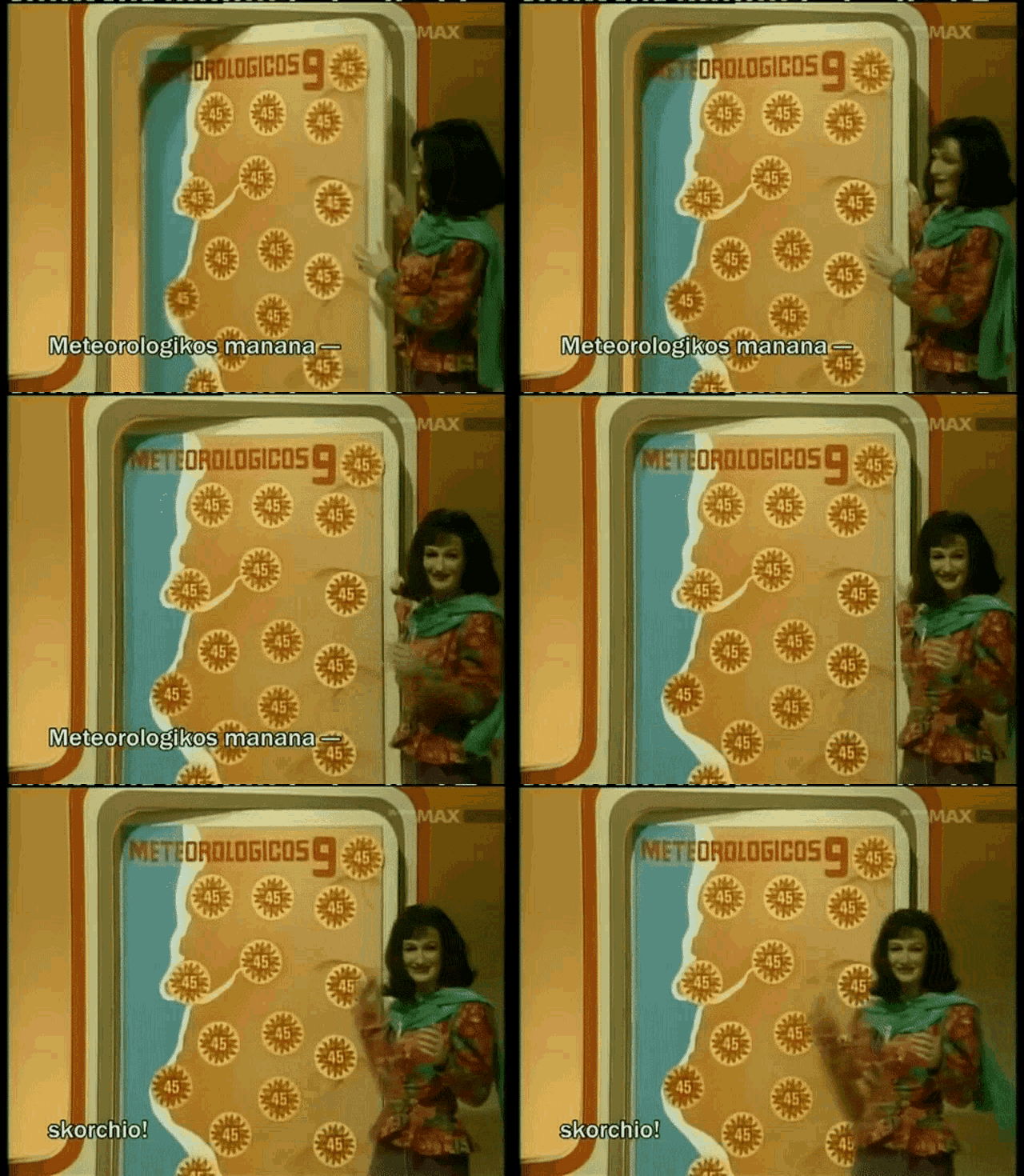
I see them as I pass the television in my house, and am alway amused by the guys who seem like they haven't got a masculine bone in their body, and women with big boobs wearing tight dresses.
But it is clear that weather reporters are completely alarmist in nature, and do it to get people to tune in (either with the alarmism or with the tight dresses)
To be fair-I never had the option of staying home when the weather got bad-I had to drive for four decades in the worst kind of ice and snow because of my job, so...I don't pay any attention to it.
Funny. MY wife is laser focused on the weather report two weeks out, and I get up, look out the window, and look at the thermometer, and that is my interest in weather.
I laughed aloud when I watched an interview with Bill Belichick about ten years ago, and he said this about the weather:

“When you play in New England, you have to be ready for everything. I’d say based on the forecasts we’ve gotten so far this year, none of them have been even very close to what game conditions were.
There was 100 percent chance of rain last week and the only water I saw was on the Gatorade table.
You know, it is what it is.
You know as well as I do, it could start one way and change during the game. we have to be ready for whatever it is, but my experience of going with the forecast in this area two days before the game, I mean I’d bet a lot that they’re wrong, just based on history because they’re almost always wrong. An hour before the game, maybe. You might have something to work with there.
I think if you start game planning for what the weather is going to be and you game plan wrong, you’ve wasted a lot of time. The forecasts are a bunch of hot air. Look, I’m not saying I could do it better than them, I’m just saying they’re wrong a lot.
That’s a fact. They’re wrong a lot.
We all make mistakes. I’m not being critical of them, I’m just saying I don’t think you can go based on that.”
Disclaimer: Opinions posted on Free Republic are those of the individual posters and do not necessarily represent the opinion of Free Republic or its management. All materials posted herein are protected by copyright law and the exemption for fair use of copyrighted works.