Skip to comments.
The Bidenization of the Dallas Cowboys
PJ Media ^
| 20 Nov 2024
| Scott Pinsker
Posted on 11/20/2024 2:31:01 PM PST by Rummyfan
Robert Bork really, truly wanted to be remembered as a great judge. And in 1987, he reached the apex of his career: President Ronald Reagan nominated him to succeed Justice Lewis Powell on the Supreme Court. He was so close! Alas, after his bitter, divisive (and ultimately unsuccessful) confirmation hearing, he became known for something else:
/bôrk/ (verb): To obstruct or oppose someone, particularly a candidate for public office by systematically defaming or vilifying them. “We must Bork that guy!” said the Democrat.
It’s unusual for a person’s name to be given the anthimeria treatment. (South Park’s “Faith Hilling” episode notwithstanding.) It’s a little more common in the world of corporate brands, where we Hoover-up information after Googling the answer, and then we send a Snap to our friends.
But it definitely happens. And not necessarily a verb either: Thomas Crapper and John Hancock were immortalized as nouns. (Thank goodness their names weren’t reversed, lest we’d be taking a crap on important documents and leaving our John Hancock in the toilet.)
Of course, the all-time WORST anthimeria victim was undoubtedly Aztec Emperor Moctezuma II, a.k.a. Montezuma — who went from the King of Kings of the New World to the namesake for traveler’s diarrhea. I’m 99% sure that’s not how he expected to be remembered.
(Excerpt) Read more at pjmedia.com ...
TOPICS: News/Current Events
KEYWORDS: nfl; sports
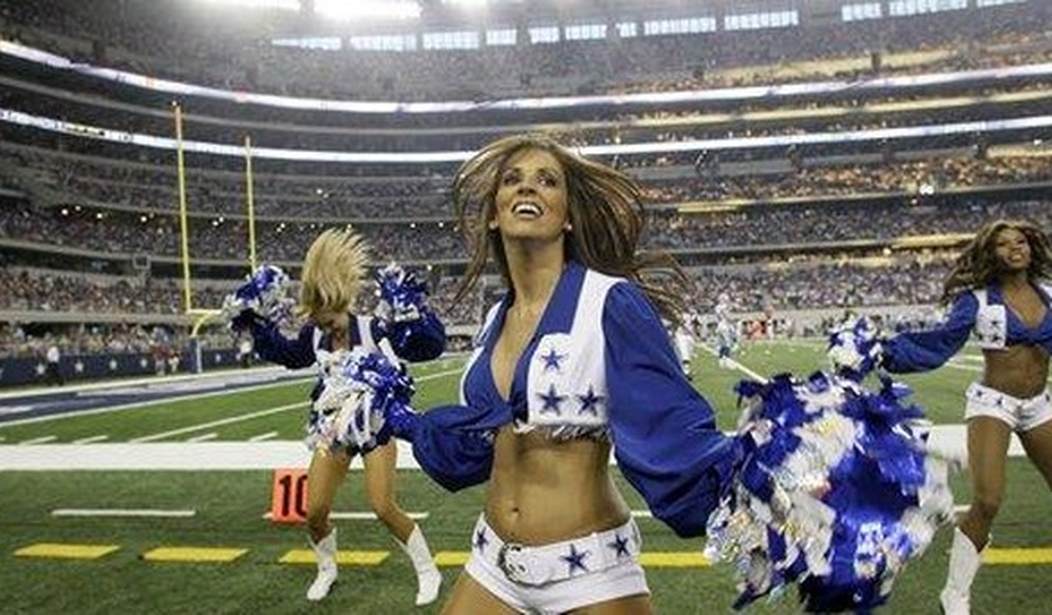
They still have the cheerleaders!
And that’s been the problem all along. Between Super Bowl I and Super Bowl XXX, the Cowboys appeared in 16 of the 30 NFC Championship games. Since then?
Nada. Nothing. Zilch.
It’s the Bidenization of the Dallas Cowboys.
1
posted on
11/20/2024 2:31:01 PM PST
by
Rummyfan
To: Rummyfan
I threw out Bidenized cheese this morning after it started getting green spots.
2
posted on
11/20/2024 2:35:28 PM PST
by
Tell It Right
(1 Thessalonians 5:21 -- Put everything to the test, hold fast to that which is true.)
To: Rummyfan
Jerry Jones needs to get rid of his GM, and put someone in there who knows football.
To: Rummyfan
How much does Jones meddle/involve himself in player decisions?
Everyone talks about the QB, and they’re certainly the highest paid member of every team - but Jones isn’t involving himself in decisions on choosing offensive linemen, cornerbacks, or defensive schemes and the like, is he?
4
posted on
11/20/2024 2:41:26 PM PST
by
PGR88
To: Tell It Right
Just scrape off the mold and it’s fine. Do not do this with green bologna, tho...!
5
posted on
11/20/2024 2:44:15 PM PST
by
citizen
(Political incrementalism is like compound interest for liberals - every little bit adds up.)
To: Rummyfan
Because the whole team, including Jerry Jones, knelt to protest the National Anthem, they should no longer be referred to as America’s Team. I always root for that team, and also the Washington Football Team, to lose.
6
posted on
11/20/2024 2:52:27 PM PST
by
Fiji Hill
To: Rummyfan
Elko Daily Free Press
July 31, 1996
Joseph Sobran
Judge Bork and the Tenth
WASHINGTON — Nearly a decade ago, the Senate rejected Judge Robert Bork’s nomination to the U.S. Supreme Court. He was defeated largely because he insisted that a primary test of the Constitution’s meaning is the “original intent” of its authors — an idea abhorrent to liberals, who prefer to treat the constitution as a malleable “living document.”
I’ve often wondered how Judge Bork would have ruled as Mr. Justice Bork. Nobody doubts that he would have lifted the court’s intellectual level. But he might have had his sharpest disagreements not with the court’s mundane liberals. but with its two keen conservatives. Antonin Scalia and Clarence Thomas.
Judge Bork has often dismissed what he once called “conservative nostalgia for the Tenth Amendment.” Justice Thomas in particular has insisted that the Tenth still demands serious consideration.
The Tenth is like no other provision of the Constitution. It says that the powers that aren’t delegated to the federal government belong to the states and the people.
Unlike, say, the clauses that authorize Congress to raise armies and coin money. the Tenth is not specific. It is comprehensive. It either means everything or it means nothing, because. unlike other clauses. it tells us how to interpret the rest of the Constitution.
The big battle over the Tenth occurred during the New Deal, when the Franklin Roosevelt administration wanted to expand federal power far beyond anything explicitly listed in the Constitution. Roosevelt’s troubles were over when his compliant court ruled in 1940 that the Tenth Amendment was no more than a “truism.” That is. it meant nothing. A couple of years later the court ruled that Congress’ power to regulate interstate commerce meant that it had the power to regulate — I paraphrase loosely — damn near everything.
In a recent TV interview, Judge Bork suggested that the Tenth is dead and gone. He said: “In Article I, Section 8 of the Constitution, [the framers] listed the powers of Congress, which were somewhat general, but definite enough. And in the Tenth Amendment they said they really meant it. that powers not granted remained with the states or with the people. That was a system that began to break down almost at once.”
He added: “I think the idea of enumerated powers through which the federal government is limited is an unrealistic idea and never had a chance of working .. The Tenth Amendment and the enumeration of the federal powers ... have become passé. The federal government has assumed plenary power, and it is too late to turn back.”
I hope he is wrong. But what if he is right?
If the Tenth was futile from the start, the implications are enormous. It means that the anti-federalists were right when they opposed ratifying the Constitution. They argued that the federal government, given the powers enumerated in the Constitution, would be so powerful that it could usurp any number of other powers never granted to it, and nobody would be able to stop it.
In other words, the Constitution would be unenforceable against the very government it was supposed to restrain. To put it another way, the Constitution itself doomed us to unconstitutional government!
It’s no answer to say that this is a democracy, and that if this is what the people want, so be it. The Constitution was supposed to protect us from pure majority rule.
What it comes to now is that the Constitution may be distorted by either majoritarian political pressures or the minoritarian eccentricities of a federal judiciary. The one thing it doesn’t do is define (and thereby limit) federal power.
What would the Tenth mean in practice? It would mean that a minority could challenge any law passed by Congress, and Congress would have to prove that it had the constitutional power to enact that law.
This was the clear “original intent” of those who wrote and ratified the Constitution, and the clear understanding of generations of American afterward. The borders of federal power were always disputed, but not the principle of enumerated powers. Now Judge Bork says that the principle itself is lost.
Just one question: So why pretend we have a constitution?
© Universal Press Syndicate
To: Rummyfan
It all began when the Jerry Richardson Carolina Panthers broke Michael Irvin’s collarbone.
8
posted on
11/20/2024 3:03:17 PM PST
by
HIDEK6
(God bless Donald Trump)
To: Fiji Hill
I vote for the Ravens to lose. Especially after they went to the UK, stood for the UK national anthem and kneeled for the US anthem.
The NFL is dead to me.
9
posted on
11/20/2024 3:20:55 PM PST
by
sauropod
("This is a time when people reveal themselves for who they are." James O'Keefe Ne supra crepidam)
To: Dalberg-Acton
Re Bork…we should all give a big THANK YOU TO TED KENNEDY for his Borking, possibly preventing a 4-5 loss in Heller, the ascent of the Collective Model, and the evisceration of the 2nd Amendment.
Oh, and possibly Dobbs/Roe's repeal, too.
Stick with me.
The Lifeguard of Chappaquiddick is largely responsible for the destruction of Robert Bork's SCOTUS candidacy. That slot was occupied by Justice Anthony Kennedy ultimately.
Justice Kennedy was a squish. But he DID side with the majority in Heller. That's big.
Ah, but what if Bork hadn't been Borked. Well...the truth is... Bork MAY have voted against Heller.
In Slouching Towards Gomorrah, Bork referred to the language of the Second Amendment as “somewhat ambiguous[].” In the same passage, he stated that “The Second Amendment was designed to allow states to defend themselves against a possibly tyrannical national government.”[4] While it is clear that Bork was opposed to gun control on policy grounds, it is not clear that he agreed that the Second Amendment conferred an individual right. In fact, Bork’s skepticism regarding the gun lobby’s advocacy of individual rights under the Second Amendment (shared by former Chief Justice Warren Burger) may have been the reason the National Rifle Association chose to remain neutral during Bork’s 1987 confirmation hearings. Moreover, Bork might have been reluctant to overrule (or distinguish into irrelevance) the arguably contrary precedent in United States v. Miller[5], which is what the majority in Heller did. It appears that Bork construed Miller the same way Justice Stevens’ dissent in Heller did: as ruling that the Second Amendment confers a collective, not an individual, right. The way he put it in Slouching Towards Gomorrah (12 years before Heller) was: “The Supreme Court has consistently ruled that there is no individual right to own a firearm.”
By blocking Bork and paving the way for Kennedy, Uncle Ted very possibly helped save the legality of the Individual Model.
It gets better.
Bork died in 2012 during Obama, thus guaranteeing a leftist nutjob tipping the scales to a 5-4 liberal SCOTUS until Ruth Buzzy Ginsberg died. That is a LOT of bad rulings.
It also means no Kavanaugh, and no 6-3 margin for Dobbs, Bruen, or EPA.
So Ted, you magnificent bastard, wherever you are, thank you for being a friend of the NRA. Oh, and Joseph Sobran was slime.
10
posted on
11/20/2024 3:31:17 PM PST
by
DoodleBob
(Gravity's waiting period is about 9.8 m/s² )
To: Rummyfan
It will take a decade for the Cowboys to get good enough to make it to the Super Bowl. That decade will not start until you see that the west wall curtains are closed on an afternoon game.
11
posted on
11/20/2024 3:33:29 PM PST
by
bosco24
To: Fiji Hill
America’s Team is whoever plays the Cowboys.
12
posted on
11/20/2024 3:34:20 PM PST
by
dfwgator
(Endut! Hoch Hech!)
To: dfwgator
My 2nd favorite team is whoever plays the Cowgirls.
13
posted on
11/20/2024 5:00:24 PM PST
by
cowboyusa
(YESHUA IS KING OF AMERICA, AND HE WILL HAVE NO OTHER GODS BEFORE HIM!)
To: Rummyfan
14
posted on
11/20/2024 5:01:51 PM PST
by
Liberty Valance
(Keep a Simple Manner for a Happy Life :o)
To: sauropod
I vote for the Ravens to lose. Especially after they went to the UK, stood for the UK national anthem and kneeled for the US anthem. Screw 'em. And I liked their name. "The Raven" by Edgar Allen Poe (1845) is, arguably, the second greatest poem to come out of Baltimore after "The Star-Spangled Banner."
Disclaimer:
Opinions posted on Free Republic are those of the individual
posters and do not necessarily represent the opinion of Free Republic or its
management. All materials posted herein are protected by copyright law and the
exemption for fair use of copyrighted works.
FreeRepublic.com is powered by software copyright 2000-2008 John Robinson