Skip to comments.
The Russia-Ukraine War: A Study in Analytic Failure
Center For Strategic & International Studies ^
| September 24, 2024
| Eliot A. Cohen and Phillips O'Brien
Posted on 10/06/2024 10:16:20 AM PDT by tlozo
Surprise occurs in many forms. Many think of it in terms of a surprise attack, but it occurs in other dimensions. The full-scale Russian invasion of Ukraine in 2022 is a good example: the attack was foreseen, but the immediate outcomes were astonishing. To use an old Soviet phrase, analysts misunderstood in fundamental ways the “correlation of forces.” Their judgments about Russian and Ukrainian military capacity were not merely off—they were wildly at variance with reality. And even more perplexing, leading and widely acknowledged experts misjudged with a degree of certainty that in retrospect is no less remarkable than the analytic failure itself.
Their misjudgment was not a case of normal error or exaggeration. The expert community grossly overestimated Russian military capabilities, dismissed the chances of Ukraine resisting effectively, and presented the likely outcome of the war as quick and decisive. This analytic failure also had policy implications. Pessimism about Ukraine’s chances restricted military support before February 24, 2022. For years, voices in the analytic community argued publicly against providing crucial military aid for Ukraine precisely because Russia was presumably so strong that a war between the two countries, particularly a conventional one, would be over too quickly for the aid to make a significant difference. Once the war began, some of Ukraine’s most important international friends hesitated to supply advanced weapons, in part out of the mistaken belief that Ukraine would prove unable to use them or would be overrun before it could deploy them effectively. Today, such hesitation remains, with Ukraine still lacking the weapons systems it needs to defeat Russia in its relentless effort to destroy Ukraine as a state. Thorough consideration of why responsible and expert analysts made egregious misjudgments is the best way to avoid a similar outcome in this part of the world or elsewhere. This report documents and explains a large, consequential failure.
TOPICS: Foreign Affairs; Russia; Ukraine
KEYWORDS: eliotacohen; militarygenius; phillipsobrien; russia; ukraine; war
Navigation: use the links below to view more comments.
first 1-20, 21-40, 41-58 next last
Conclusion: Remedies The analytic failure at the outset of the war rippled beyond the conflict. The initial estimates seem to have influenced the tentativeness with which the West armed Ukraine, holding back on advanced weapons systems in part based on the argument that the primitive Ukrainian military could not operate them successfully. Pessimism about Ukrainian chances, hesitation about reinforcing Ukrainian successes, and difficulty in seeing Russia’s true weaknesses were all hangovers from the initial failure, even though many analysts eventually adjusted to the reality of the situation. The Russia-Ukraine War: A Study in Analytic Failure | 50
The broader implications of the failure are even more important. It is striking how small the analytic community was that made the judgments that shaped public perceptions and, in some measure, government policy. These individuals, for the most part, had similar backgrounds—degrees in political science and experience almost exclusively in think tanks, along with occasional stints in the intelligence community. They were not historians and certainly not military historians. Few had field experience as soldiers. They were overwhelmingly “Russia military analysts” by trade and not experts on Ukraine, often accepting, at a tacit level, deep-seated Russian views about the unreality of Ukrainian nationhood. Their internal system was mutually supportive. They constantly approved citations of one another’s work and treated both the underlying uncertainty and commentary of those outside the community with a degree of disdain.
This was a recipe for what the pioneering social psychologist Irving L. Janis referred to as groupthink.164 Indeed, the analytic community exhibited many of the characteristics Janis noted: underestimation of the group’s susceptibility to error, stereotyped views, self-censorship of dissent and commitment to unanimity, and even “self-appointed mindguards” who enforced orthodoxy.165
Full Report: https://csis-website-prod.s3.amazonaws.com/s3fs-public/2024-09/240924_Cohen_Russia_Ukraine.pdf?VersionId=1YNnRnwS.6DkrwNcAkdb5Dbsfjclg0JR
1
posted on
10/06/2024 10:16:20 AM PDT
by
tlozo
To: tlozo
Wait, was this a “full scale invasion”? /s LOL
2
posted on
10/06/2024 10:21:41 AM PDT
by
DesertRhino
(2016 Star Wars, 2020 The Empire Strikes Back, 2024... RETURN OF THE JEDI. )
To: tlozo
The shock is going to be epic as Russia finishes off Ukraine.
3
posted on
10/06/2024 10:22:22 AM PDT
by
SaxxonWoods
(.You will suffer from one: The pain of discipline or the pain of regret. )
To: tlozo
Some recent FR offerings by Eliot A. Cohen:
Putin’s Regime Faces the Fate of His Kerch Strait Bridge
The Atlantic ^ | October 9, 2022
Trump's impending nomination means it's time for a third candidate
Washington Post ^ | May 3, 2016 | Eliot A. Cohen
Eliot appears to be a wrongbro.
4
posted on
10/06/2024 10:24:55 AM PDT
by
kiryandil
(Kraft durch Freude! - The Kamunist and The Walzrus )
To: tlozo
Good to see the truths finally surfacing. Post war analysis will be breathtaking.
Now, just who is going to be held responsible for this Ukie debacle? The historic damage done to the US can not be undone.
5
posted on
10/06/2024 10:27:32 AM PDT
by
delta7
To: SaxxonWoods
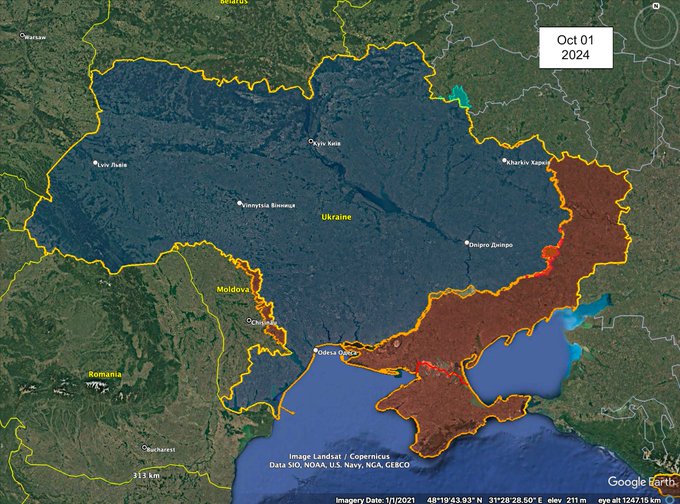
The shock is going to be epic as Russia finishes off Ukraine. During the last 12 months Russia achieved a net surplus in additional land by around 600 square kilometers (240 square miles), which is roughly 0.1% of Ukraine's total size.
Comparison of the land control between Ukraine and Russia. Left picture is October 2023, right October 2024.

6
posted on
10/06/2024 10:28:12 AM PDT
by
tlozo
(Russia is ruled by a psychologically deranged dictator and worst of all, it obediently follows)
To: SaxxonWoods
Have you noticed how small the land is that Russia has gained in 2 years? And compared to how much land Ukraine has gained in Russia puts Russia in the negative column.
7
posted on
10/06/2024 10:35:12 AM PDT
by
POGO163
To: tlozo
These individuals, for the most part, had similar backgrounds—degrees in political science and experience almost exclusively in think tanks, along with occasional stints in the intelligence community.
Not just these people, but Putin and presumably much of the Russian hierarchy believed it as well. But then, these Russian people are more akin to political scientists in analysis as opposed to real scientists are other technical people. At this point Putin needs to "finish off Ukraine" or else Russians and history will regard him as having been outsmarted and outmaneuvered by the West. That is his greatest fear.
To: tlozo
I see the usual suspects posting their Pro-PUkin comments.
The same as it ever was.
9
posted on
10/06/2024 10:37:42 AM PDT
by
SpeedyInTexas
(Defeat the Pro-RuZZia wing of the Republican Party)
To: Chad_the_Impaler
Maybe his greatest fear is he will shrink more as he ages. Eventually standing below 5 feet.
Maybe other stuff shrinking as well.
10
posted on
10/06/2024 10:40:43 AM PDT
by
SpeedyInTexas
(Defeat the Pro-RuZZia wing of the Republican Party)
To: DesertRhino
“Wait, was this a “full scale invasion”? /s LOL”
Yes, and to their credit, they put the Dog Whistle in the second sentence, so no need for non-Zeepers (those not wanting WW3) to read further.
On to Alex and Alexander to get some facts.
11
posted on
10/06/2024 10:40:45 AM PDT
by
BobL
To: tlozo
The real shock here is how the two sides* blundered into an idiotic repeat of WW1 - another meat grinder, with little being accomplished except death and destruction.
* I include NATO on the Ukraine side.
12
posted on
10/06/2024 10:45:01 AM PDT
by
Leaning Right
(The steal is real.)
To: tlozo
During the last 12 months Russia achieved a net surplus in additional land by around 600 square kilometers (240 square miles), which is roughly 0.1% of Ukraine's total size. Yes they are holding the new Russian lands very well.
To: BobL
Military Summary Channel and Weeb Union:
Kupiansk defence collapses.
14
posted on
10/06/2024 10:46:55 AM PDT
by
kiryandil
(Kraft durch Freude! - The Kamunist and The Walzrus )
To: tlozo
Did somebody get paid to write this?
It has about as much analysis as the label on a soup can.
15
posted on
10/06/2024 10:52:15 AM PDT
by
blueunicorn6
("A crack shot and a good dancer” )
To: kiryandil
“Kupiansk defence collapses.”
Nice!
16
posted on
10/06/2024 10:53:00 AM PDT
by
BobL
To: blueunicorn6
It has about as much analysis as the label on a soup can. Its a synopsis, full report (78 pages) is at:
https://csis-website-prod.s3.amazonaws.com/s3fs-public/2024-09/240924_Cohen_Russia_Ukraine.pdf?VersionId=1YNnRnwS.6DkrwNcAkdb5Dbsfjclg0JR
17
posted on
10/06/2024 10:55:44 AM PDT
by
tlozo
(Russia is ruled by a psychologically deranged dictator and worst of all, it obediently follows)
To: POGO163
Have you noticed how small the land is that Russia has gained in 2 years? While you focus on land gain/loss, Russia is achieving its stated goals.
Demilitarization ✅
Denazification ✅
To: delta7
The historic damage done to the US can not be undoneCould you elaborate?
19
posted on
10/06/2024 11:03:45 AM PDT
by
Jeff Chandler
(THE ISSUE IS NEVER THE ISSUE. THE REVOLUTION IS THE ISSUE.)
To: SaxxonWoods
The shock is going to be epic as Russia finishes off Ukraine.
Shock to who? Russia was supposed to finish off Ukraine inside a week, at minimal cost. That invasion was supposed to intimidate the West, and be highly profitable as energy shipments from newly-absorbed Donetsk and Luhansk were sold to a western Europe increasingly dependent on Russia. Energy.
That scenario has been blown completely to hell by Ukraine.
Instead, Russia has expended horrific amounts of men and material that cannot be replaced, lost the entire Nordstream 2 pipeline project, and spurred a European re-investment in alternative fuels so that they are less dependent on Russia moving forward. They also have suffered a strategic defeat by having the rest of the Nordic countries join NATO, because keeping Sweden and especially Finland out of NATO has been a cornerstone of Russian geopolitical strategy since the 50's.
No matter what happens from this point forward, this war has been a strategic disaster for Russia.
Navigation: use the links below to view more comments.
first 1-20, 21-40, 41-58 next last
Disclaimer:
Opinions posted on Free Republic are those of the individual
posters and do not necessarily represent the opinion of Free Republic or its
management. All materials posted herein are protected by copyright law and the
exemption for fair use of copyrighted works.
FreeRepublic.com is powered by software copyright 2000-2008 John Robinson