Posted on 05/06/2022 4:48:01 AM PDT by tlozo
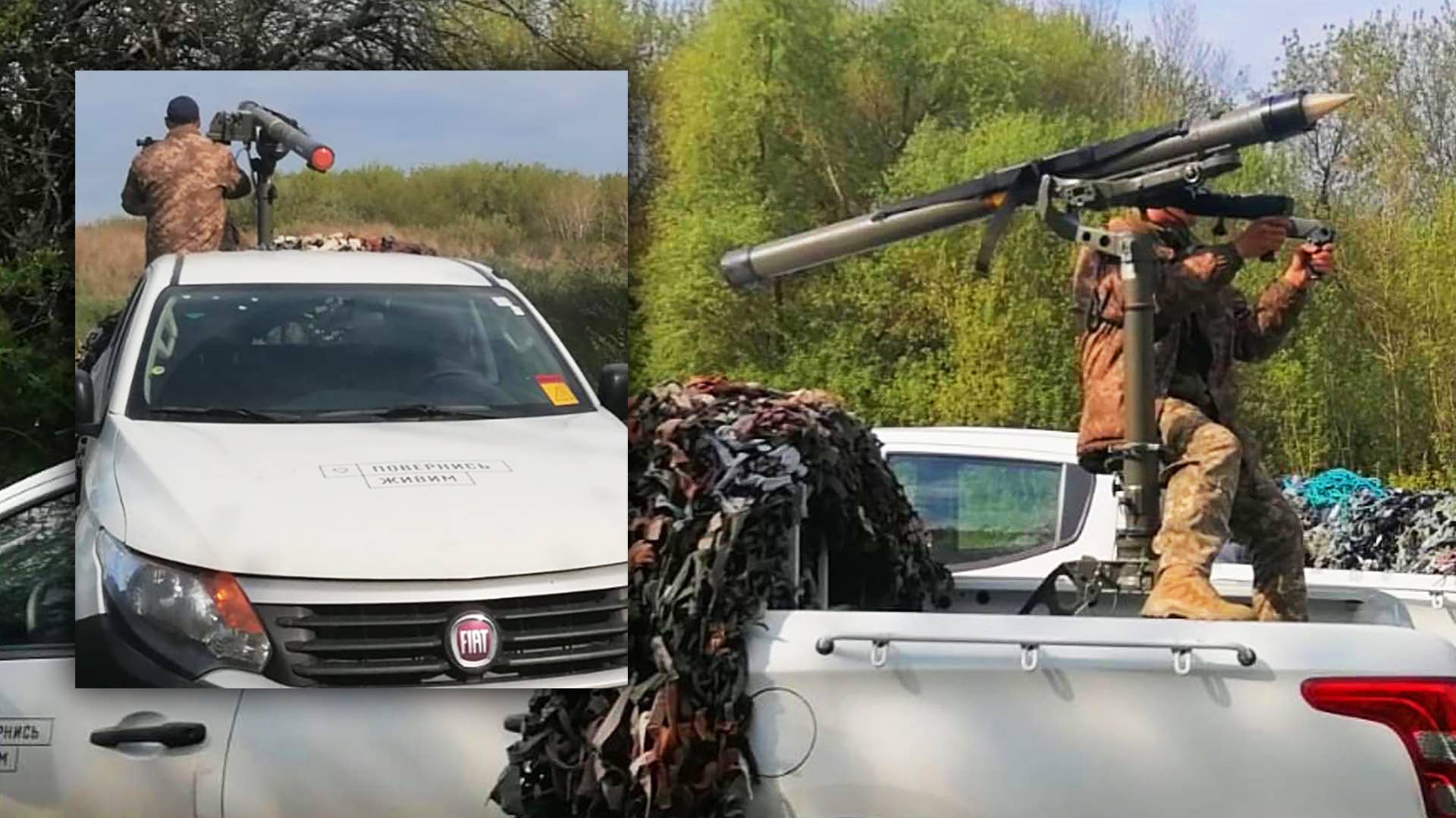
Norway’s recent donation of Mistral man-portable air defense systems, or MANPADS, including at least 100 missiles and an unspecified number of launchers, have made it to Ukraine. Now, thanks to an additional donation of an undisclosed amount of Fiat Fullback 4x4 pickup trucks from the Ukraine-based Come Back Alive foundation, some of those Mistral systems are now road-mobile.
The Come Back Alive foundation is a crowdfunded Ukrainian non-governmental organization founded by Vitaliy Deyneg in 2014 after Russia seized Crimea. The foundation then began supporting Ukrainian forces by fundraising money to deliver supplies and technologies ranging from bulletproof vests to thermal optics.
With the delivery of the Fiat Fullbacks, Come Back Alive hopes to promote the implementation of ‘mobile fire groups’ equipped with the French-made Mistrals to help address the looming aerial threat posed by Russian forces.
The MBDA-produced Mistral is a heat-seeking, short-range MANPADS ideal for use against aerial targets like unmanned aerial vehicles, or UAVs, as well as fixed-wing and rotary-wing aircraft. The Mistral missiles Norway donated actually came from the country’s Navy, but they were supplied from portable seated launch systems that could be used on land. Considering they are not quite as mobile as other MANPADS, this likely prompted their installation in the beds of pickup trucks, turning them into something akin to technical-based SAM systems.
“Mobile fire groups with MANPADS and ATGMs must be fast.” Andriy Rymaruk, head of the foundation’s military department said in the Facebook post. “They are destroying enemy drones and helicopters, and in the future, they will also cover the Russian fighter jets. They are working, in particular, with Stingers and 9K38 Igla systems. And this kind of work really needs mobility. That’s why we are donating new, not used, vehicles to those groups. These vehicles are serviceable and fast, and could assist in hitting the moving targets.”
The foundation posted photos of the Fullback-mounted Mistrals to Facebook, with the caption reading that Valery Zaluzhny, commander-in-chief of the Ukrainian Armed Forces, has claimed that the Mistrals have aided Ukrainian forces in taking down 20 Russian UAVs worth a total of $20 million. However, both numbers are unverified and have likely changed since the day of posting.
For perspective, the Facebook post goes on to explain that Russia’s ZALA drones and Orlan reconnaissance drones were among the UAVs shot down by these mobile fire groups, with a single Orlan-10 drone costing between $80,000 and $120,000 depending on the configuration.
The photos depict at least two white Fiat Fullbacks, the hoods adorned with the Come Back Alive foundation logo. In the beds of the trucks are the Mistral MANPADS launchers with camouflage netting strewn about in an attempt to obscure them from view. The added mobility of the Fiat Fullback paired with the camouflage shown has the potential to increase survivability and caters to the ‘shoot-and-scoot’ tactics that Ukrainian forces are becoming notorious for.
MANPADs have been pivotal in Ukrainian air defense efforts. Deliveries have been flooding in from numerous countries, making it so Ukrainian forces now have the most extensive and diverse MANPADS arsenal on the planet.
As exemplified by the Come Back Alive foundation’s role in delivering the Fiat Fullbacks that are mobilizing the Mistral systems, the donation underscores a unique and sometimes bizarre wartime relationship between the Ukrainian government and private entities. With the help of social media, the Ukrainian Armed Forces and its supporters have managed to launch crowdfunding campaigns to pay for the assets they need and may not otherwise receive.
An entrepreneurial campaign made popular by the hashtag #buymeafighterjet was launched by Ukrainian forces, the Czech government relied on crowdfunding to send weapons to Ukraine, and the Ukrainian embassy in Prague did the same shortly after Russia’s invasion began.
Civilian donations have become a fascinating aspect of Ukraine's wartime efforts, and without them, at least in this case, one of the drawbacks of the Mistral system, its more cumbersome primary deployment method, might not have been turned into an advantage.
They might want to paint those trucks another color.
L
MacGyver must be advising the Ukrainians.
They blend in to the snow though.
These were called technicals when the Somalians mounted 50 cal. guns on the back of Toyotas 30 years ago. Me friends and I had some good laughs over their ingeniousness. Out of a Mad Max Road Warrior scenario.
https://en.wikipedia.org/wiki/Technical_(vehicle)
“They might want to paint those trucks another color.”
For the summer, anyway.
ISIS and Al-Qaeda had lots of vehicles like this which we destroyed.
Yea only in winter ..
Interesting:
Who Would Have Guessed That Every Major Politician Who Has Visited Ukraine In 2022 Is A Member Of The World Economic Forum ?
Since February 2022, with the abrupt termination of all things Covid, Ukraine took over the spotlight. What is highly unusual about the Ukraine/Russia conflict is the amount of foreign politicians who have flown into Ukraine to witness the devastation first-hand. In years gone by they would have stayed at home, watching from the safety of the sidelines.
But let’s have a look at who has paid President Zelenskyy a visit.
https://threadsirish.substack.com/p/who-would-have-guessed-that-every?s=r
“ISIS and Al-Qaeda had lots of vehicles like this which we destroyed.”
The Russkie air force is a dud. And you know why. Too much theivery by Generals and others on down the line.

You know the Trilateral’s are getting jealous. No one pays them attention anymore.

A Man
A Plan
MANPAD
I disagree with that even if its true. There are numerous techniques that can be used to both surveil and attack.
We destroyed them in all seasons.
Another thing Ukrainians did was turn ancient anti-tank grenades into a potent weapon by 3-d printing tail-fins and dropping them from commercial toy drones.
https://www.rferl.org/a/ukraine-cheap-grenades-expensive-tanks/31835434.html
The RKG-3 (pictured) is an anti-tank grenade designed in the Soviet Union that was first introduced in 1950. The weapon is the size and weight of a slender bottle of wine and made to be thrown by hand at enemy armored vehicles.
The grenade contains a drogue parachute (visible at right inside this museum cutout), that springs out when thrown to ensure the grenade hits the target fuze-first.
On impact, the RKG-3 detonates a shaped charge (demonstrated in yellow in this cutout) that fires a hypersonic slug of copper with enough force to penetrate more than 20 centimeters of armor.
The burst of superheated metal into the interior of tanks can sometimes lead to “catastrophic” explosions of the ammunition inside.
Although remarkably effective on impact, the RKG-3 required near-suicidal proximity to enemy vehicles, and when rocket-propelled Soviet anti-tank weapons such as the RPG-7 entered service in the 1960s, fighters were able to hit enemy armor from hundreds of meters away. The risky, hand-thrown RKG-3 became largely obsolete.
LOL!
Time will tell my anti-Ukie friend
“You know the Trilateral’s are getting jealous. No one pays them attention anymore.”
FWIW I have heard no mention of the Trilateral Commission in 30 years. The WEF is what is happening now with Uncle Klaus.
Disclaimer: Opinions posted on Free Republic are those of the individual posters and do not necessarily represent the opinion of Free Republic or its management. All materials posted herein are protected by copyright law and the exemption for fair use of copyrighted works.