Posted on 12/29/2021 3:57:07 AM PST by tlozo
Ukraine's acquisition and subsequent use of the Turkish Bayraktar TB2 has been a cause of significant concern for separatist forces in Eastern Ukraine, and for Russia, which has provided the Donetsk People's Republic (DNR) and Luhansk People's Republic (LPR) with extensive military support. Although separatist forces in Eastern Ukraine operate significant numbers of anti-aircraft (AA) guns and surface-to-air missile (SAM) systems supplied by Russia, including the 9K33 Osa-AKM (NATO designation: SA-8) and the 9K35 Strela-10 (SA-13), these lack the range to target UCAVs like the Bayraktar TB2 flying overhead at some 5000 metres.
Yet one would be mistaken in thinking the separatists' air defences are solely made up of short-range SAM systems, with a number of Russian electronic warfare (EW) systems like the Krasukha-2 and Repellent-1 deployed to Eastern Ukraine meant to fill in the gaps. [1] However, given the lack of success of even Russia's most modern EW systems in combatting the TB2 over Nagorno-Karabakh while in service with the Armenian Army, there is currently little reason to suggest that these would present a grave danger to the operations of the TB2 over any part of Ukraine. [2]
In the case of a future escalation in Eastern Ukraine, Russia could deploy its own SAM systems to the region. In 2014 Russia already deployed Pantsir-S1s, Tor-M1s and Buk-M1s to Eastern Ukraine to provide an air defence umbrella for separatist forces, which were frequently being targeted by Ukrainian Su-24s and Su-25s. [3] Whilst they managed to shoot down several aircraft, more advanced iterations of these same systems proved little able against drones in Syria, Libya and Nagorno-Karabakh. The challenge Russia is facing is thus not only that the air defence and EW systems currently deployed in Eastern Ukraine will likely prove incapable of halting operations of the TB2, but also that its more modern systems could have equal difficulty in combatting UCAVs like the TB2. Russia for its part maintains two public positions that couldn't be more contradictory. On the one hand, the delivery of Bayraktar TB2s to Ukraine has stirred fury in Moscow, which claims that "the deliveries of such armament [i.e. TB2s] to the Ukrainian military may potentially destabilize the situation at the engagement line". [4] On the other hand Moscow has frequently tried to downplay the success of the TB2, arguing that the system can be countered with the air defence systems currently present in separatist-held areas of Eastern Ukraine. [5]
In an interview with Russian state television, the deputy chief of the Anti-Aircraft Missile Troops of the Russian Aerospace Forces Colonel Yuri Muravkin argued that Bayraktar TB2 drones are in fact easy targets for air defence systems, stating that the "Bayraktar [TB2] has such high-speed and mass-dimensional characteristics that it is not difficult to shoot down a drone even for an average-skilled crew", also claiming that Pantsir-S1s deployed in Syria and Libya managed to shoot down more than 40 Bayraktar TB2 and TAI Ankas (visual evidence only supports the loss of 19 TB2s and Ankas over Libya and Syria). [6]
Colonel Yuri Muravkin would go on to state that the Bayraktar TB2 "is a very light target, very tasty for Pantsir". [7] In an effort to explain the visually confirmed destruction of eleven Pantsir-S1s in Syria and Libya, Muravkin explained that the systems in question were not active, or were otherwise unattended by military personnel. [7] This is demonstrably untrue, and statements like these are likely aimed at pleasing a domestic audience. [8] In reality, Russia has to come up with different solutions to effectively counter UCAVs like the TB2s after witnessing their ability to take on most of the air defence systems Russia can muster, including the Pantsir-S1, Tor-M2 and Buk-M2 (although the destruction of the Buk-M2 by TB2s can't yet be visually confirmed). [9]
It's been common for Russia to downplay the success of opposing weapons systems and to inflate the successes of its own military equipment. When the United States, France, and the United Kingdom carried out a series of cruise missile strikes in April 2018 in retaliation for the Douma chemical attack, Russia claimed that Syrian air defences managed to intercept 71 of the 103 missiles fired. [10] Nonetheless, it failed to show the wreckage of even one missile despite obviously having the incentive to do so. [10] The U.S. maintained that all of its missiles had successfully hit their intended targets while acknowledging that Syrian air defences fired 40 missiles at them in vain. [11] Interestingly, most of the missiles were fired after the last cruise missiles had struck their targets. [11]
Arguably even less impressive was the performance of Russian electronic warfare systems (EW) on the side of Armenia during the 2020 Nagorno-Karabakh War. Armenian Prime Minister Nikol Pashinyan voiced sharp criticism about an EW system that had just been acquired from Russia – believed to have been the Repellent-1 – stating that "it simply did not work". [12] While such instances might be countered with claims that the systems used were of an older version or that their crews were improperly trained (mirroring other Russian statements to explain losses of its air defence systems in service with other countries), the EW systems used by Armenia are in fact currently the most modern systems on offer by Russia.
Both Russia and analysts unaccustomed to the reality of modern conflicts make frequent attempts to downplay the success and potential of the Bayraktar TB2 in the face of even the most modern air defence and EW systems. Yet the threat posed by such systems is very real: operations over Syria, Libya and Nagorno-Karabakh have casted serious doubt on the ability of modern air defence systems to counter or even significantly hinder operations of UCAVs. It's not unlikely the same scenario could play out over Eastern Ukraine, and only the massive influx of air defence systems or even fighter aircraft would do much to upset the significant shift in capabilities that is occurring. Hopefully however, cooler heads will prevail and prevent a Russo-Ukrainian War from ever reaching such a point.
Russian surface-to-air missile (SAM) systems successfully destroyed by Bayraktar TB2s (37)
1 2K11 Krug ''SA-4'': (1)
17 9K33 Osa ''SA-8'': (1) (2) (3) (4) (5) (6) (7) (8) (9) (10) (11) (12) (13) (14) (15) (16) (17, destroyed by TB2 and loitering munition)
3 9K35 Strela-10 ''SA-13'': (1) (2) (3)
2 S-300PS ''SA-10'': (1 and 2, destroyed by TB2 and ground-launched guided munition)
1 Tor-M2KM ''SA-15'': (1, destroyed by TB2 and loitering munition)
2 Pantsir-S1 ''SA-22'': (1) (2)
2 2K12 Kub ''SA-6'': (1) (2)
7 Pantsir-S1 ''SA-22'': (1) (2) (3) (4) (5) (6) (7)
1 Pantsir-S1 ''SA-22'': (1)
1 Pantsir-S1 ''SA-22'': (1)
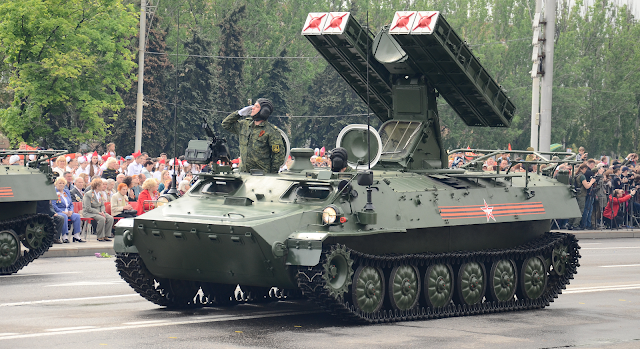
A 9K35 Strela-10 (SA-13) in Donetsk, May 2019. Just like the 9K33s these were also supplied by Russia.
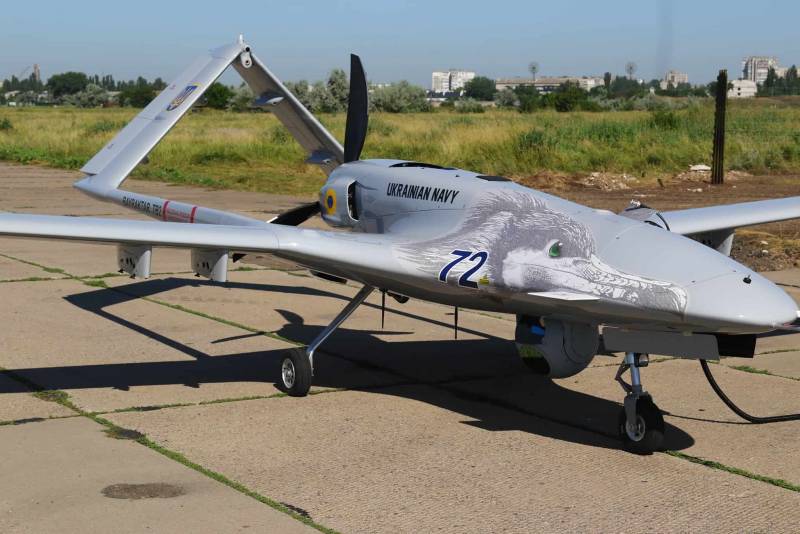
I want one.
CORRECTED VERSION
Ukrainian Symbols:
Trident- a golden trident on a blue shield. In the times of Kyiv Rus, the trident was the symbol of Rurik dynasty. The archaeologists have found tridents on coins, stamps, crockery, brickwork and wall paintings of that period. Prince Volodymyr (980—1015) minted coins with the trident on one side and portrait of the ruler on the other one.
The first mentioning of trident as the official national symbol of Ukraine dates back to 1918 – the times of the Ukrainian People`s Republic. The Central Council of Ukraine declared that trident embodied the princes` rule and succession of Ukrainian state traditions. However, in 1918, the Central Council of Ukraine was superseded by the Bolsheviks. During the Soviet era, Ukrainian trident was officially discredited as a symbol of national liberation movement. Ukraine was assigned a traditional Soviet emblem of star, hammer and sickle.
Only in February 1992, after dissolution of the Soviet Union, Verkhovna Rada of Ukraine approved trident as the official emblem of the independent Ukraine. As for the meaning of Ukrainian “tryzub” symbol, has encrypted word “воля” (“freedom”) and that it symbolizes the Christian Trinity.
Ukrainian Flag
In 1917—1921, the yellow and blue flag served as an official symbol of the Ukrainian People`s Republic and Ukrainian State. During the Soviet era, the yellow and blue flag could be used only secretly, because the USSR government prohibited it as a sign of nationalism. The usage of that flag during the Soviet period was considered as a crime and carried a prison sentence.
On September 18, 1991 after the USSR dissolved, the presidium of Verkhovna Rada gave yellow and blue flag the status of Ukrainian national symbol.
Today, Ukrainians annually celebrate the Day of National Flag on August 23rd. The meaning of the flag`s colors is quite simple: blue color symbolizes the sky, and yellow color embodies ears of wheat on fertile lands of Ukraine. .
These drones carved up the Armenian side using Russian tech in their war last year.
The barriers to entry for this stuff are dropping fast. It will be interesting to see how it plays out in the future. I hope we can keep one step ahead of it.
Disclaimer: Opinions posted on Free Republic are those of the individual posters and do not necessarily represent the opinion of Free Republic or its management. All materials posted herein are protected by copyright law and the exemption for fair use of copyrighted works.