Posted on 11/17/2021 2:41:39 PM PST by george76
With inflation running at over 6 percent and interest rates on savings near zero, the Federal Reserve is delivering a negative 6 percent real (inflation-adjusted) return on trillions of dollars in savings. This is effectively expropriating American savers’ nest eggs at the rate of 6 percent a year. It is not only a problem in 2021, however, but an ongoing monetary policy problem of long standing. The Fed has been delivering negative real returns on savings for more than a decade. It should be discussing with the legislature what it thinks about this outcome and its impacts on savers.
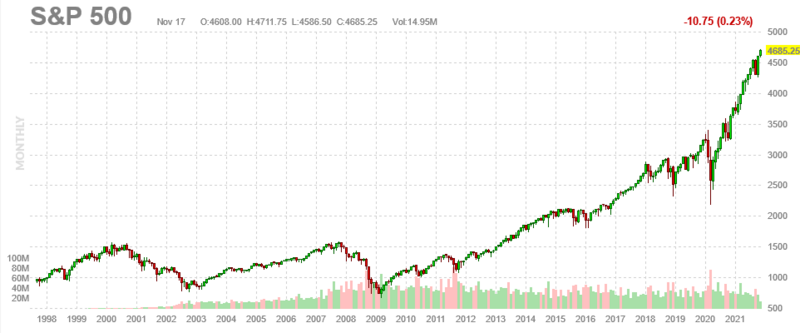
The effects of central bank monetary actions pervade society and transfer wealth among various groups of people—a political action. Monetary policies can cause consumer price inflations, like we now have, and asset price inflations, like those we have in equities, bonds, houses, and cryptocurrencies. They can feed bubbles, which turn into busts. They can by negative real yields push savers into equities, junk bonds, houses, and cryptocurrencies, temporarily inflating prices further while substantially increasing risk. They can take money away from conservative savers to subsidize leveraged speculators, thus encouraging speculation. They can transfer wealth from the people to the government by the inflation tax. They can punish thrift, prudence, and self-reliance.
Savings are essential to long-term economic progress and to personal and family financial well-being and responsibility. However, the Federal Reserve’s policies, and those of the government in general, have subsidized and emphasized the expansion of debt, and unfortunately appear to have forgotten savings. The original theorists of the savings and loan movement, to their credit, were clear that first you had “savings,” to make possible the “loans.” Our current unbalanced policy could be described, instead of “savings and loans,” as “loans and loans.”
As one immediate step, Congress should require the Federal Reserve to provide a formal savers impact analysis as a regular part of its Humphrey-Hawkins reports on monetary policy and targets. This savers impact analysis should quantify, discuss, and project for the future the effects of the Fed’s policies on savings and savers, so that these effects can be explicitly and fairly considered along with the other relevant factors. The critical questions include: What impact is Fed monetary policy having on savers? Who is affected? How will the Fed’s plans for monetary policy affect savings and savers going forward?
Consumer price inflation year over year as of October 2021 is running, as we are painfully aware, at 6.2 percent. For the ten months of 2021 year-to-date, the pace is even worse than that—an annualized inflation rate of 7.5 percent.
Facing that inflation, what yields are savers of all kinds, but notably including retired people and savers of modest means, getting on their savings? Basically nothing. According to the Federal Deposit Insurance Corporation’s October 18, 2021, national interest rate report, the national average interest rate on savings account was a trivial 0.06 percent. On money market deposit accounts, it was 0.08 percent; on three-month certificates of deposit, 0.06 percent; on six-month CDs, 0.09 percent; on six-month Treasury bills, 0.05 percent; and if you committed your money out to five years, a majestic CD rate of 0.27 percent.
I estimate, as shown in the table below, that monetary policy since 2008 has cost American savers about $4 trillion. The table assumes savers can invest in six-month Treasury bills, then subtracts from their average interest rate the matching inflation rate, giving the real interest rate to the savers. This is on average quite negative for these years. I calculate the amount of savings effectively expropriated by negative real rates. Then I compare the actual real interest rates to an estimate of the normal real interest rate for each year, based on the fifty-year average of real rates from 1958 to 2007. This gives us the gap the Federal Reserve has created between the actual real rates over the years since 2008 and what would have been historically normal rates. This gap is multiplied by household savings, which shows us by arithmetic the total gap in dollars.
...
To repeat the answer: a $4 trillion hit to savers.
The Federal Reserve through a regular savers impact analysis should be having substantive discussions with Congress about how its monetary policy is affecting savings, what the resulting real returns to savers are, who the resulting winners and losers are, what the alternatives are, and how its plans will impact savers going forward.
After thirteen years with on average negative real returns to conservative savings, it is time to require the Federal Reserve to address its impact on savers.
I’m claiming 10% of that, screw the Big Guy.
Mostly Dims in charge those years.
“No economist would say that”
Jen Psaki
In a world of such great advances in productivity through technology, invention and international trade, opening of communist economies, etc... prices for everything should be continuously dropping and standards of living and real incomes should be continuously rising.
But that’s not what has happened. Its because Government, and those closest to it, can continuously skim, like counterfeiters, from the economy and your labor, through massive issuance of debt and rapid expansion of money supply
And to add insult to injury, they TAX those fake gains that are really losses.
It’s as much a theft as if they helped themselves to our money. (Which they plan on doing).
It’s funny to hear the party line being that this inflation is actually a good thing. We hear from Jen Psaki and others that consumers have more money than ever to spend, thus, inflation is not a problem because people have more money to spend.
It’s a cliche, but inflation is the cruelest tax of all. Inflation erodes the buying power of your money.
I was talking to someone, who told me that we actually had deflation during the Great Depression, and that given the choice of deflation and a depression, and inflation with an improving economy, he would gladly take the latter.
How about we avoid the extreme choices, and return to policies of the Trump years, which would promote economic growth with minimal inflation? Why do some people make these extreme choices the choice we face?
If you have the cash stuffed in a mattress, it’s a losing proposition. By design.
In a world of such great advances in productivity through technology, invention and international trade, opening of communist economies, etc... prices for everything should be continuously dropping and standards of living and real incomes should be continuously rising.
—
Exactly. We should be in a deflationary economy with an expanding supply of goods for less money. Instead we’re in an inflationary economy with a decreasing supply of goods for more money.
Great article. Thanks for posting.
Thanks
Which they plan on doing
The plan has been operative for decades. I wonder how much individual responsibility God will hand out to the perpetrators or if we will all bear our share based on care of the poor.
Disclaimer: Opinions posted on Free Republic are those of the individual posters and do not necessarily represent the opinion of Free Republic or its management. All materials posted herein are protected by copyright law and the exemption for fair use of copyrighted works.