
Posted on 08/31/2021 9:59:38 PM PDT by SeekAndFind
A few months ago US national debt exceeded $28 trillion. This number is certainly the one economists usually work with, but does this figure capture a long-term perspective?
In March 2021, the Department of the Treasury published the 2020 Financial Report of the United States Government. In the initial message, Secretary Janet L. Yellen writes: “This Financial Report discusses not only current financial results but also important, long-term trends affecting our critical social insurance programs and fiscal health.” The report not only discloses the current debt level, but also projects the cost of the government’s future obligations to its citizens. It notes that citizens will have the right to demand benefits from the state in the future.
The United States is one of the few countries whose treasury, in an act of transparency and with rigorous analysis, has warned its government of the unsustainability of the country’s public finances.
The US Department of the Treasury anticipates that unless there are substantial changes, the system will not be sustainable: “If changes in policy are not so abrupt as to slow economic growth, then the sooner policy changes are adopted, the smaller the changes to revenue and/or spending [that] will be required to return the government to a sustainable fiscal path.”
Government reports on macroeconomic matters tend to be ambivalent. Nevertheless, this one’s conclusion is decisive: the US government’s fiscal policy is unsustainable.
The report usefully distinguishes between the primary deficit and the total deficit. Generally speaking, the primary deficit does not include the cost of servicing the debt (i.e., interest) while the total deficit does.
To conduct a rigorous analysis of public finance sustainability, it is appropriate to consider the primary deficit, because if there is a structural primary deficit, it is difficult for a country to achieve long-term sustainability no matter the interest rate. The Fed could help the government lower the total deficit with a rate decrease, but major structural changes are needed to lower the primary deficit.
The following graph, which appears in the report, compares total fiscal receipts, represented by the black line, with total structural expenditure. When the line representing total receipts (the thick black line) is below the sum of the various budget expenditure items, there is a primary deficit. During the years of the financial crisis (2009–12), the deficit-to-GDP ratio spiked, and it skyrocketed again in 2020 due to increased spending to address covid-19.
Chart 1: Comparison of Each Major Category’s Weight with Respect to Tax Revenues

The Department of the Treasury assumes there will be a structural primary deficit and that total deficit (represented by the difference between the blue line and the thick black line), which includes the cost of servicing the debt, will increase with time.
The report continues with a graph that illustrates how, if the trend continues, the government’s debt could reach 300 percent of GDP in less than forty years.
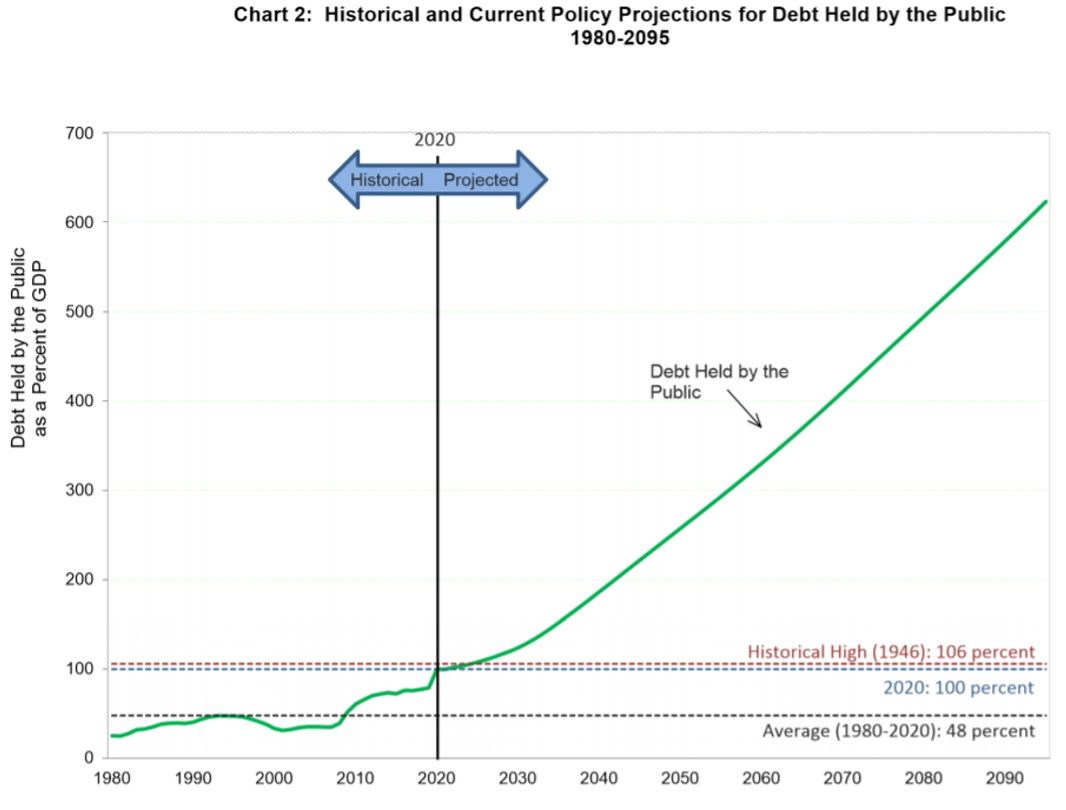
It is important to clarify that the above graph only considers “debt held by the public,” currently around 100 percent of GDP; however, if debt held by Federal Reserve Banks were included, the total debt would be 130 percent of GDP. The Fed argues that this additional $6 trillion debt should not be considered because “Federal Reserve Banks remit their profits to the Treasury, [and] any interest earned on their federal debt is rebated to the federal government.” But if the Fed continues to increase its position relative to US debt, this consideration might need to be reviewed.
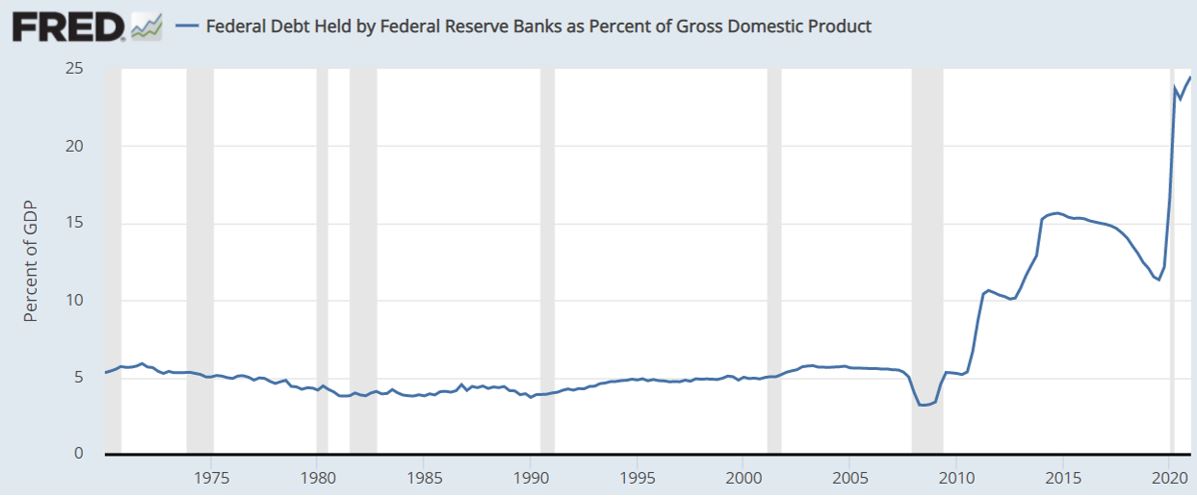
In any case, the Department of the Treasury projects the future debt of the government and calculates that it could triple GDP within forty years. If the Federal Reserve Banks’ debt were consolidated, this threshold would be reached in much less time.
A country with a welfare state commits to offering its citizens future benefits (principally pensions and health services) using taxes collected in the present. While tax revenues are accounted for upon collection, government’s future obligations are not. What would happen if we accounted for the obligations in present value terms? This is exactly what the Department of the Treasury does in its analysis.
US companies that agree to provide their employees with future pensions (which the companies have to finance) have to budget annually to satisfy their future payment obligations in accordance with US Generally Accepted Accounting Principles (GAAP). But the government is not required to make provisions to cover future benefits, currently doing so only for federal employees and veterans.
The Department of the Treasury declares that “[t]he long-term fiscal projections indicate that the government’s debt-to-GDP ratio will rise to 623 percent over the 75-year projection period, and will continue to rise thereafter, if current policy is kept in place.” Just to give an idea of how fast the debt-to-GDP forecasts are increasing, the same report two years ago estimated that same ratio would rise to 530 percent in that period.
Author: Enrique Briega
Enrique Briega completed an MBA at IESE Business School with an exchange at Chicago Booth. He has a financial certification CFA (Chartered Financial Analyst) and has worked in investment banking, corporate strategic consulting, as well as in the world of development in Africa and Central America. Article cross-posted from Mises.
Just for shats ang giggles, I converted our debt amount to where each dollar equals one mile and if we did that, we’d get a distance of 4.7 light years, enough to get us to Proxima Centauri at 4.2 light years or Alpha and/or Beta Centauri at 4.3 light years and have a little change left over. When we get this far where you have to use astronomy and hypothetical interstellar travel to visualize our debt, I begin to think we are done for.
Good graphs … good grief …
I predict the U.S. government will eventually default on its loans.
Most US debt is internal, so the cascade will be something like $150 max SS payments and so on. Defaulting just isn’t an option.
“Even the Fed...,” Really?!
But they keep printing that money at record pace, yeah?!!!!!!
Well just print more money, Problem solved.
That’s the plan.
If you multiply our “on the books debt” by 7% interest it exceeds all our federal revenue combined (excluding Social security taxes)
That means that 100% of our tax revenue would go to interest with nothing left for ANYTHING ELSE.
Keep in mind that all of the Freddie Mac and Fannie Mae mortgages monies borrowed are off the books debt. They own most residential mortgages in the USA.
The Fed doesn't determine revenue or control spending. Congress does that. All the Fed does is put their bad decisions into action.
Easy solution. Quit paying interest....... :)
My tax accountant says the same thing, not to worry about the US Government debt, as it’s going to file bankruptcy sooner rather than later.
RE: Quit paying interest....... :)
That will CRASH the bond market and the stock market with it and our 401K and pensions all go out the window.
Nobody will want to invest in the USA if they do that.
Disclaimer: Opinions posted on Free Republic are those of the individual posters and do not necessarily represent the opinion of Free Republic or its management. All materials posted herein are protected by copyright law and the exemption for fair use of copyrighted works.