Posted on 04/11/2021 9:55:52 AM PDT by E. Pluribus Unum
The purchasing power of a currency is the amount of goods and services that can be bought with one unit of the currency.
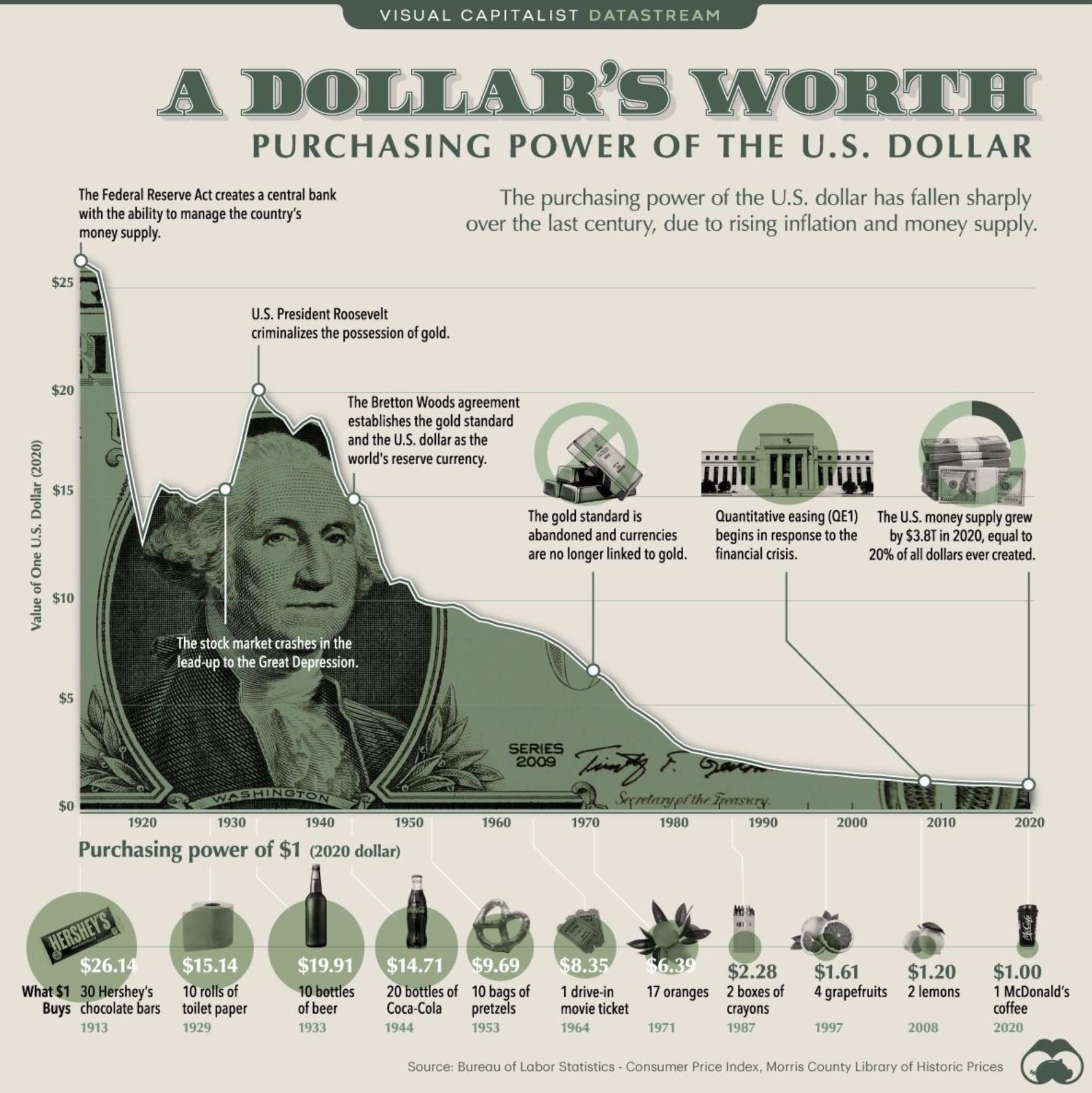
For example, one U.S. dollar could buy 10 bottles of beer in 1933. Today, as Visual Capitalist’s Govind Bhutanda notes, it’s the cost of a small McDonald’s coffee.
In other words, the purchasing power of the dollar – its value in terms of what it can buy – has decreased over time as price levels have risen.
In 1913, the Federal Reserve Act granted Federal Reserve banks the ability to manage the money supply in order to ensure economic stability. Back then, a dollar could buy 30 Hershey’s chocolate bars.
As more dollars came into circulation, average prices of goods and services increased while the purchasing power of the dollar fell. By 1929, the value of the Consumer Price Index (CPI) was 73% higher than in 1913, but a dollar was now enough only for 10 rolls of toilet paper.
Between 1929-1933, the purchasing power of the dollar actually increased due to deflation and a 31% contraction in money supply before eventually declining again. Fast forward to 1944 and the U.S. dollar, fixed to gold at a rate of $35/oz, became the world’s reserve currency under the Bretton Woods agreement.
Meanwhile, the U.S. increased its money supply in order to finance the deficits of World War II followed by the Korean war and the Vietnam war. Hence, the buying power of the dollar reduced from 20 bottles of Coca-Cola in 1944 to a drive-in movie ticket in 1964.
By the late 1960s, the number of dollars in circulation was too high to be backed by U.S. gold reserves. President Nixon ceased direct convertibility of U.S. dollars to gold in 1971. This ended both the gold standard and the limit on the amount of currency that could be printed.
Money supply (M2) in the U.S. has skyrocketed over the last two decades, up from $4.6 trillion in 2000 to $19.5 trillion in 2021.
The effects of the rise in money supply were amplified by the financial crisis of 2008 and more recently by the COVID-19 pandemic. In fact, around 20% of all U.S. dollars in the money supply, $3.4 trillion, were created in 2020 alone.
How will the purchasing power of the dollar evolve going forward?
Can you say Venezuela?
Which is why most Americans that already have a job, are taking up either a second job, or have a side hustle. I predict that within 10 years, even the side hustles will not be enough to make ends meet. The already obvious decline in the standard of living will increase.
I also recommend that citizens acquire the skills to produce their own food from a garden, acquire the land to do so and start learning self reliance.
Those that can, should move out of the cities now. Get a quarter to half an acre and put up a green house. Learn to grow food and if you can, hydroponics/aquaponics. A lot of food can be grown on 20 sq feet of space that has good sun exposure.
I was thinking more like Zimbabwe
If we just add a ZERO to all denominations of currency, we will be just fine.
I have some exposure to a dollar bearish fund. Despite increased debt, rising inflation and increased money supply the dollar has strengthened of late. Nevertheless, I’m holding in anticipation of an eventual rise in the fund. Hedging, if you will.
The already obvious decline in the standard of living will increase.
*****************
It will put the squeeze on a lot of people, especially retirees who won’t have enough to keep up with hot running inflation.
Which funds are “dollar bearish?”
A bit of apples to oranges comparison here. A better example would be to compare each of these items cost alone over a period of time.
Comparatively,
*The cost of staying in an average hotel (room and board) used to be $20 gold coin.(~$1800 today)
* the cost of a meal used to be $1 silver coin(~$17.50 today)
*cost of a Field grade firearm (~20 silver dollars) (~ about $350 today)
*cost of a “shot” of average grade whiskey- 1 .45 LC bullet (~$3-4 today)
Cost of hotel room per month(room and board)
Pulling from the McDonald’s Dollar menu, lmao.
But yeah, we have not seen nothing yet..........
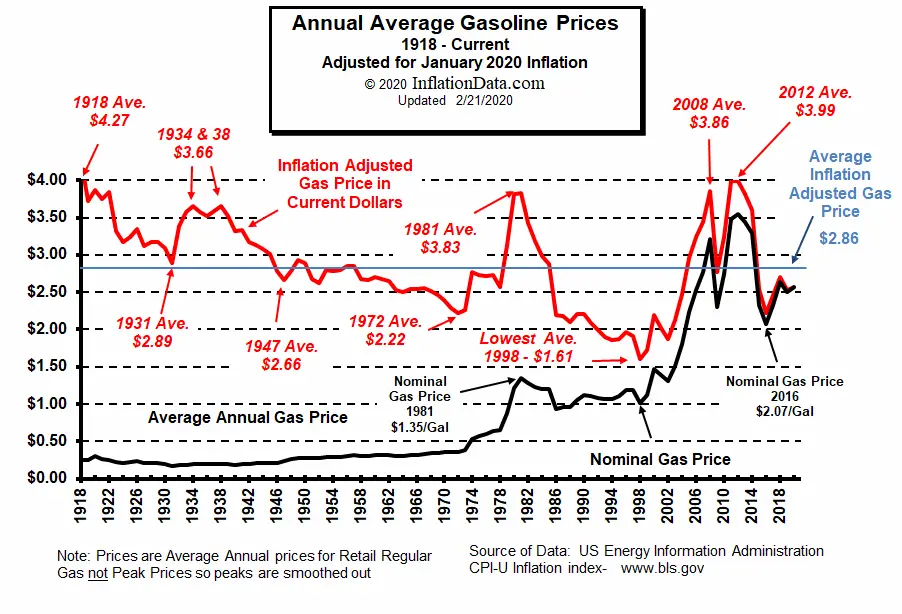
Do that same chart with gasoline per gallon.....please
The dollar is currency not money. It fails the money test because it is not a long term store of value.
Inflation is a huge tax on the Middle Class, always has been.
The Wealth is transferred to the Government which basically gets to pay their bills for free and to the Rich who have assets which are revalued upward to keep pace with inflation.
My dad, born in 1908, gave me a lesson:
During the depression, ANYONE, anyone who desired to work could do so, for a dollar a day, with a shovel. With that dollar, you could buy a pig which would feed your whole family for a week.
He made a fortune in the 20s and 30s. When I asked if we were likely to have another depression, he said, ‘I hope so!’
Those who wanted to work did fine.
The others, who sat croaking with hands outstretched for FDR’s handouts, he called, bakala, dried fish.
My Dad delivered milk during the depression......dropped off at peoples doors ,in glass bottles. Remember them ?
.
Honest wages for honest work.
Inflation is built into the system. Inflation is a big advantage to the statists. It raises the numbers on the standard economic indicators, fooling all into believing that it’s due to rising prosperity. (DOW goes way up, all think we’re doing great.)
The ruling elite will not suffer from rising inflation. They are protected by their investments and cost of living increases.
Social Security recipients are worst hit. No way for them to increase their income.
Rampant inflation turns savings into worthless paper.
bkmk
Disclaimer: Opinions posted on Free Republic are those of the individual posters and do not necessarily represent the opinion of Free Republic or its management. All materials posted herein are protected by copyright law and the exemption for fair use of copyrighted works.