Skip to comments.
Honoring the Unsung Black Religious Leaders who Shaped Christian America
Townhall.com ^
| February 3, 2021
| Allen West
Posted on 02/03/2021 7:53:33 AM PST by Kaslin
While we all recognize the names of Harriet Tubman, Frederick Douglass and Martin Luther King, Jr., from our studies of Black History Month, there are many other African American heroes who were important in the struggle for freedom and equality but whose names aren’t as widely known. These men and women are a vital part of our nation’s religious heritage, as well, and without their contributions, we might not even have had a Martin Luther King, Jr. So, I would like to highlight a few of those here today.
Many black preachers alive today are renowned for their impressive sermon oratory, but this is nothing new in African-American history. One of the earliest American black preachers to be appreciated and respected for his sermon delivery was Rev. Harry Hosier, who was the first to preach to white audiences during the post-Revolutionary War era. He was born a slave in North Carolina and freed in Maryland toward the end of the war, but remained illiterate despite traveling with the famed leader of American Methodism Francis Asbury. This is what made his sermon delivery all the more impressive. One of his most famous sermons, “The Barren Fig Tree,” based on Luke 13:6-9, goes down in history as the first formal sermon delivered by an African American. Always humble, Rev. Hosier credited his faith in God for everything he accomplished.
Two other black pastors were instrumental in the beginning of the African Methodist Episcopal Church (AME) denomination: Absalom Jones and Richard Allen. Rev. Jones was the first African American priest in the Episcopal Church, and Rev. Allen, his lifelong friend, started the first AME church in Philadelphia in 1794, the Mother Bethel AME Church. As of 2020, the denomination now boasts 7,000 congregations and 2.5 million members. Together, they also established the Free African Society, serving black widows and orphans in need, including personally nursing many who were struck by the 1793 outbreak of Yellow Fever. They worked alongside Dr. Benjamin Rush, a fellow Christian who was a signer of the Declaration of Independence and friend of both John Adams and Thomas Jefferson. Rev. Jones twice petitioned Congress and the president in the 1790s opposing slavery, and is still honored every year with a feast day on the official Episcopal Church calendar.
Many recognize the name Sojourner Truth from their history lessons as the author of The Narrative of Sojourner Truth: A Northern Slave, published in 1850 and influential in the fight against slavery. But she was also an itinerant Methodist preacher who at six feet tall was always a commanding presence and often the only black woman in the room. After she won her freedom from slavery, she had her name officially changed from Isabella Baumfree to Sojourner Truth as a testimony of God’s call on her life to journey about the countryside sharing the truth about God to all who would listen. Known for her big, booming voice, she could capture the attention of a large, noisy room when she began to sing one of the hymns she wrote, such as this one for which she is known: “It was early in the morning–it was early in the morning, Just at the break of day– When he rose–when he rose–when he rose, And went to heaven on a cloud.”
Another powerful black preacher was Alexander Crummel, a scholar and Episcopal priest, whose education at Cambridge University was funded by abolitionists. After serving as a missionary in Liberia for 20 years, he returned to the U.S. and started the first independent black Episcopal church in Washington, D.C., in 1875. One of his most famous sermons, “Building Men,” based on I Corinthians 3:10, was prophetic in its attack against the spiritual apathy so rampant today: “There are people who would fain convince themselves that it is possible to stand in a place of utter indifference in spiritual matters; devoid of all moral responsibility. Never was there a more deceptive error framed by Satan for human ruin.”
John Jasper’s sermon “De Sun Do Move” is one of many that nets this black Baptist preacher a place in the annals of influential pastors for his command of oratory as well as his scriptural depth. He served the Sixth Mount Zion Baptist Church in Richmond, Virginia, during the latter half of the 19th century and is remembered for sermons pointing to the awesomeness of God’s perfect plan: “Fellow-sinners in ranks! Turn your back on Hell, and look toward Heaven! King Jesus cometh! — Fall in ranks! When all his elect shall mount in chariots drawn by winged horses, and be seen going up in the clouds to that blessed abode where all the houses is made of gold and the streets is paved with pearls. Amen.”
Today’s Protestant Pentecostals now number in the hundreds of millions, but had their humble beginnings as a street revival in 1906 Los Angeles, led by an African American preacher named William Seymour. Originally from Louisiana and baptized as a Catholic, he grew up attending a Baptist church before receiving additional education in the Holiness movement. When the established church leaders in Los Angeles discounted his emphasis on the spiritual gift of speaking in tongues, he launched an independent Bible study that grew into the Azusa Street Revival. This movement of God lasted several years, featuring dramatic miracles and Spirit-filled interracial worship, sparking the spread of Pentecostalism in the 20th century.
Many recognize the name Sojourner Truth from their history lessons as the author of The Narrative of Sojourner Truth: A Northern Slave, published in 1850 and influential in the fight against slavery. But she was also an itinerant Methodist preacher who at six feet tall was always a commanding presence and often the only black woman in the room. After she won her freedom from slavery, she had her name officially changed from Isabella Baumfree to Sojourner Truth as a testimony of God’s call on her life to journey about the countryside sharing the truth about God to all who would listen. Known for her big, booming voice, she could capture the attention of a large, noisy room when she began to sing one of the hymns she wrote, such as this one for which she is known: “It was early in the morning–it was early in the morning, Just at the break of day– When he rose–when he rose–when he rose, And went to heaven on a cloud.”
Another powerful black preacher was Alexander Crummel, a scholar and Episcopal priest, whose education at Cambridge University was funded by abolitionists. After serving as a missionary in Liberia for 20 years, he returned to the U.S. and started the first independent black Episcopal church in Washington, D.C., in 1875. One of his most famous sermons, “Building Men,” based on I Corinthians 3:10, was prophetic in its attack against the spiritual apathy so rampant today: “There are people who would fain convince themselves that it is possible to stand in a place of utter indifference in spiritual matters; devoid of all moral responsibility. Never was there a more deceptive error framed by Satan for human ruin.”
John Jasper’s sermon “De Sun Do Move” is one of many that nets this black Baptist preacher a place in the annals of influential pastors for his command of oratory as well as his scriptural depth. He served the Sixth Mount Zion Baptist Church in Richmond, Virginia, during the latter half of the 19th century and is remembered for sermons pointing to the awesomeness of God’s perfect plan: “Fellow-sinners in ranks! Turn your back on Hell, and look toward Heaven! King Jesus cometh! — Fall in ranks! When all his elect shall mount in chariots drawn by winged horses, and be seen going up in the clouds to that blessed abode where all the houses is made of gold and the streets is paved with pearls. Amen.”
Today’s Protestant Pentecostals now number in the hundreds of millions, but had their humble beginnings as a street revival in 1906 Los Angeles, led by an African American preacher named William Seymour. Originally from Louisiana and baptized as a Catholic, he grew up attending a Baptist church before receiving additional education in the Holiness movement. When the established church leaders in Los Angeles discounted his emphasis on the spiritual gift of speaking in tongues, he launched an independent Bible study that grew into the Azusa Street Revival. This movement of God lasted several years, featuring dramatic miracles and Spirit-filled interracial worship, sparking the spread of Pentecostalism in the 20th century.
TOPICS: Culture/Society; Editorial
KEYWORDS:
1
posted on
02/03/2021 7:53:33 AM PST
by
Kaslin
To: Kaslin
Didn’t some of these statues get destroyed by pantifa and such over the last several months?
2
posted on
02/03/2021 7:58:36 AM PST
by
A Voice
(As it was in the days of Noah, so shall it be in the end times.)
To: Kaslin
Didn't Obama have a special Pastor for 20 years...a Pastor who preached "God damn America".
And didn't Bubba have a famous pastor who had a bit of a scandal under his belt.
To: Kaslin
A great black preacher in the Churches of Christ, Marshall Keeble, was said to have proclaimed “I find that the Bible sure sheds a lot of light on these commentaries!”
A truly great man.
4
posted on
02/03/2021 8:00:42 AM PST
by
ColoCdn
(Nihil, sine deo)
To: Kaslin
Oh might inspiring words powerfully said result in something real.
5
posted on
02/03/2021 8:01:24 AM PST
by
allendale
To: Kaslin
But did they stand in alliance with the demands of BLM? That is all that matters to the Left.
6
posted on
02/03/2021 8:02:28 AM PST
by
GreyFriar
(Spearhead - 3rd Armored Division 75-78 & 83-87)
To: Kaslin
This was back when the Methodist and Episcopal churches were still Christian.
To: Kaslin
This brings to mind
Rev Thomas A. Dorsey Without Thomas A. Dorsey who was born in Villa Roca, Georgia on July 1, 1899, there would be no Yolanda Adams, Donnie McClurkin, Whitney Houston or Kirk Franklin. Thomas Dorsey was a man who found himself conflicted between the work of man and the work of God. God did use Thomas Dorsey and by obeying the voice of God and utilizing his gifts, Thomas A. Dorsey, revolutionized sacred church music and ushered in a new genre: gospel.
There is a wonderful movie about the prolific Thomas A. Dorsey. The movie is called Say Amen, Somebody Sad to say, other than the trailer, I can't find a free copy on the internet.
Back in the day before agitators, black gospel along with real country music was part of life's background sounds. Even to this today, particularly in rural areas, you can often find a 500 Watt daytimer on the AM dial playing black gospel. This is part of Flannery's South, the Christ haunted South.
8
posted on
02/03/2021 8:22:17 AM PST
by
Governor Dinwiddie
(Guide me, O my great Redeemer, pilgrim through this barren land.)
To: Kaslin
It’s never brought up but MLK was a sexual predator.
9
posted on
02/03/2021 8:24:11 AM PST
by
Beowulf9
To: Kaslin
Both Col. West and Readers here will appreciate the Year 1876 words of then-Ohio State Senator and A.M.E. Bishop Benjamin W. Arnett, outstanding scholar, Legislator, and Minister, who lived through the period of the Civil War and delivered a most outstanding
Centennial Sermon, at St. Paul Church in Norwalk, Ohio, by invitation, in honor of the 100th Anniversary of the
Declaration of Independence, in which he traced the history of nations and that of America, from it's inception and up to the Year of the Centennial of its Declaration.
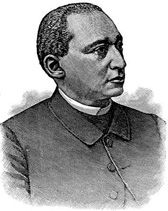
In that Sermon, Dr. Arnett issued a grave warning of what might happen to America if a group, including academics who then self-described as "Liberals," had its way. Excerpts follow:
"The Danger to our Country."Now that our national glory and grandeur is principally derived from the position the fathers took on the great questions of right and wrong, and the career of this nation has been unparalleled in the history of the past, now there are those who are demanding the tearing down the strength of our national fabric. They may not intend to tear it down, but just as sure as they have their way, just that sure will they undermine our superstructure and cause the greatest calamity of the age. What are the demands of this party of men? Just look at it and examine it for yourselves, and see if you are willing that they shall have their way; or will you still assist in keeping the ship of state in the hands of the same crew and run her by the old gospel chart! But ye men who think there is no danger listen to the demands of the Liberals as they choose to call themselves:
"'Organize! Liberals of America! The hour for action has arrived. The cause of freedom calls upon us to combine our strength, our zeal, our efforts. These are The Demands of Liberalism:"'1. We demand that churches and other ecclesiastical property shall no longer be exempt from just taxation.
"'2. We demand that the employment of chaplains in Congress, in State Legislatures, in the navy and militia, and in prisons, asylums, and all other institutions supported by public money, shall be discontinued.
"'3. We demand that all public appropriations for sectarian educational and charitable institutions shall cease.
"'4. We demand that all religious services now sustained by the government shall be abolished; and especially that the use of the Bible in the public schools, whether ostensibly as a text-book or avowedly as a book of religious worship, shall be prohibited.
"'5. We demand that the appointment, by the President of the United States or by the Governors of the various States, of all religious festivals and fasts shall wholly cease.
"'6. We demand that the judicial oath in the courts and in all other departments of the government shall be abolished, and that simple affirmation under the pains and penalties of perjury shall be established in its stead.
"'7. We demand that all laws directly or indirectly enforcing the observance of Sunday as the Sabbath shall be repealed.
"'8. We demand that all laws looking to the enforcement of “Christian” morality shall be abrogated, and that all laws shall be conformed to the requirements of natural morality, equal rights, and impartial liberty.
"'9. We demand that not only in the Constitution of the United States and of the several States, but also in the practical administration of the same, no privilege or advantage shall be conceded to Christianity or any other special religion; that our entire political system shall be founded and administered on a purely secular basis; and that whatever changes shall prove necessary to this end shall be consistently, unflinchingly, and promptly made.'
"'Let us boldly and with high purpose meet the duty of the hour.'
In another section of the lengthy discourse, Bishop Arnett addressed the topic of "The Greatness of America," as follows: "Let us see what it is that makes us so great; wherein lies our strength. What has made us one of the greatest powers of the earth, politically and intellectually? Have we come to the conclusion that it is Righteousness that exalteth a nation? We have met to-day at the request of the President of the United States, Ulysses S. Grant, and also the Governor of our beloved State, Rutherford B. Hayes. For what? Why call us from our homes? Why come to the house of God? Why not go to the hall of mirth and to the places of amusement to-day? No that is not what they want us to do. We are commanded to go to our 'several places of worship, and there offer up thanks to Kind Providence which has brought our nation through the scenes of another year, and blessed the land with peace, plenty and prosperity.' Then as Americans we have reason to rejoice and congratulate ourselves on the greatness of our beloved country; at this the close of the first hundred years of experimental government of the people, by the people, and for the people. To be a citizen of this vast country is something, and to share in its privileges and duties is more than something." - Dr. Benjamin W. Arnett, 1876 "Centennial Thanksgiving Sermon" -
CENTENNIAL Thanksgiving Sermon, DELIVERED BY REV. B. W. ARNETT, B. D., AT ST. PAUL A. M. E. CHURCH, URBANA, OHIO 1876 - available in the "Library of Congress - Historical Collections" - "African-American Pamphlets from the Daniel A. P. Murray Collection," 1820-1920; American Memory, Washington, DC.
This historical treasure is one which should be prominent in our national discussions, especially now, when our philosophical foundations are being challenged, and when the views of a learned man like Dr. Arnett might shed light on centuries-old ideas about America's history. His theme: Righteousness Exalteth a Nation, but Sin is a Reproach to any People."
"Withdraw from Christendom the Bible, the Church with its sacraments and ministry, and Christian morality and hopes, and aspirations for time and eternity; repeal all the laws that are founded in the Christian Scriptures; remove the Christian humanities in the form of hospitals and asylums, and reformatories and institutions of mercy utterly unknown to unchristian countries; destroy the literature, the culture, the institutions of learning, the art, the refinement, the place of woman in her home and in society, which owe their origin and power to Christianity; blot out all faith in Divine Providence, love, and righteousness; turn back every believer in Christ to his former state; remove all thought or hope of the forgiveness of sins by a just but gracious God; erase the name of Christ from every register it sanctifiesin a word annihilate all the legitimate and logical effects of Christianity in Christendomjust accomplish in fact what multitudes of gifted and learned minds are wishing and trying to accomplish by their science, philosophy, and criticism, and what multitudes of the common people desire and seek, and not only would all progress toward and unto perfection cease, but not one of the shining lights of infidelity would shine much longer. Yes, the bitterest enemies of this holy and blessed religion, owe their ability to be enemies to its sacred revelations - to the inspiration and sublimity of that faith which reflects its glories on their hostile natures. They live in the strength of that which they would destroy. They are raised to their seats of opportunity and power by the grace of Him they would crucify afresh; and is it to be thought that they are stronger than that which gives them strength? Can it be supposed that a religion which civilizes and subdues, and elevates and blesses will succumb to the enmities it may arouse and quicken in its onward march? Are we to tremble for the ark of God when God is its upholder, and protector, and preserver? - Dr. Benjaming W. Arnett, St. Paul A.M.E. Church, Urbana, Ohio, Centennial Thanksgiving Sermon, November 1876
Dr. Arnett, an A.M.E. Minister and Ohio State Legislator, was invited to publish this remarkable sermon commemorating the Centennial of the Declaration of Independence by the following method:To:
Rev. B. W. ARNETT, B. D.
Dear Pastor:
Will you please prepare your Centennial Thanksgiving Sermon for publication: together with whatever matter pertaining to the colored people of this city, you deem worth preserving.
We make this request of you, believing that the publication of such matter, will be of benefit to the present and succeeding generations.
Yours Respectfully,
J GAITER
J. DEMPCY
C. L, GANT
Trustees W. A. STILGASS, W. O. BOWLES
Urbana, O.
December 7th, 1876
J GAITER, J. DEMPCY, C. L, GANT
Trustees W. A. STILGASS, W. O. BOWLES
To: loveliberty2
I was hoping you would post to this thread! Thanks!
11
posted on
02/03/2021 9:27:09 AM PST
by
Albion Wilde
(Laughter separates us from despair and gives us a chance at love. --Craig Ferguson)
To: Albion Wilde
Thank you!!
Love your "about" page, with all of its remarkable quotations.
Oh, the brilliance of former generations of immigrants to this continent--many of whom fled oppression in its many forms in their own countries in order to participate in the greatest experiment in liberty in the history of the world.
Keep up the posting of such gems!
To: loveliberty2
Same to you, and I appreciate your kind comments!
13
posted on
02/05/2021 6:22:13 PM PST
by
Albion Wilde
(Laughter separates us from despair and gives us a chance at love. --Craig Ferguson)
Disclaimer:
Opinions posted on Free Republic are those of the individual
posters and do not necessarily represent the opinion of Free Republic or its
management. All materials posted herein are protected by copyright law and the
exemption for fair use of copyrighted works.
FreeRepublic.com is powered by software copyright 2000-2008 John Robinson
