None of this is good news.
Posted on 11/17/2020 6:08:58 AM PST by billorites
No one was expecting the snap on Nov. 6 as engineers at the Arecibo Observatory in Puerto Rico weighed their options for dealing with damage to the facility from a cable failure over the summer.
But just as engineers were ready to begin repairs on that secondary cable, which slipped out of its socket in August, they faced a much more serious challenge: one of the main cables unexpectedly snapped, putting the entire facility at risk.
"We have seen some individual wire breaks on that particular cable, but we hadn't seen any change for weeks," Francisco Cordova, the director of the observatory, told Space.com.
"That particular situation was evaluated by the engineering team and determined not to be an issue because the capacity of that cable was so much higher than the load that it was taking, that it really shouldn't have been a problem," Cordova said. "Certainly now with this failure, we understand that that capacity's just not there and that there has been other degradation."
Nestled into a natural basin in the middle of the Puerto Rican jungle, the Arecibo Observatory began science work in 1963 and is the world's second-largest radio dish. Scientists have used it to confirm that pulsars are superdense neutron stars, to discover the first planets beyond our solar system and to broadcast a message out into the cosmos in hopes of reaching intelligent alien life. It's also Earth's prime sentinel for identifying whether specific asteroids are on a path to hit the planet — and it appeared in the blockbuster movies like James Bond's "GoldenEye" and "Contact," no less.
Arecibo was designed by a scientist at Cornell University, which operated the facility until 2011, with the National Science Foundation (NSF) as the observatory's main funder. Facing increasing budget pressure, the NSF gradually phased out its funding, transferring operations first to the Universities Space Research Association and then to the University of Central Florida, although the NSF still owns the site.
But the past few years have been difficult on the observatory. In 2014, a strong earthquake damaged parts of the facility, including a cable that the facility's managers were hoping to replace later this year. In 2017, Hurricane Maria battered Puerto Rico but mostly spared Arecibo. The observatory's helipad and well water were vital resources for those living near the facility. Outside astronomers had to wait over a week to learn that the observatory was still standing.
This year, throughout January, a series of earthquakes, the strongest a 6.4 temblor, rocked Puerto Rico and the facility closed for inspection. When the month ended and the earthquakes with it, Puerto Ricans celebrated the new year afresh, hoping that the worst of the year was over, Abel Mendez, a planetary astrobiologist at the University of Puerto Rico who regularly brings students to observe at Arecibo, told Space.com — only to face the outbreak of the coronavirus pandemic in March.
But for the observatory, things would only get worse.
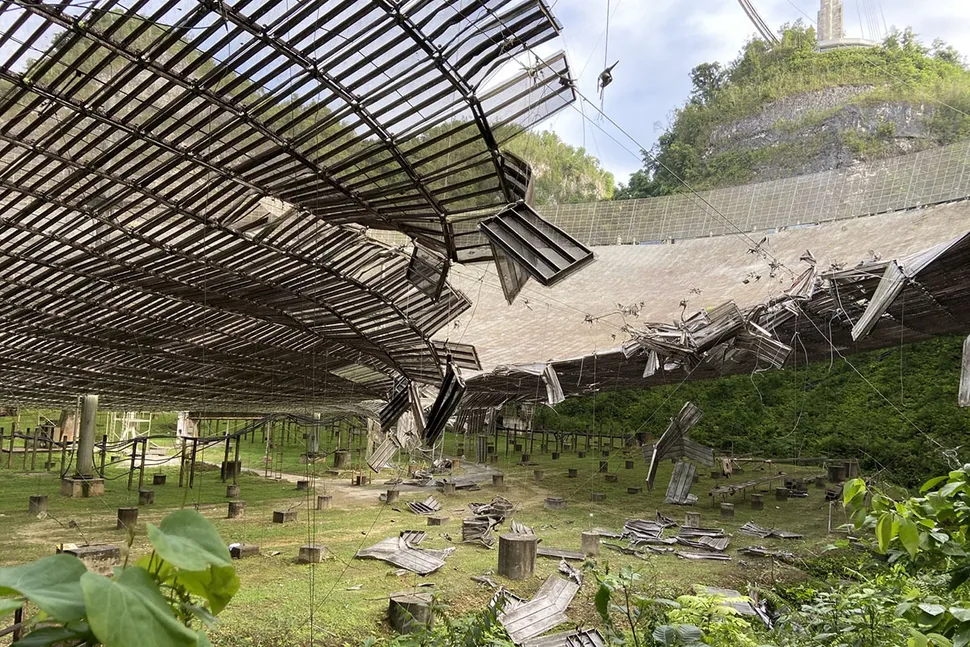
The first cable slipped out of its socket on Aug. 10 at 2:45 a.m. local time. On its way down, it damaged observation facilities suspended above the dish, as well as gouging a 100-foot-long (30 meters) "gash" in the fragile dish, according to a statement from the University of Central Florida, which operates the facility.
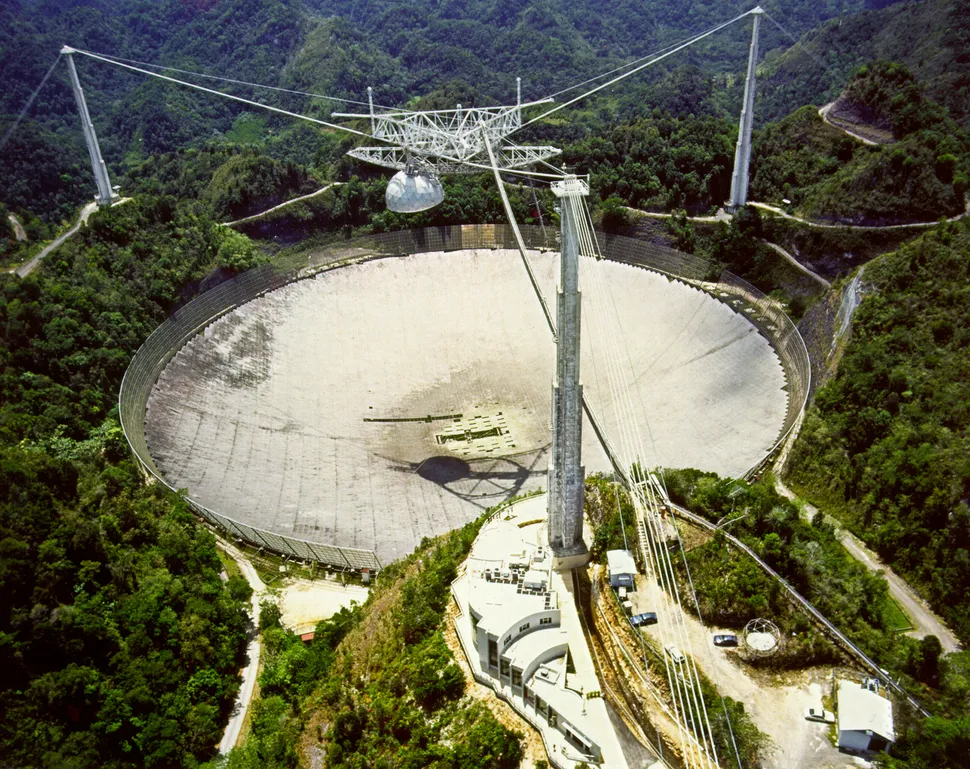
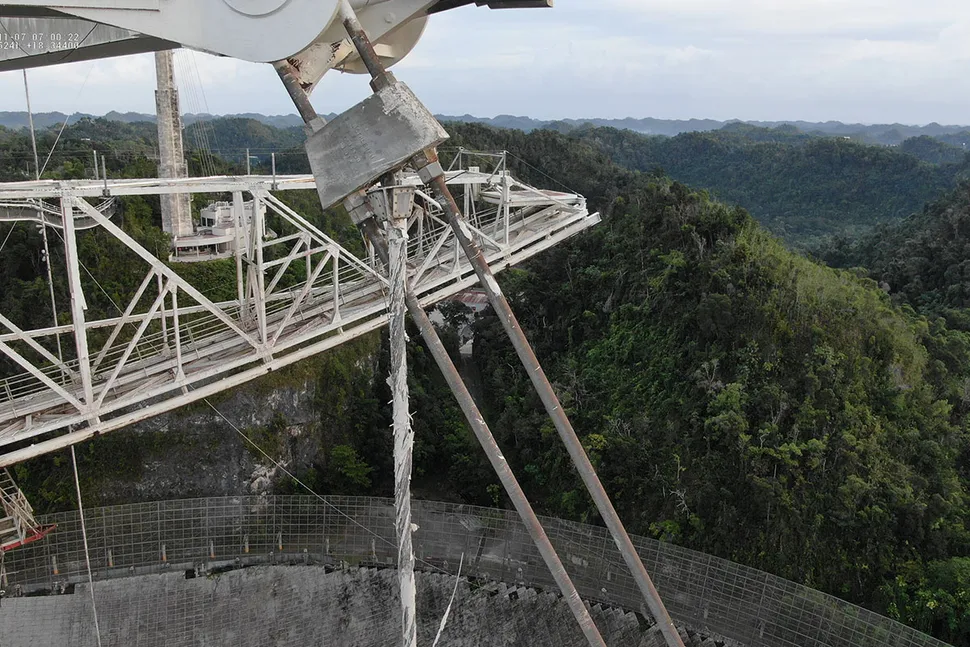
The situation became much more dire on Nov. 6 at 7:39 p.m., when a second cable — this time, one of the primary cables — snapped, compromising the structural integrity of the 900-lb. (400 kilograms) platform that looms over the dish, holding the facility's antennas and scientific instruments.
"Time right now is critical," Mendez told Space.com. "I'm totally scared of what's happening at the observatory now. I am so worried about it."
Evaluating the situation is also difficult, since reaching the suspended platform and the towers that anchor its supporting cables is dangerous. "When you have access to the towers, when you have access to the platform, there's a million ways you can remove a failed cable, hoist a new cable, things like that," Cordova said. "When you can't access the attachment points for these cables, then that becomes a big challenge."
arecibo observatory damage A view of Arecibo Observatory's suspended platform and science equipment, as seen before damage incurred in 2020. (Image credit: University of Central Florida)
On the ground, Cordova said, the damage doesn't look as bad as it really is.
"You don't see a whole lot of difference when you look at the platform — certainly you do see a couple of extra cables that are hanging down that shouldn't be, they should really be pointing up, and they're pointing down," Cordova said. "But this is such a massive structure that even that gets lost in the background size of the telescope platform itself."
The same is true of the damage the dish has accumulated during the incidents, he said. "Certainly the dish is fairly damaged," Cordova said, "[but] whenever you look at how big our primary reflector is and you look at what the damage is, it also doesn't look like something that's insurmountable."
The observatory has put together a suite of options for stabilizing the situation and is waiting for a decision from the National Science Foundation, which owns the facility, about how to proceed. "Hopefully in the next couple days, we'll have that decision," Cordova said.
In the meantime, scientists connected to Arecibo Observatory are hoping for the best. Researchers are also gathering at regular virtual meetings, which Mendez described as "stress relief" sessions, to talk about the situation and to share memories of the facility.
"It's quite clearly an extremely worrisome situation," Don Campbell, who began his career at Arecibo in 1965 and eventually served as the observatory's director in the 1980s, told Space.com. "The first cable failure was certainly a surprise and of strong concern … With the second cable failure, obviously things became significantly more serious."
At risk is not just the observatory's half-century history of research spanning astronomy, atmospheric studies, near-Earth asteroids and the search for life beyond Earth. More concerning, scientists say, is the possibility of losing a unique facility with plenty of work left to do.
"Arecibo is still very much a telescope that is at the forefront of many areas and its loss would be tremendous," Campbell said. "I'm very much keeping all my fingers crossed that they will figure out how to stabilize the structure and get it repaired. I'm still somewhat hopeful."
"It's a precarious situation," he added, "and we just kind of have to wait and see."
None of this is good news.
Cable failure?
Then get DISH Network!...........................
Jodie Foster is going to be PISSED!
Obama’s fault. Kind of looks like the US after he was done with it.
I hated that movie.
It had little or nothing to do with the BOOK that it was supposedly made from.................
Damn, but those are the risks when you locate something like that in a Third World country.
BINGO! Another example of a rat country!
It had little or nothing to do with the BOOK that it was supposedly made from.................
Was the book any good? Sagan, right?
The book was written by Carl Sagan, and it was a great story the Hollywood types ruined.....................
Need to relocate to Winslow Arizona,
less cloud cover, better infrastructure supports
https://www.americansouthwest.net/arizona/meteor_crater/index.html
Some silly comments need a side of seriousness. This situation is largely due to starving legitimate scientific endeavors of funds over several decades in favor of junk science such as global warming crap. This led to substandard inspections, preventative maintenance and planned refurbishment.
On the other hand, it spared us about 300 pages’ worth of Foster’s character having a difficult time getting laid in college because she was so smart *eyeroll*. What made Sagan think he was the person to carry this message?
(The real-world problem would be the exact opposite: every nerd in the world losing their sh*t because “There’s a hot babe in the lab!!!” and “OMG! She understands what I’m talking about!!!!!”)
Problem is: after a while you get sick of the Eagles (even if it one of their less annoying songs, accounting for radio over-play):
Well, I’m a standing on a corner
In Winslow, Arizona
And such a fine sight to see
It’s a girl, my Lord, in a flatbed Ford
takin’ a REALLY REALLY REAAAAALLLY good look at me!
That would be such a fine sight to see.
Most of the Sci-fi genre Hollywood ruins.
Heinlein’s Starship Troopers is nothing even remotely like the movie.
Michael Crichton’s Timeline, and even some Stephen King’s novels are not like the movie portrayed them......
Damn it, ear worm, ear worm!
I’m sorry... I should use explicit warnings when making Eagles references.
If I were evil, I’d tell you to lighten up while you still can.
But that would be wrong,
so I’d never do that.
Just don’t let the sound of my inferrals drive you crazy.
I hate you... Satan get thee behind me
You can check out any time you want, but you can never leave!!! MWAHAHAHAHA!!!!
Disclaimer: Opinions posted on Free Republic are those of the individual posters and do not necessarily represent the opinion of Free Republic or its management. All materials posted herein are protected by copyright law and the exemption for fair use of copyrighted works.