Posted on 06/27/2020 5:50:24 AM PDT by marktwain
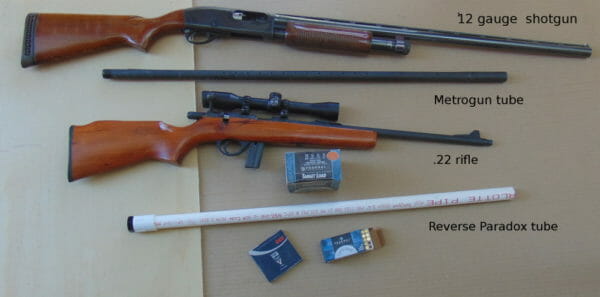
Opinion: Why The Reverse Paradox Tube is NOT a Firearms Silencer
In the previous article about the reverse paradox tube, there was a comment that the BATFE might consider the tube to be a silencer.
Legally, the reverse paradox tube is not a silencer. The law is clear, and there is considerable precedent as to why this is so.
The definition of a silencer, in the law, is in 18 U.S.C. § 921(a)(3):
(24) The terms “firearm silencer” and “firearm muffler” mean any device for silencing, muffling, or diminishing the report of a portable firearm, including any combination of parts, designed or redesigned, and intended for use in assembling or fabricating a firearm silencer or firearm muffler, and any part intended only for use in such assembly or fabrication.
This is the definition used by the BATFE. There are three parts to this definition. There is the definition for a complete silencer; a combination of parts designed or intended for fabricating a silencer, and any single part intended only for use in a silencer.
In an article first published in Small Arms Review, written by By Teresa G. Ficaretta, Esq. and Johanna Reeves, Esq., the three parts are explained. The first part is for complete silencers (bold added).
(1) Complete silencer
(Excerpt) Read more at ammoland.com ...
Solution in search of a problem....
Some fraction of them use .22 shot shells to eliminate pests.
I can’t imagine for what purpose anyone would bother?
Eliminate pigeons inside a barn, without putting holes in the roof.
Get rid of sparrows in an aircraft hanger.
Take out pests raiding the garden without endangering the neighbors.
Shoot rats or mice inside of a cabin/shop/garage.
Eliminate carpenter bees that are damaging a wooden structure.
Popping mylar balloons that have accumulated inside a roofed stadium, and cause problems with air circulation.
And they have for generations, without “benefit” of unwieldy barrel extensions.
Air rifles do most of that.

I'd never bother trying to manage that barrel length for a steady shot.
I shot a rat inside my kitchen cabinet with .22 shotshell.
Fine, if you’re shooting patterns from a bench. How do you keep the pipe aligned with the bore in actual use? How do you navigate with it indoors? I once saw an overgrown kid giggle when he saw a rat going for the cat’s dish out on the patio. His mom had company in the living room, so he happily snuck off to get a .22 revolver loaded with shot. The next time the rat came out, he popped it. At 20 feet. Incapacitated it, and it didn’t move. The lull in the conversation from the living room was priceless. He finished it off with a second, closer shot. I know a guy that complained about the “new”. CCI shotshells. Said they were crap. He used to wing-shoot swallows with the old crimped shotshells. Most of the vermin that I’ve dispatched required a speedy response. Dealing with a 7 foot pole is not gonna get it. 30 feet is CB round or air rifle territory, for me.
Range?
In some cases, the crimped loads were much better, even though the CCI loads have 25% more shot!
Yeah, I’m not sure what effect the plastic shot cup has on the pattern. Seems like it might be nearly liquefied after going down the barrel. Ever recover any of them?
At ten feet, you can count all the pellets on paper. by 20 feet a great many are pretty far out.
By thirty feet, the Federal crimped loads are either equaling or doing better than the CCI loads.
In some guns/ reverse paradox tube combinations, the crimped Federal loads had 20% more pellets in the pattern, on average, than the CCI, even though the CCI started with 25% more.
As they say, analyzing shotgun patterns will drive you crazy.
Certainly rifling damages some of the pellets. That might create fliers I recall that 12 gauge patterns are said to have some problems with larger shot sizes giving wider patterns with full chokes than with smaller ones. Internal ballistics of shot loads is a pretty chaotic thing, I’m sure.
Wider chokes, rather than smaller.
The reverse paradox tube takes off the spin. The long, straight, tube actually gives better patterns than what are expected from a cylinder bore.
The ones I have measured, over dozens of averaged shots, give from improved cylinder to full choke patterns, depending on the gun, tube, and load used.
I don’t doubt that it’s effective. It just doesn’t seem practical.
It all depends on the specific circumstances.
Disclaimer: Opinions posted on Free Republic are those of the individual posters and do not necessarily represent the opinion of Free Republic or its management. All materials posted herein are protected by copyright law and the exemption for fair use of copyrighted works.