Posted on 04/18/2020 4:23:14 AM PDT by Kaslin
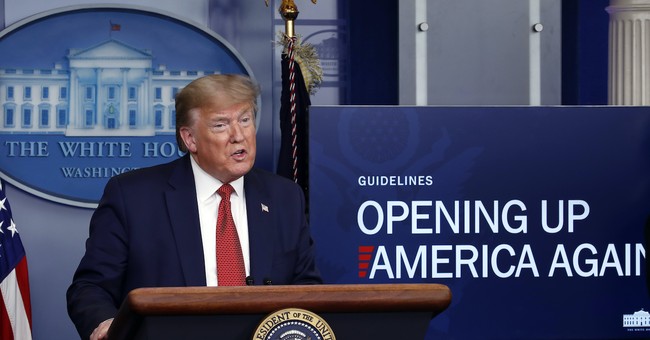
The Guidelines for Opening Up America Again released by President Trump on April 16 reveal a balance of sound medical and economic planning. But they make solid sense from a psychological perspective as well.
In fighting the COVID-19 pandemic, President Trump has warned that the cure must not be worse than the disease and that any long-term strategy must protect both the physical and also the economic and social health of the nation. State-level lockdowns have played a major part in flattening the curve of disease growth. But with businesses closing across the nation, unemployment claims coming in by the millions each week, and projections that continued lockdowns could result in Depression-era unemployment levels, the wisdom of the President’s position is becoming indisputable.
A recent poll by McLaughlin and Associates confirms the President’s concern that we must address the nation’s economic fears even as we combat the virus. Two-thirds of respondents in March said that the economy is getting worse, a huge jump from the February numbers. And those who said the economy is in a recession jumped from just under 20 percent in February to 44 percent in March. At a more personal level, 35 percent overall and 50 percent of those under age 55 said they could only afford to be out of work for one month or less. Those percentages dropped when respondents were asked about longer periods out of work.
Outside the relative safety of lockdown, however, lurks the coronavirus. Any plan for reopening America must help to manage the fear that appropriately comes with the reopening. Otherwise, fear will keep Americans emotionally locked down and hesitant to resume normal activities even as the physical lockdowns are eased. In a sense, we must flatten the fear curve just as we have flattened the curve of disease growth.
Fear of economic ruin is clearly rising, yet the fear of the virus remains understandably strong. Psychologically, Americans are in a classic approach-avoidance conflict. People want and need to get back to some semblance of normalcy, to get back to work and to ease the growing financial fears. But doing so could raise the risk of contracting the virus, and the resulting fear could keep people from doing what they need to do in order to get the country back on its feet.
And that is why the Guidelines for Opening Up America Again make solid sense from a psychological perspective as well as from the medical and economic perspectives.
Psychologists understand fear as one of the primary survival emotions. The fear system that exists in all mammalian brains provides the motivation to avoid and escape harmful situations. Because of its importance to survival, fear is not something to be eliminated but managed.
Fear occurs along a continuum from low to high, and it affects behavior differently at different intensities. Too little fear in a dangerous situation leads to complacency and foolish risk. At very high levels, however, fear can lead to avoidance of reasonable activities and interfere with the ability to meet other needs such as social activity and providing for ourselves and our families. But, between the extremes of complacency and panic, managed fear can focus our attention and provide the energy we need to take appropriate precautions when confronting risk.
The Guidelines do not minimize the risk of the virus, but neither do they yield to over-reaction and panic. Instead, they keep fear at manageable levels by opening America in stages, relying on objective data for safe movement from one stage to the next, and allowing for quick adjustment in the case of the resurgence of the virus.
Those are the kinds of tools that psychologists have used for decades to help people to handle feared situations. A gradual approach to the feared situation keeps fear at a manageable level. Objective information helps people to see the feared situation in a more rational and less emotional light.
Fear is exacerbated when there is a sense of loss of control and helplessness, so psychologists provide practical tools to help people perform in feared situations. And each stage of the Guidelines is packed with practical tools and protections, ranging from screening and testing to methods for keeping employees safer as they return to work.
Once a stage is completed safely according to objective gating criteria, there is a gradual increase in normal activity at the next stage. Even within each stage, however, provisions are made to address the safety of populations at higher risk.
And rather than forcing all fifty states to reopen at the same time, the plan allows each state to assess its situation and reopen as local conditions warrant.
Nothing will appease partisan critics who are more focused on undermining the President for their own political ends than on guiding the nation through this crisis. But President Trump and his team have produced Guidelines that steer the nation between the dangers posed by both the virus and by a stalled economy.
The path forward is grounded in prudence, but not panic.
‘Because of its importance to survival, fear is not something to be eliminated but managed.’
sure, when the entire country is populated with pearl clutching old women, regardless of actual age and gender...
There is no context to this mania being pushed by the Media and the Left (but then I repeat myself).
Birx and the Fasciest Fauci ought to produce a chart showing the deaths from this Chinese Virus by age and morbidity.
When it is seen that such a HUGE % off deaths is in people over 75 AND with serious health disorders people will begin to calm down.
Those who are in the most susceptible age groups can then be instructed to stay in self quarantine and we can more quickly get back to what approaches normal.
turn off all FakeNewsMSM, which created public hysteria, and the panic will subside. as someone posted elsewhere, there are places in US where cars are back on the roads.
same in Australia. tradespeople talking about busy roads in some towns once more. just do it.
17 Apr: Spiked Online UK: ‘There’s no direct evidence that the lockdowns are working’
Dr John A Lee on why we need to keep questioning the response to Covid-19.
Dr John A Lee, a recently retired professor of pathology and NHS consultant pathologist, has repeatedly called for a critical and dispassionate examination of the evidence in relation to Covid-19, raising questions about the government and its advisers’ interpretation of the data. spiked caught up with him to find out more...
LEE: The figures are just so unreliable...
These figures are then fed into models of the disease and the epidemic which are being used to influence and inform public policy. But those models are only as good as their input data and the assumptions they make. And there are so many unknowns which means the models’ outputs are really quite questionable. And given that we have now got ourselves into this situation, for a variety of reasons, getting ourselves out of it using the same models and predictions is even more questionable...
LEE: For example, we are currently in lockdown for two reasons. One is that the initial figures suggested that we were dealing with a very highly virulent disease...
My guess is that it will end up between 0.5 and 0.1 per cent, and probably nearer to the lower end of that...
LEE: I think it’s difficult because governments, having gone down this route, are stuck between two rather difficult places. One is the worry that any relaxation of the lockdown which causes an increase in the scorecard number of deaths will be criticised.
But also, the very fact that the lockdown was put in place, despite the huge set of side effects, means that the government has to justify having done it. In a way, that actually makes it harder to come out of a lockdown...
I think personally that we should aim to relax the lockdown faster than some commentators are suggesting. The government’s reticence to talk about this is based on modelling assumptions of numbers which we know are fraught with uncertainty. It is equally possible to make a case that relaxing the lockdown more quickly than is currently being suggested will have beneficial effects overall, even if the number of viral deaths ticks up again. Time will tell, but they are going to have to try to do the right thing soon, which means not prolonging this unnecessarily.
(Dr John A Lee was talking to Fraser Myers)
https://www.spiked-online.com/2020/04/17/theres-no-direct-evidence-that-the-lockdowns-are-working/
17 Mar: Stat: A fiasco in the making? As the coronavirus pandemic takes hold, we are making decisions without reliable data
By John P.A. Ioannidis
(John P.A. Ioannidis is professor of medicine and professor of epidemiology and population health, as well as professor by courtesy of biomedical data science at Stanford University School of Medicine, professor by courtesy of statistics at Stanford University School of Humanities and Sciences, and co-director of the Meta-Research Innovation Center at Stanford METRICS at Stanford University)
Draconian countermeasures have been adopted in many countries. If the pandemic dissipates — either on its own or because of these measures — short-term extreme social distancing and lockdowns may be bearable. How long, though, should measures like these be continued if the pandemic churns across the globe unabated? How can policymakers tell if they are doing more good than harm?
Vaccines or affordable treatments take many months (or even years) to develop and test properly. Given such timelines, the consequences of long-term lockdowns are entirely unknown...
The data collected so far on how many people are infected and how the epidemic is evolving are utterly unreliable...
Conversely, with lockdowns of months, if not years, life largely stops, short-term and long-term consequences are entirely unknown, and billions, not just millions, of lives may be eventually at stake.
If we decide to jump off the cliff, we need some data to inform us about the rationale of such an action and the chances of landing somewhere safe.
https://www.statnews.com/2020/03/17/a-fiasco-in-the-making-as-the-coronavirus-pandemic-takes-hold-we-are-making-decisions-without-reliable-data/
19 Mar: CBC: Prominent scientist dares to ask: Has the COVID-19 response gone too far?
Leading epidemiologists publish duelling commentaries, igniting debate on social media
by Kelly Crowe
It’s a clash of titans — an epic battle between two famous scientists over the world’s response to the COVID-19 pandemic.
In one corner, influential Stanford University epidemiologist John Ioannidis, who wrote a commentary asking whether taking such drastic action to combat the pandemic without evidence it will work is a “fiasco in the making.”
Across the mat, prominent Harvard epidemiologist Marc Lipsitch punched back with a defiant response titled: “We know enough now to act decisively against COVID-19.”...
Ioannidis told CBC News he worries about the consequences of those measures (social distancing and lockdowns).
“Put a stall to the entire economy. Tell people to stay at their homes, get depressed, commit suicide, domestic violence. Who knows? Child abuse, children losing their education, companies crashing … unemployment, the stock market already dropping 20 per cent.
“Is that the solution?”...
https://www.cbc.ca/news/health/coronavirus-covid-pandemic-response-scientists-1.5502423
Woke townies do not know how a hotdog is made or where milk comes from.
If everyone is at home sitting on their thumbs, who exactly is going to grow the food, sort/bag/process the food, deliver to stores,etc.
Disclaimer: Opinions posted on Free Republic are those of the individual posters and do not necessarily represent the opinion of Free Republic or its management. All materials posted herein are protected by copyright law and the exemption for fair use of copyrighted works.