Posted on 06/23/2019 1:44:03 PM PDT by Cronos
Today marks the third anniversary of the EU referendum in which the country voted narrowly (by 52% to 48%) in favour of leaving the EU.
Since then, the country has spent much of the last three years debating how the process of leaving has and should be handled, the terms on which we should aim to leave, and even the merits of the original decision itself.
The debate has precipitated a general election and resulted in the downfall of a Prime Minister. The one thing that has not happened is Britain making its exit from the EU – thanks to the repeated refusal of the House of Commons to accept the terms of the withdrawal treaty that was negotiated with the EU by the UK government.
Instead the country is awaiting the arrival of a new Prime Minister who will be charged with the task of solving in three months a Brexit riddle that Theresa May was unable to solve in three years.
One might imagine that the difficulties that have beset the withdrawal process would have had an impact on support for the principle of remaining or leaving the EU in the first place. But of that there is remarkably little evidence. Our poll of polls of how people would vote in another referendum continues to report that the country is more or less evenly divided between Remain and Leave, much as it was three years ago.
True, as has been the position ever since our poll of polls series began at the beginning of 2018, the balance of support is now tilted in favour of Remain rather than, as in the referendum, in favour of Leave. Indeed, the current average of Remain 52%, Leave 48% is the exact mirror image of what emerged from the ballot boxes in June 2016.
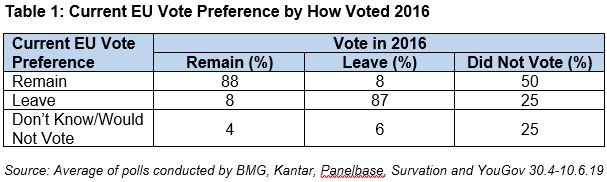
However, this does not mean that there is a discernible, key group of Leave voters who have changed their minds about Brexit. That much becomes clear if, as in the table below, we examine separately the current vote intentions of those who voted Remain in 2016 and those who backed Leave. In both cases over 85% say they would vote exactly the same way as they did in 2016. The sound and fury of the last three years has left the vast majority of voters unmoved. And although 8% of those who backed Leave say that they would now vote Remain, they are counterbalanced by 8% of Remain supporters who indicate that they would now support Leave.
The principal reason why public opinion is now tilted towards Remain is because, as we have noted before, those who did not vote three years ago prefer Remain to Leave by around two to one (if they express a view at all). In part, at least, this reflects the fact that this group of abstainers consists disproportionately of younger voters who in general are more likely to back Remain. However, it also suggests that, far from being certain to produce a majority for Remain, the outcome of a second referendum could turn on the ability or otherwise of the Remain side to mobilise the support of a group of voters who cannot necessarily be relied upon to vote at all. Meanwhile, we should note that, in so far as there has been any change in recent weeks, it consists of a slight narrowing of the lead for Remain. The latest figures of Remain 52%, Leave 48%, contrast with ones of Remain 54%, Leave 46%, that had hitherto pertained for most of the time since the beginning of this year. Still, this movement could be the product of chance variation or the possibility that more recent polls have been undertaken disproportionately by companies that tend to produce relatively narrow leads for Remain anyway. However, this seems to be an inadequate explanation. Of the four companies that have polled vote intentions in a second referendum since the beginning of May and who also did so in January this year, three (BMG, Survation and YouGov) have registered clear drops in support for Remain, on average by three points, while only one (Kantar) has not.
The principal explanation for this change appears to be that there has been some ‘hardening’ of the Leave vote in recent weeks. At the beginning of the year we reported that while 89% of those who voted Remain said that they would vote the same way again, the equivalent figure among Leave supporters, 83%, had become somewhat lower. Now the two figures are almost identical. Recent events have, it seems, simply reinforced Leave voters in their original views rather than encouraged them to think again.
Summary. The UK is still hopeless divided. Leave and Remain camps are sticking to their guns and hardening their stances.
And still the divide is too close to 50:50 to call.
A second referendum makes no sense as neither side would get a 60% clear victory.
My personal opinion is that the UK should put northern Ireland in the EU customs union, give Scotland freedom and crash out of the EU as England and Wales. This will remove two nations that clearly voted remain.
The only thing that all of the UK agrees on is that 92% of the electorate consider May to have been a terrible Prime Minister. She united the country
Of course his opponent campaigned for "Remain" just as May did.
From where I stand it's looking more and more as if the Swamp Creatures of Berlin,Brussels and Dublin are going to win in the end.
Just do it.
And I think that the EU should force Poland to accept 20 million Middle Eastern moslems...and require that they be allowed to be governed *only* by "sharia" law and "sharia" courts.
I know this much, if remain had won it would have been a settled issue 3 weeks after the vote.
I don’t understand why they have to pay the EU a ton of money
But the only way I would advise paying any money would be if the EU would take back ALL the Muslims they have dumped in the UK.
In this day and age a 4 percentage point spread IS a mandate.
If the ‘remainers’ had won by even ONE VOTE, your statement is correct.
The will of the people had better conform to the will of the overlords, I guess
The “EU” includes Poland and the UK so decisions are jointly made. When Germany wanted to force Poland, Hungary etc to accept refugees, they refused and then the decision was jointly rejected in the EC.
That’s the thing. The UK had veto options over every single decision when it was a member and it agreed to the 2014 budget.
Even more, the Good Friday agreement was signed separately bu the UK vowing to keep the Irish border open. This was before the “control our borders”
The swamp creatures include Farage who IS “Brussels”. He’s been im the EU parliament for years, with the worst attendance on matters that affect the UK.
The EU hasn’t sent any Muslims to the UK. The UK imported its Muslims directly from Pakistan etc and other parts of the commonwealth.
And the $39 b is for the rest of the budget period 2014-2020 that the UK agreed to back in 2013.
It’s like you buy a one year gym membership and decide to leave in October. You still need to pay for and still have privileges until end December.
Similarly the money is for projects the UK agreed ti until end 2020; and for Nigel Farage salary and pension.
Sigh, it’s not a punishment, not an exit fee, not a divorce bill. It’s the amounts due for the rest of the budget period that the UK signed up to and it’s for paying Farage and co salary and pension. I haven’t heard of Nigel giving uo this money...
BoJo will still become the Prime Minister. He DESERVES to be the PM after his push for leave.
Once BoJo is PM he can then
1. Lay out the success criteria for the Leave initiative
2. Lay out the timeline
3. Solve the northern Ireland boondoggle by letting Ireland reunite.
4. Get rid of the nagging Scots (who voted 62% to stay. A clear statement) and create a pure England-Wales
according to the following article pm may stopped uk government preparations for a hard brexit on march 29. why did she do that?
Should the markets fear a Halloween Brexit?
gavyn davies
financial times (uk)
june 23, 2019
https://www.ft.com/content/9a4c42f8-9346-11e9-aea1-2b1d33ac3271
The Civil Service head said that the UK is prepared for a Hard Brexit. I doubt that, but that’s what he said.
The stock market cost is already factored in by brokers, so I don’t expect a FTSE fall on November 1, no matter what.
As regards British preparedness — from my insiders knowledge I can say that the basics are in place - namely airlines, fuel and food stockpiles for a period of 3 months (not fresh food).
The problem is that the warehouses are full and the cash on hand for many retailers is low because they have increased their inventory. now they need to keep that inventory sitting around, unused for another 4 months and longer. Quite a few in the supply chain community FOR RETAIL are going bonkers trying to figure out the expiration dates and how to constantly replenish the inventory while keeping stocks fresh.
For fresh foods SCM specialists this is a nightmare as the stocks can’t be kept too long and there are few places to get fresh stuff. No solution
For the CPG this is a little less of a concern due to the longer duration, but the costs are much, much higher, so companies are drowning in debt.
For manufacturers they have stockpiled enough for a few weeks and have tried to streamline (slowly shifting work out of the UK). So November won’t be a problem, but January will start to bite.
Overall I disagree with a Halloween Brexit SCARE - November will be calm. December will be panicky due to both the Christmas purchase rush merged with the lower availability of goods and consumer sentiment on spending will be lower.
January will be when the bite occurs.
Let’s go back here — I gave my personal opinion based on
1. NI and Scotland voting remain
2. England and Wales voting leave
The solution I proposed is already partially planned in the Boris deal (NI being in the EU customs union)
And you came back with a “forced to accept” - that’s hyperbole at best. The UK had veto options over every single decision when it was a member and it agreed to the 2014 budget.
Disclaimer: Opinions posted on Free Republic are those of the individual posters and do not necessarily represent the opinion of Free Republic or its management. All materials posted herein are protected by copyright law and the exemption for fair use of copyrighted works.