To: SubMareener
As I recall (from the movie presentation) the charge was attached to the bow of the sub by a spar that was 15 to 20 feet long. I can’t imaging “harpooning” something that close with a charge that strong! And I believe that they were submerged when they struck the Housatonic.
My inclination would have been to tow the package behind me with enough buoyancy that, even when I went under the hull, the explosives would stay afloat and impact the ship (with the hull shielding me from the direct blast).
23 posted on
08/23/2017 2:15:14 PM PDT by
rockrr
(Everything is different now...)
To: rockrr
The idea was to harpoon the target ship, let the line out for about a hundred feet, then yank on the line, causing the torpedo to detonate. Looks like they set it off close enough to kill the crew, but not close enough to damage the sub severely. A sad fate that proves people only learn enough about state of the art systems by trial and error and, inevitably, with some casualties.
To: rockrr
As I recall (from the movie presentation) the charge was attached to the bow of the sub by a spar that was 15 to 20 feet long. I can’t imaging “harpooning” something that close with a charge that strong! And I believe that they were submerged when they struck the Housatonic. I used to keep up with what was going on with the Hunley, and my recollection is that the "torpedo" had a barb on it that would embed itself in the wood when the sub rammed a ship. The "torpedo" was attached to the spar in such a way that it would slide off as the sub backed away from it. The Trigger mechanism was actually a rope attached to the "torpedo" that would reel out until the entire length of the rope was reached, at which point the tension on the rope would pull the trigger and detonate the charge.
It wasn't 20 feet, I think it was more like 150 feet of rope that played out.
150 feet (or whatever it was) was clearly not enough distance to dissipate the energy before it reached them as a result of the greater force transfer ability of water.
A timer mechanism of some sort might have saved them.
37 posted on
08/23/2017 2:57:19 PM PDT by
DiogenesLamp
("of parents owing allegiance to no other sovereignty.")
To: rockrr; DFG
"My inclination would have been to tow the package behind me with enough buoyancy that, even when I went under the hull, the explosives would stay afloat and impact the ship (with the hull shielding me from the direct blast)" ~~~~~~~~
That was how they tried to do it at first. However, tides and currents caused the floating torpedo to catch up with them and nearly blew them up.
I hosted a research forum on how the torpedo was deployed -- before any attempt was made to raise Hunley. We predicted that the torpedo was on a 20' metal spar, pivoted on a y-yoke off the bottom of the bow, and deployed at a downward angle of 30 degrees -- and that is exactly what was found when the bow was excavated. (The torpedo spar -- in its own cradle -- was the first part of the Hunley to be raised.)
Here's a page from that 1998-1999 forum:
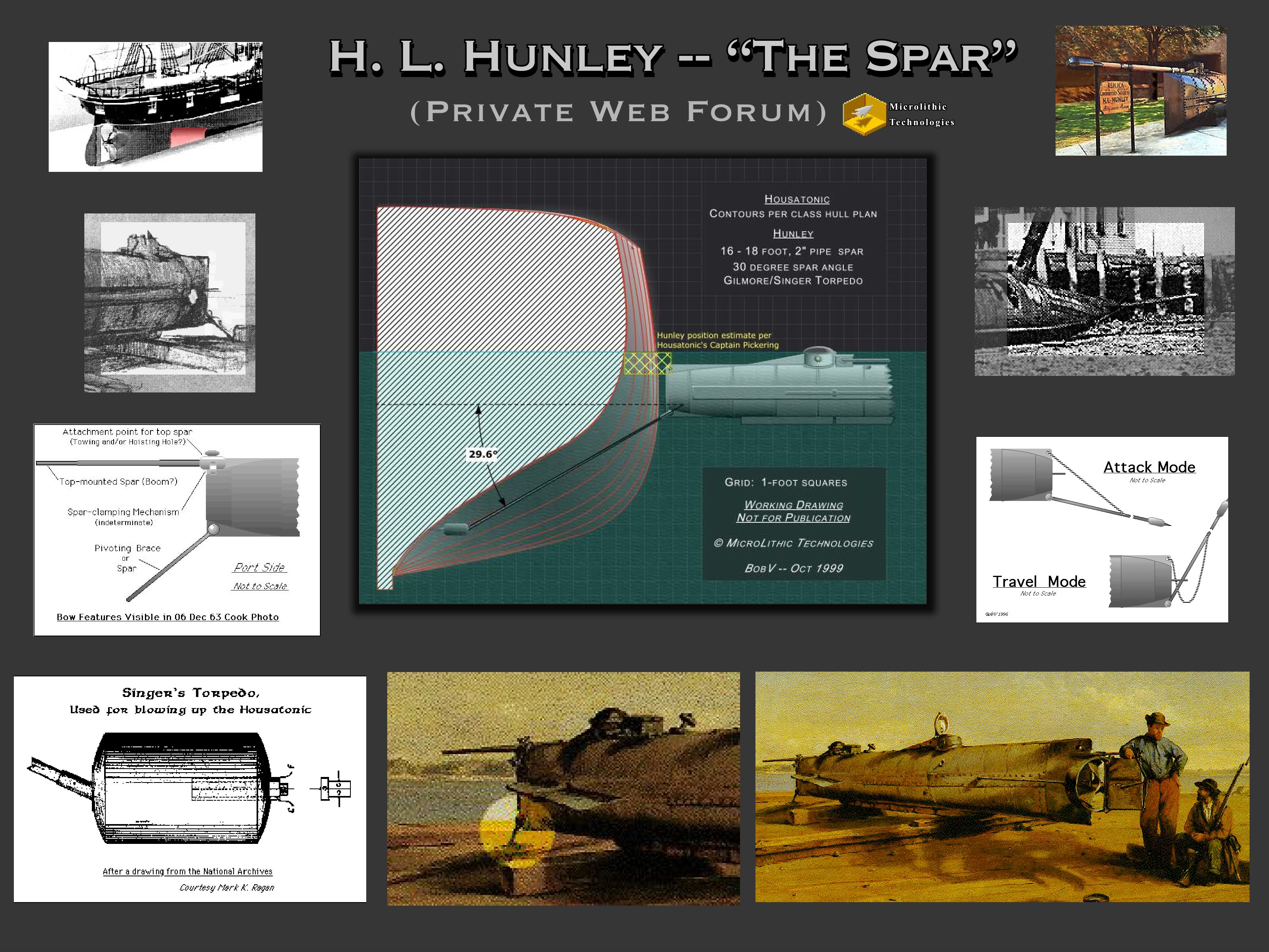
However, everyone thought that the torpedo had a spike that was rammed into the target, and a shear pin released the torpedo so that the Hunley could back away a safe distance and fire the torpedo by pulling a lanyard.

But, that's not what was found. The remains of the torpedo were found still bolted onto the end of the 20' iron pipe spar!
The torpedo was still solidly attached to the Hunley when the 130-lb charge exploded!
I maintain that the shock --, hard- coupled up the iron shaft of the spar -- was a major contributor to the shock that killed the crew...
52 posted on
08/23/2017 7:12:34 PM PDT by
TXnMA
(Remember the Alamo! Remember Goliad! Treat George P. Bush like Santa Ana at San Jacinto!!!)
FreeRepublic.com is powered by software copyright 2000-2008 John Robinson