~~~~~~~~
That was how they tried to do it at first. However, tides and currents caused the floating torpedo to catch up with them and nearly blew them up.
I hosted a research forum on how the torpedo was deployed -- before any attempt was made to raise Hunley. We predicted that the torpedo was on a 20' metal spar, pivoted on a y-yoke off the bottom of the bow, and deployed at a downward angle of 30 degrees -- and that is exactly what was found when the bow was excavated. (The torpedo spar -- in its own cradle -- was the first part of the Hunley to be raised.)
Here's a page from that 1998-1999 forum:
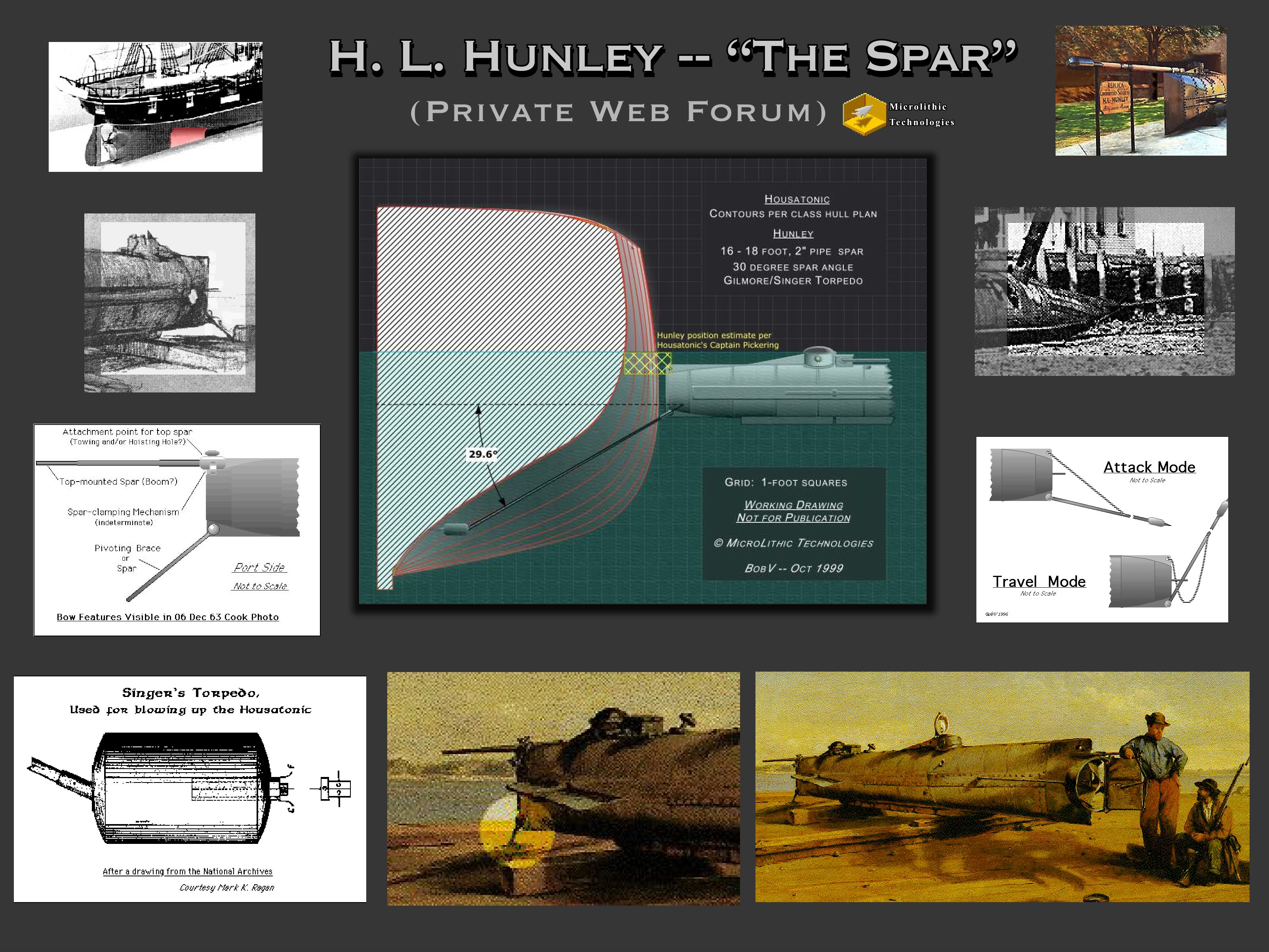
However, everyone thought that the torpedo had a spike that was rammed into the target, and a shear pin released the torpedo so that the Hunley could back away a safe distance and fire the torpedo by pulling a lanyard.

But, that's not what was found. The remains of the torpedo were found still bolted onto the end of the 20' iron pipe spar!
The torpedo was still solidly attached to the Hunley when the 130-lb charge exploded!
I maintain that the shock --, hard- coupled up the iron shaft of the spar -- was a major contributor to the shock that killed the crew...