Posted on 08/08/2017 8:21:39 AM PDT by sukhoi-30mki
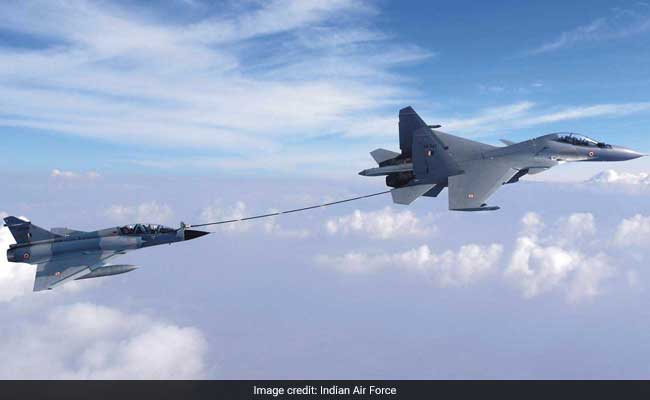
An Indian Air Force Mirage 2000 refuels mid-air from a Su-30 buddy-tanker
NEW DELHI: Indian Air Force fighter jets will be able to effectively tackle Chinese Air Force fighters over Tibet in the event of hostilities between the two countries. A new yet-to-be-released document, "The Dragon's Claws: Assessing China's PLAAF Today" makes the point that the IAF has significant operational advantages over the Chinese Air Force in operations in the Tibetan Autonomous Region which lies to the North of the Line of Actual Control between the two countries.
Written by Squadron Leader Sameer Joshi, a former Indian Air Force Mirage 2000 fighter pilot and produced by Vayu Aerospace, the document is the first comprehensive Indian assessment of the air power balance between India and China since the crisis in the Doklam plateau broke out last month.
According to Squadron Leader Joshi, "Terrain, Technology and Training, will assuredly give the IAF an edge over the PLAAF (People's Liberation Army Air Force) in Tibet and southern Xinjiang, counterbalancing the numerical superiority of the PLAAF, at least for some years to come."
The altitude of China's main airbases "along with the prevalent extreme climatic conditions seriously restrains the performance of aircraft, which reduces the effective payload and combat radius by an average of 50%." In other words, the lower density of air at high-altitude Tibetan bases prevents Chinese Air Force fighters such as the Su-27, J-11 or J-10 from taking off with a full complement of weapons and fuel. These aircraft would, therefore, enter a fight with the IAF at a severe disadvantage in the event of a conflict. The IAF, on the other hand, operates fighters in the Northeast from bases such as Tezpur, Kalaikunda, Chabua and Hasimara which are located near sea level elevations in the plains. This means "the IAF has no such restrictions and will effectively undertake deep penetration and air superiority missions in the Tibetan Autonomous Region."
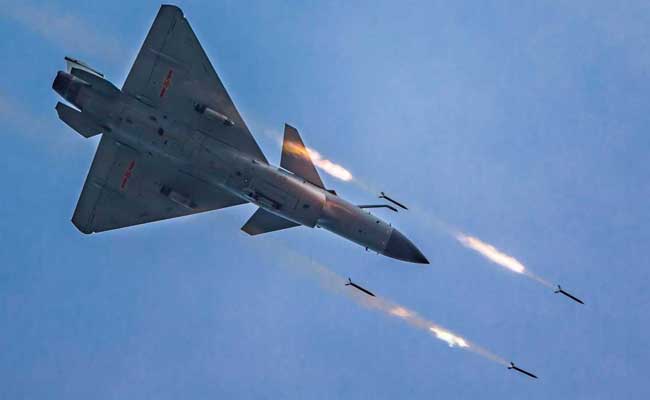
The Chinese J-10B is a lightweight multi-role fighter jet
What's more, the Indian Air Force is thought to be a more nimble force which "focusses much more on experience in air combat and varied weapon delivery, backed by exposure at multinational exercises, to maintain a 'qualitative' edge over its foes." At the same time, both Air Forces are challenged by the mountainous terrain which makes detection of each other's aircraft difficult. In such a situation "terrain hugging fighters, masked by innumerable mountain valleys of the TAR (Tibetan Autonomous Region), will be a major factor for the both sides, delaying crucial early warning to the defenders."
What's clear though is that while the Indian Air Force can clearly match or better the Chinese Air Force in the event of a limited air-war, China's substantially larger ballistic missile forces makes the IAF's infrastructure distinctly vulnerable to attack. China also operates a host of relatively advanced surface-to-air missile systems such as the S-300, HQ-9 and HQ-12 "all of which pose a grave danger to the IAF although they are reliant on early detection for success."
In the long run however, China's rapidly expanding Air Force which is now in the process of inducting home-grown stealth fighters such as the J-20 will gain meaningful regional air superiority unless the Indian Air Force gets "an adequate number of fighter aircraft to simultaneously protect the western and north-eastern borders."
Would they get into a fight? Over Macho Grande?
“I don’t think I’ll ever get over Macho Grande.”
Hmmmm.
Maybe a country could give money to Israel. Israel could he sell SAMs, training, AWACS and other crucial items to the Indians at a favorable price.
You know, kind of like the way North Korea “provides” nuclear technology to Pakistan.
I think they are already cooperating. India has more recent combat experience with Pakistan. China is a huge question mark.
The key word is ‘limited’.
Old Uncle Joe once said something like “Quantity has a quality all its own”.
And China has a hoard and more.
I don’t think Israel can spare any of those, especially AWACS.
India should be buying the F-35.
Already they will be the worldwide center of F-16 construction. The latest version of the F-16, with proper avionics/weapons is a match for anything China has in the air.
China has an industrial base that can replace aircraft loses from attrition. India does not. This is why protecting the USA’s industrial base is so important, more important than the actual number of aircraft ships tanks etc. we have on hand at any given moment.
Legally, Indian jets shouldn’t be over Tibet unless in pursuit of Chinese aircraft that have invaded Indian airspace.
Practically, as the Japanese have learned, aggressive Chinese incursions have to be generally tolerated.
The Turks may have had the legal right to shoot down a Russian aircraft a few months ago, but the result was only to anger the Russian bear.
Only by economic measures, not by military responses, can Chinese incursions be limited or eliminated.
Both China and India have substantial numbers of nuclear weapons.
Neither country should follow a path that could lead to nuclear devastation.
The Chinese should realize that India, unlike Japan, can hit back hard.
“Legally, Indian jets shouldn’t be over Tibet unless in pursuit of Chinese aircraft that have invaded Indian airspace.”
I never DID get the airspace thing. Is altitude involved? What about commercial and/or private planes?
.
sOUNDS A Little like some “FLYING Tigers HISTORY” AGAINST, (FORGIVE ME), JAP Planes in pre-WWII.
The only problem with China losing an Air War, would be the escalation to ICBMs or IRBMs.
Nuclear.....
Really? That’s a fact?
Odd, since they’ve already had a border WAR and multiple border skirmishes, and they didn’t escalate to total war:
https://en.wikipedia.org/wiki/Sino-Indian_War
https://en.wikipedia.org/wiki/EL/W-2090
https://en.wikipedia.org/wiki/1987_Sino-Indian_skirmish
“Only by economic measures, not by military responses, can Chinese incursions be limited or eliminated.”
Hmmm. These economic measures seem especially effective:
https://en.wikipedia.org/wiki/Sino-Vietnamese_War
Hahahaha!
1962 skirmish and an 87 ground skirmish....???
The article and I specifically addressed the possible loss in an AIR WAR.
Do you notice any difference?
Disclaimer: Opinions posted on Free Republic are those of the individual posters and do not necessarily represent the opinion of Free Republic or its management. All materials posted herein are protected by copyright law and the exemption for fair use of copyrighted works.