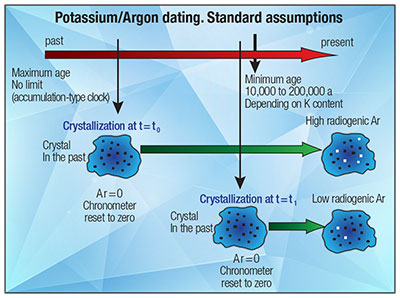
One of many images from the ICR article.
Posted on 12/01/2014 5:04:54 AM PST by fishtank
The Noble Clock: Radioactive Dating, Part 3
by Vernon R. Cupps, Ph.D. *
Radioactive dating methods—many of which are quite elaborate—have numerous physical condition requirements that cannot realistically remain unaffected over millions and perhaps billions of years. Since the potassium-argon dating methods clearly appear to be unreliable, why should any rational person trust them to provide accurate dates for rocks?
In the early 1950s, scientists established theories for using the decay of radioactive potassium (40K) to argon (40Ar) as a clock for dating certain types of rocks. Called “noble” because it rarely bonds with other elements, argon (Ar) is one of the six noble gases. The others include helium (He), neon (Ne), krypton (Kr), xenon (Xe), and radon (Rn).
(Excerpt) Read more at icr.org ...
MeV is an abbreviation for the energy unit of one million electron volts. One eV is defined as the amount of energy gained (or lost) by the charge of a single electron moved across an electrical potential difference of one volt. One MeV is 106 eV.
Hurlbut, C. S., et. al. 1977. Manual of Mineralogy, 19th ed. New York: John Wiley & Sons, 428. Sanidine is potassium feldspar mineral, KAlSi3O8, which is considered the best specimen for dating using the K-Ar methodology.
Faure, G. 1986. Principles of Isotope Geology, 2nd ed. New York: John Wiley & Sons, 67. Blocking temperature, or more generally closure temperature, is defined as the temperature at which the loss of 40Ar by diffusion out of a given mineral or rock suite is negligible compared with its rate of accumulation.
Fractionation is the separation of isotopes through chemical and physical processes and occurs frequently during the cooling of igneous rocks as they come into the crust and solidify.
Cupps, V. 2014. Clocks in Rocks? Radioactive Dating, Part 1. Acts & Facts. 43 (10): 8-11.
Cross-sections for the reaction 39K(n, γ)40K range from approximately two barns (10-24 cm2) for three MeV neutrons to 1,000 barns for one eV neutrons. These are very large cross-sections for nuclear reactions.
Cupps, V. 2014. The Iconic Isochron: Radioactive Dating, Part 2. Acts & Facts. 43 (11): 10-13.
Faure, Principles of Isotope Geology, 74. J is the isotope production factor. In order to evaluate the amount of 39Ar generated during the irradiation of 39K, the amount of 39K must be known as well as the time over which the irradiation occurs, the number (flux) of neutrons of a given energy which strike the sample during the irradiation, and finally the cross section (or probability of the reaction occurring) at the given energy. Summing (integrating) the product of these factors over the entire energy spectrum of the neutrons generated by a specific nuclear reactor will then yield the amount of 39Ar formed by the irradiation.
Faure, Principles of Isotope Geology, 95.
Brereton, N. R. 1970. Corrections for Interfering Isotopes in the 40Ar/39Ar Dating Method. Earth and Planetary Science Letters. 8 (6): 427-433.
Spallation is the process by which a nuclear projectile, such as a proton or neutron, breaks a target nucleus into two or more component parts.
Snelling, A. A. 2000. Geochemical Processes in the Mantle and Crust. In Radioisotopes and the Age of the Earth: A Young-Earth Creationist Research Initiative. El Cajon, CA: Institute for Creation Research and St. Joseph, MO: Creation Research Society, 128.
* Dr. Cupps is Research Associate at the Institute for Creation Research and received his Ph.D. in nuclear physics from Indiana University-Bloomington.
Cite this article: Vernon R. Cupps, Ph.D. 2014. The Noble Clock: Radioactive Dating, Part 3. Acts & Facts. 43 (12).
One of many images from the ICR article.
Ive had a few radioactive dates....
Oh...I thought someone had written an unauthorized biography on me....
Disclaimer: Opinions posted on Free Republic are those of the individual posters and do not necessarily represent the opinion of Free Republic or its management. All materials posted herein are protected by copyright law and the exemption for fair use of copyrighted works.