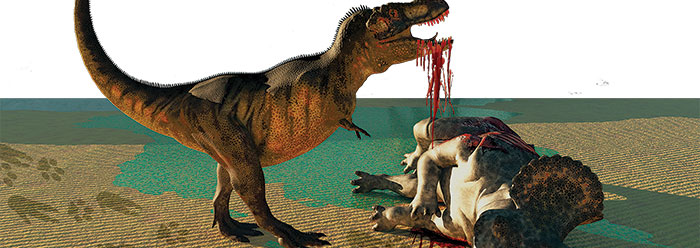
Image from ICR article.
Posted on 11/07/2013 6:01:31 AM PST by fishtank
Tyrannosaurus rex: Scavenger or Predator?
by Tim Clarey, Ph.D. *
Tyrannosaurus rex looms in recent history as likely the most famous dinosaur that ever lived. The Jurassic Park movies pumped new life into its image as a savage predator. But how much of this is Hollywood hype and how much reflects science?
Looking at the numbers, an adult T. rex weighed in at over five tons. If it were endothermic (i.e., warm-blooded), it would need to eat the equivalent of a full-grown, three-ton hadrosaur each week. If it were ectothermic (i.e., cold-blooded), it would only require a fifth to a tenth as much sustenance. Research on the eating habits and predatory patterns of T. rex lends some interesting results.
Studies of bite mechanics support the notion that T. rex was truly the “king of dinosaurs.” Scientists in England used dynamic musculoskeletal models to simulate its bite strength and found it nearly doubled that of an equivalent-size alligator.1 Such strength explains the numerous teeth marks imprinted on dinosaur fossils and found to match T. rex’s unique, D-shape teeth. Gouges from large carnivore teeth were even identified on a T. rex toe bone, implicating possible cannibalism.2 The question is, what was this great strength used for—scavenging, predation, or both?
Paleontologist John R. Horner thinks T. rex was exclusively a scavenger, surmising it was slow in speed and pointing to its massive olfactory lobe that likely enabled it to smell carcasses from afar. However, healed wounds, caused by an animal the size of T. rex and found on Triceratops and Edmontosaurus dinosaur skeletons, indicate these creatures survived predatory attack.3 Most recently, scientists reported finding the tip of a T. rex tooth embedded in the backbone of a duck-billed dinosaur.4 The backbone had healed around the tooth, demonstrating survival after the failed attack. Such evidence aligns with conclusions by some paleontologists that there weren’t enough carcasses available for T. rex to subsist only by scavenging.5 Finally, contrary to perceptions of these creatures as “slow,” they were certainly fast enough to catch their dinner. A study using biomechanical models determined an adult T. rex could run about 18 miles per hour—fast enough to capture prey.6 These findings imply that T. rex probably ate whatever it came across—as an opportunist, and not just a scavenger.
Regardless of its bite strength and teeth, in God’s original creation even T. rex was a vegetarian, like all other animals.7 It wasn’t until after the sin of man and the Curse that T. rex became a meat-eater—Genesis 3:14 extends the Curse to every beast, which included dinosaurs. With those massive teeth, it’s still a mystery as to exactly what type of vegetation T. rex ate.
Recently, scientists documented fruit and plant consumption in 13 of the 18 species of crocodilians, classifying them as “generalist predators that complement an otherwise carnivorous diet with fruit.”8 In the same way, fruit and plants probably served as supplements to the mighty T. rex after the Curse. In fact, according to Genesis 6:21, the Ark stored a wide variety of plants, grains, and nuts for the year-long journey during the Flood. Preservation of each species would have required animals on the Ark to survive exclusively on a vegetarian diet.
Although discoveries of some predators consuming plants may surprise evolutionary scientists, creationists expect them. Tyrannosaurus rex may have had the strongest bite and the biggest teeth of any dinosaur, but it once survived on a diet of plants alone. In spite of its reputation as a violent aggressor, T. rex actually reveals God’s creativity in its anatomy and the diversity of its eating habits, which allowed for survival in a variety of conditions.
References
Bates, K. T. and P. L. Falkingham. 2012. Estimating maximum bite performance in Tyrannosaurus rex using multi-body dynamics. Biology Letters. 8 (4): 660-664.
Longrich N. R. et al. 2010. Cannibalism in Tyrannosaurus rex. PLoS ONE. 5 (10): e13419.
Brusatte, S. L. 2012. Dinosaur Paleobiology. Chichester, UK: John Wiley and Sons, Ltd., 169-171.
DePalma II, R. A. et al. 2013. Physical evidence of predatory behavior in Tyrannosaurus rex. Proceedings of the National Academy of Sciences. 110 (31): 12560-12564.
Carbone, C., S. T. Turvey, and J. Bielby. 2011. Intra-guild competition and its implications for one of the biggest terrestrial predators, Tyrannosaurus rex. Proceedings of the Royal Society B. 278 (1718): 2682-2690.
Sellers, W. I. and P. L. Manning. 2007. Estimating dinosaur maximum running speeds using evolutionary robotics. Proceedings of the Royal Society B. 274 (1626): 2711-2716. Genesis 1:30.
Platt, S. G. et al. Frugivory and seed dispersal by crocodilians: an overlooked form of saurochory? Journal of Zoology. Published online before print July 16, 2013.
* Dr. Clarey is Research Associate at the Institute for Creation Research and received his Ph.D. in geology from Western Michigan University.
Cite this article: Tim Clarey, Ph.D. 2013. Tyrannosaurus rex: Scavenger or Predator?. Acts & Facts. 42 (11).
Image from ICR article.
Yes.
I thought they were domesticated...
Fortunately, there were plenty of those available at the time.


We report, you decide.
I can’t even imagine these monsters on earth. Don’t you love things that provide grant money...forever!!
Oh? Woah.
Barney the T-Rex.
Maximum swipage imminent.
How funny, there was another topic similar to this just this morning on here.
Yeah, I remember reading/hearing that many scientists had concluded that T Rex was too big and clumsy to be a serious aggressor. More like just a great big brutish scavenger that would come along and take away a carcass from the smaller predators that actually did the real killing. Their massive teeth and jaws were more for breaking bone, getting at the marrow, and maximizing the take from each carcass rather than clamping down on the necks of big plant-eaters and bringing them down in bloody all-out fights.
On my so I guess all these scientists have never seen bears eat berries or know about the word omnivore.
What does a five ton T Tex eat? Anything it wants to.
"And the Lord God said unto the serpent, Because thou hast done this, thou art cursed above all cattle, and above every beast of the field; upon thy belly shalt thou go, and dust shalt thou eat all the days of thy life:"
~ Gen. 3:14

So it would seem that T. Rex was a...umm...dust eater.

Well, if you believe in evolution, it is very possible the ancestors of T. rex were herbivores and later evolved into carnivores. There is no way T. rex ate plant material.
I guess one needs to be enough of a Biblical Scholar to go back and see what the ACTUAL ORIGINAL HEBREW WORDS were here and be enough of a scholar to ADEQUATELY TRANSLATE the same.
The Bible was intended to be a message from God to man about faith, God, loss of Paradise, the Savior, redemption, and the way man should relate to God and to his fellow man.
It was never intended to be a biology, geology or history primer although it contains elements of all of them.


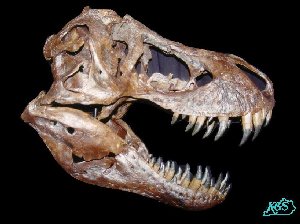
Yes, those are the teeth of a broccoli eater. Being a creationist in 2013 requires equal parts ignorance and idiocy.
This is the best part of the article:
“In fact, according to Genesis 6:21, the Ark stored a wide variety of plants, grains, and nuts for the year-long journey during the Flood. Preservation of each species would have required animals on the Ark to survive exclusively on a vegetarian diet.”
Yep, the Earth is 6000 years old and the millions of species all fit on a ship and ate appetizers.
Disclaimer: Opinions posted on Free Republic are those of the individual posters and do not necessarily represent the opinion of Free Republic or its management. All materials posted herein are protected by copyright law and the exemption for fair use of copyrighted works.