Posted on 08/24/2012 8:35:43 AM PDT by Second Amendment First
First of a five-part series
The history of fire in the American Southwest is buried in a catacomb of rooms under the bleachers of the football stadium at the University of Arizona.
Here rules Professor Thomas Swetnam, tree ring expert. You want to read a tree ring? You go to Tom. He's a big, burly guy with a beard and a true love for trees.
"Around 1890 or 1900, it stops," Swetnam says. "We call it the Smokey Bear effect."
Settlers brought livestock that ate the grass, so fires had little fuel. Then when the U.S. Forest Service was formed, its marching orders were "no fires."
And it was the experts who approved the all-out ban on fires in the Southwest. They got it wrong.
That's the view of fire historian Stephen Pyne.
"The irony here is that the argument for setting these areas aside as national forests and parks was, to a large extent, to protect them from fire," Pyne says. "Instead, over time they became the major habitat for free-burning fire."
So instead of a few dozen trees per acre, the Southwestern mountains of New Mexico, Arizona, Colorado and Utah are now choked with trees of all sizes, and grass and shrubs. Essentially, it's fuel.
And now fires are burning bigger and hotter. They're not just damaging forests — they're wiping them out. Last year, more than 74,000 wildfires burned over 8.7 million acres in the U.S.
That included the huge Wallow fire in Arizona.
"It burned more than 40,000 acres in the first eight hours," says Swetnam, the tree ring expert. "A tornado of fire."
Fires in the Southwest have been getting bigger and bigger over the past two decades.
"Now the fire behaviors are just off the charts," Swetnam says. "I mean, they are extraordinary. Actually, I think in some cases, they're fire behavior that probably these forests haven't seen in millennia or maybe even tens of thousands of years."
The choice is not whether or not these forests burn. The choice is how they burn.
Over the past several years, even as fewer fires have struck the Southwest, they've burned more land. The U.S. Forest Service now spends about half its budget on firefighting.
Many fire experts embrace controlled, or "prescribed," fires — purposely set fires that do the cleanup job that small natural fires once did. It takes the tinder out of the tinder box.
But people have built homes and towns close to forests; they don't like the smoke, and prescribed burns sometimes get out of control. The Cerro Grande fire in New Mexico in 2000 was a controlled fire — until it jumped fire lines and destroyed hundreds of homes.
I talked to veteran fire manager William Armstrong of the U.S. Forest Service about that, sitting on a ridge near Santa Fe, where he has done prescribed burns himself. Armstrong says people must accept fire in their lives.
"Large blocks of forest — if they want those — then what they must understand is that fire is inevitable," he says.
A Smokey the Bear fire prevention sign sits in Valles Caldera along Highway 4, which was one of the front lines in fighting the Las Conchas Fire in 2011.
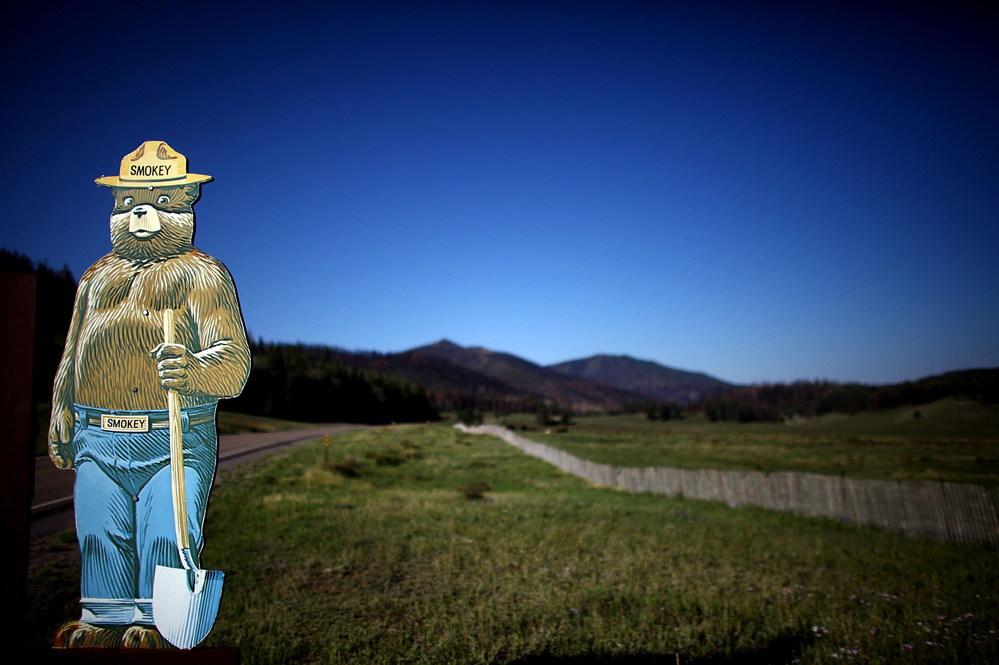
A Smokey the Bear fire prevention sign sits in Valles Caldera along Highway 4, which was one of the front lines in fighting the Las Conchas Fire in 2011.
He says to save forests from total annihilation — and the wildlife and water supplies they protect — you have to set some fires and let some natural fires burn.
"The choice is not whether or not these forests burn," Armstrong says. "The choice is how they burn. What kind of intensity are we going to see those burn at?"
But as fire experts like Craig Allen, an ecologist with the U.S. Geological Survey in New Mexico, are now discovering, fire is increasingly out of their control.
"Basically, the mountains in the Southwest — you can almost think of them as caskets of fuel," Allen says. "Gunpowder has been building up in these things for a century, and now it's dangerous to try to defuse."
Immanentizing the eschaton. Nature doesn’t know what it’s doing — we know better. Humans can step in and help the earth “get it right” and that will help us get a little closer to creating Heaven on Earth. Sheesh!!
The do-gooders are responsible for most of the bad stuff around us.
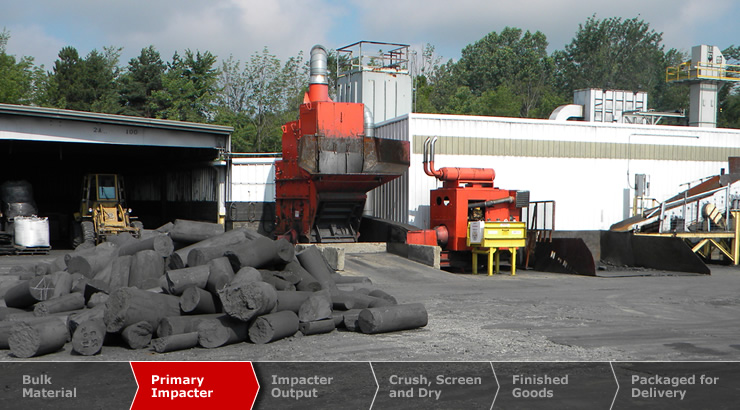
Here's a few tons of graphite (carbon) in the atmosphere for ya'!!!
Where are all the CO2 global warming crybabies about the forst fires pumping who-knows-how-many-millions of tone of CO2 into the air????
Hypocrites.........
We’ve changed the way trees grew naturally in that area and are paying the consequences. There was a reason they were spaced like they were.
For those who don’t know there was a natural progression of tree spacing between the thick Eastern forests and the mostly treeless prairies. Part of it was called the oak barrens IIRC. The oaks were spaced well and the thick bark could withstand the periodic fires. You can still see examples in Indiana and the Chicago area.
Secondly, grazing was allowed. The cattle and sheep ate the grasses down thereby eliminating much of the fuel that allows fires to spread rapidly.
Thirdly, with the advent of the 'green movement', the grazing was pushed out of the forests and it became more cost effective for sheep and cattle ranchers to feed their animals in containment lots.
Finally, houses were allowed to be constructed where there should never be houses. A prescription for disaster.
There you have it. Just what I have observed over the past 50 years.
I agree, but be prepared to be savaged here for that one.
There is whole lot of wisdom to human’s admitting they are no substitute for what nature is designed, and destined, to do herself.
When it comes to the forested lands in the west, preventing the natural course of occasional fires has only “enraged the natural process”.
I know, but I have been savaged, here, before.
Disclaimer: Opinions posted on Free Republic are those of the individual posters and do not necessarily represent the opinion of Free Republic or its management. All materials posted herein are protected by copyright law and the exemption for fair use of copyrighted works.