
From the APA site
Posted on 10/05/2010 5:50:20 AM PDT by sukhoi-30mki
Strategic Needs and Force Structure Analysis: The Thinking Behind the F-22A and Evolved F-111 Force Mix Option (excerpt)
(Source: Air Power Australia; published Oct. 4, 2010)
Air Power Australia, a group of Australian opponents to the Joint Strike Fighter which have, in the past, published interesting analysis of the aircraft’s drawbacks and operational shortcomings, have now come up with a proposal to instead upgrade the F-111 strike fighters that the Royal Australian Air Force is due to retire at year-end. Their rationale for modernizing the F-111, excerpted from an improbable political fiction scenario backing their call for parallel procurement of F-22s, is excerpted below--Ed.
The Evolved F-111
The US Air Force, cognisant of the value of dedicated large bomber aircraft, plans to operate the 1962 built B-52H and 1985 built B-1B until the 2040 timescale. Survivability will be ensured by ongoing upgrades in defensive avionics, guided weapons and by the provision of the lethal F-22A escort fighter. To support this paradigm, the US Air Force will perform the necessary structural relifing of key components in these aircraft, and an ongoing program of new technology insertion to reduce operating costs and improve capability 4041.
There is no fundamental or sound reason why Australia cannot pursue a similar strategy with the F-111, operating it into the 2030 to 2040 timescale in parallel with a capable escort fighter, such as the F-22A. The ‘Evolved F-111’ concept is a model for accomplishing exactly this, through a force structure mix of the F-22A and ‘Evolved F-111’ aircraft. It incorporates a wide range of feasible technological growth paths for the F-111 which exploit 5th generation fighter technology to retain survivability and lethality, while progressively reducing support costs.
These F-111 growth paths include a glass cockpit, ‘phased array’ AESA radar, advanced high speed datalink, advanced imaging chips, high performance computers, supersonic cruise propulsion, internal ‘small diameter bombs’, significant radar cross section reduction through the application of advanced composite and laminate materials, and liquid cooling of future avionics. The underlying aim of these upgrades, other than stated improvements in supportability and basic capability, is to provide a highly evolvable sensor architecture capable of meeting the needs of future information intensive and network centric combat. Like the F-22A, the Evolved F-111 is intended to be an ‘information-gathering asset’, capable of achieving ‘information superiority’ over opposing forces42.
Importantly, replacement of the existing legacy TF30 series engines would result in economically significant improvements in fuel burn, long term support costs and also performance, including endurance and range. Engineering studies show this is a low risk effort, choices including the GE F110 and P&W F119 series engines43.
Notably, the system architecture of the F-111 fleet following the 1990s AUP (Avionics Upgrade Program) and the BUP (Block Upgrade Program) programs as undertaken by Boeing Australia Limited is well suited to such upgrades. This is because future growth had been taken into account in the development of these designs - designs done by Australians for Australians.
As a mothballed stockpile of 70+ F-111F, 50+ F-111D and around thirty EF-111A aircraft reside in the US AMARC storage facility and are available at very low cost, the opportunity exists to not only stockpile significant quantities of structural spare components in Australia, but to also expand the existing F-111 fleet at a very low incremental cost44.
By doing so, Australia would retain and enhance its most lethal combat asset, and extract dividends in a number of key areas:
1. A program of ongoing small incremental technology upgrades does not incur the large peaks in annual defence expenditure characteristic of new aircraft purchases.
2. Current estimates would indicate that the retention of an upgraded and much cheaper to maintain F-111 would allow a larger fraction of the planned fighter replacement funding package to be invested into the replacement of the F/A-18A/B aircraft. This would permit the introduction of a genuine 5th generation air superiority fighter - the stealthy supercruising F-22A. Rather than adopt a technologically obsolete evolved third generation fighter like the F/A-18F Super Hornet, or the narrowly optimised F-35 Joint Strike Fighter which represents a hybrid of third, fourth and fifth generation design philosophies, the taxpayer could be given a robust capability which retains its combat value over the longer term45.
3. An Evolved F-111 could be very precisely tuned in capability to the ADF’s unique geographical and strategic needs, thereby avoiding the fundamental losses in capability which result from adopting ‘off the shelf’ production fighters optimised for European, Middle Eastern or other less demanding, short range, strategic environments.
4. The depth of ADF and Australian Aerospace Industry experience with the F-111 allows risks in force expansion and upgrades to be very precisely estimated in comparison with new types of combat aircraft.
5. The political risks, at home and abroad, in the retention and upgrading of the F-111 fleet are significantly lower than in the deployment of alternative aircraft types which are newer by airframe design, and thus attract attention.
6. A wholly domestically supported F-111 weapon system allows the ADF to respond very quickly with technological adaptations to a changing environment, examples being new weapons or radar modes. Any alternative aircraft choice queues ADF adaptation needs behind those of larger overseas clients.
7. A series of ongoing upgrades and support work for the F-111 would provide Australia’s Aerospace Industry with a core activity to sustain personnel and facilities, thereby facilitating future growth into other areas.
8. As the F-111 has the endurance and combat radius to perform many roles with little or no aerial refuelling support, important operational economies could be realised in comparison with a smaller multirole aircraft which cannot function effectively without continuous tanker support.
9. Judicious choices in radar/datalink and electro-optical upgrade technology and architecture would enable a genuine dual role strike/recce capability in every Evolved F-111 aircraft.
10. The provision of supersonic cruise propulsion in the Evolved F-111 would result in a doubling of achievable combat sortie rates in long range strike/recce operations, against every alternative fighter other than the F-22A, while providing engine commonality with the F-22A.
11. There is greater potential for the cost effective insertion of advanced technologies, such as sensor fusion software and systems, into the Evolved F-111 than could be achieved on smaller, foreign designed fighters. This in turn facilitates maintenance of the ‘Knowledge Edge’ throughout the life cycle of the aircraft.
12. The Evolved F-111 has significant growth potential in a number of Defensive Counter Air roles, such as cruise missile defence and the intercept of long range/heavy aircraft. Therefore some economies could be realised in numbers of F/A-18A/B replacement air combat fighters.
13. As a ‘coalition warfare asset’ the F-111 offers considerable firepower and persistent bombardment capability, yet does so with comparable demands in scarce ramp footprint to less capable third generation multirole fighters. In many geographical environments, it imposes modest or little demand on scarce aerial refuelling assets. (end of excerpt)
Click here for the full paper (98 pages in PDF format) on the APA website.
-ends-
From the APA site
Regardless of technology, performance in the modern battlefield environment, or cost, the F111 has always maxed out the ‘cool’ factor.
It just looks like a bird of prey.
Looks pretty smart to me if they can get F-22’s.
Here is the new F-111 posting at Air Power Australia:
It really didn't do anything very well and the AF couldn't wait to get rid of it.
On the contrary, it performed the deep penetration strike mission very effectively. The Air Force got rid if it for two reasons:
1) The advent of GPS guided JDAMs negated the need for laser guided bombs such as the Paveway. With laser guided munitions, the attacking aircraft has to maintain laser designation of the target all the way to impact, and cannot simultaneously strike several targers.
2) The USAF needed to cut funds to pay for what it thought was going to be 370+ F-22s. They retired the F-111Fs and EF-111As, having the F-15E and EA-6B take over their roles, and applied the savings to the F-22.
Muammar Gadaffi would argue otherwise.
I think that the B-1 could perform the deep penetration strike mission better. It was stealthier, carried a larger bomb load, and had better endurance, but it wasn’t as fast. I know that the AF fighter pilot community really didn’t like the side-by-side seating.
As proof, the Russians took the Su-27 fighter and turned it into the Su-34 tactical strike aircraft, ala the F-15E Strike Eagle.
One of the changes was to replace the Su-27's tandem cockpit and replace it with a side-by-side cockpit.
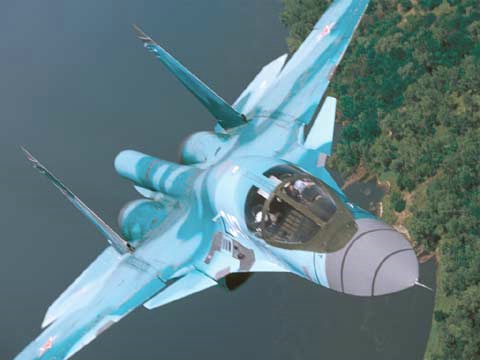
The back seaters in the F-4E and F-4G had to get a periodic cert in landing. They really hated it because they had really limited visibility forward, especially in the Weasel. I can see how it would be an advantage in surface attack aircraft. The visibility for co-pilot would be much better when watching for SAMs and IDing friendly forces.
I've used a rock to pound in nails, but that doesn't make it the best tool for the job. ;o)
The fault of the F-111 was its engines. With updated engines it is a killer.
Disclaimer: Opinions posted on Free Republic are those of the individual posters and do not necessarily represent the opinion of Free Republic or its management. All materials posted herein are protected by copyright law and the exemption for fair use of copyrighted works.