Here's a comment on the significance of CO2:
The total concentration (all there is since the beginning of time) of CO2 in the atmosphere is ~360 parts per million (ppm).
How big is 360 ppm?
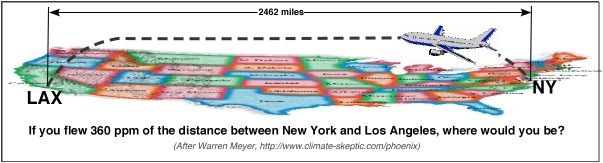
Posted on 04/03/2010 5:04:23 PM PDT by EBH
The Environmental Protection Agency (EPA) has proposed several changes to its greenhouse gas (GHG) registry, a new mandatory program requiring thousands of facilities economy-wide to monitor and report their emissions of global warming gases. EPA is proposing to add oil and natural gas facilities and facilities that inject carbon dioxide (CO2) underground for storage, along with other facilities. EPA also wants to collect additional data from all covered businesses to get a better understanding of emissions at the corporate level and within whole industry sectors, not just by facility. Overall the changes would strengthen the registry and provide the agency and the public with crucial additional information needed to design policies to mitigate climate change and hold polluters accountable. After Congress required EPA to design a system for mandatory reporting of GHG emissions, the EPA finalized a mandatory reporting rule in Oct. 2009. By requiring the largest emitters of GHG from a broad section of the economy to monitor and report their pollution, policymakers and the public are provided an invaluable information tool. Current and future climate change policies, shareholder actions, decision-making by businesses and individuals, and basic corporate and government accountability all depend on this registry. We must know who is polluting and how much.
At the time EPA's reporting rule was finalized, however, the agency refrained from including several key industries, preferring instead to collect more public comments and do more analyses before adding them to the program. This week the agency acted on several of the remaining industries, including oil and natural gas systems.
Oil and natural gas systems include onshore and offshore wells, along with certain processing plants, storage, and distribution systems. This proposed addition would add an estimated 351 million tons CO2e to the registry. ("CO2e" means carbon dioxide equivalent, a unit of measure that relates the global warming potential of all the greenhouse gases.)
EPA also proposes requiring all covered facilities to report their corporate parent and to describe their primary and other related industries. EPA is choosing to have each facility select from a standard list of industry classifications known as the North American Industry Classification System (NAICS). These are worthy additions. It certainly is not too much to ask that a facility report who owns it, even if there are multiple owners each owning different percentages. Accountability requires that investors, government, and the public know who are responsible. The inclusion of the NAICS code greatly improves the ability of researchers to analyze and use the information.
The agency is also proposing requiring facilities that inject CO2 underground to report the net amount that goes underground. Many hope that such CO2 injections, known as geologic sequestration, will allow major polluters such as coal-burning power plants to capture the CO2 before it leaves their smokestacks and permanently store it in geologic formations deep underground, ostensibly rendering it harmless from a climate change perspective. The oil and gas industry has for decades injected CO2 underground in order to force out the last drops of fossil fuel (these facilities will also have to report). However, widespread use of this practice for carbon sequestration is still years in the future. Nevertheless, EPA wants to be sure to have the data in order to evaluate how well it works.
The final proposed expansion announced this week would require the reporting of fluorinated GHGs, which are the most potent global warming gases and include hydrofluorocarbons (HFCs), nitrogen trifluoride (NF3), perfluorocarbons (PFCs), and sulfur hexafluoride (SF6), by the largest emitters of these gases.
The proposed thresholds for reporting for all of the added sources is 25,000 tons of CO2e, the same threshold that is applied to the other polluters. However, these late additions get a one-year extension; they do not have to report their emissions until 2012.
More Actions Anticipated
At the time the original mandatory reporting rule was issued, EPA also postponed designing a plan to deal with information that companies claim are trade secrets. Businesses are notorious for inappropriately labeling all sorts of information as "classified business information" (CBI) in an attempt to hide information about their activities and products that should be publically disclosed. The CBI label is intended for legitimate business information that would hurt a company's bottom line if disclosed to competitors. EPA still needs to clarify how it will prevent businesses from abusing the CBI privilege and make sure the public has access to all the information to which we are entitled.
We are also hoping that before too long the agency will begin taking public comments on the design of the electronic reporting system. The architecture of the system will play a significant role in the overall usefulness of the registry, influencing what kinds of analyses can be done, how well the data can be linked to other types of information, and how easily the public can use the information.
EPA is expected to propose rules adding additional sectors to the registry, such as ethanol production, underground coal mines, wastewater treatment, suppliers of coal, magnesium production, industrial landfills, and food processing. Food processing plants, for example, release millions of tons of methane every year from their onsite wastewater treatment plants and landfills. Foolishly, Congress effectively banned EPA from gathering pollution data from manure management systems at factory farms, which are major methane and nitrous oxide emitters.
Public comments will be accepted as soon as the agency officially publishes the proposed rules. Public hearings are already scheduled in Washington, DC on April 19 for the addition of the oil and gas and carbon sequestration facilities, and on April 20 for the reporting of fluorinated GHGs.
I f*rt in their general direction.
The number one greenhouse gas is water vapor (H2O).
“Public comments will be accepted as soon as the agency officially publishes the proposed rules.”
John Galt would send letters to the agency demanding that all companies be required to report their discharge of water vapor since water vapor us actually the most significant greenhouse gas. Soon, the Obama administration would be requiring restrictions on the release of water vapor. Then the capitalist system would collapse, and John Galt would take the credit.
Yep, 95X more significant than CO2...
Here's a comment on the significance of CO2:
The total concentration (all there is since the beginning of time) of CO2 in the atmosphere is ~360 parts per million (ppm).
How big is 360 ppm?
Your wheels would still be on the runway in New York...
They truly want to kill this country.
All these ABC agencies need to be eliminated, and if re-authorized later they musy each have ‘’provision’’ and be re-authorized anew, if desirable.

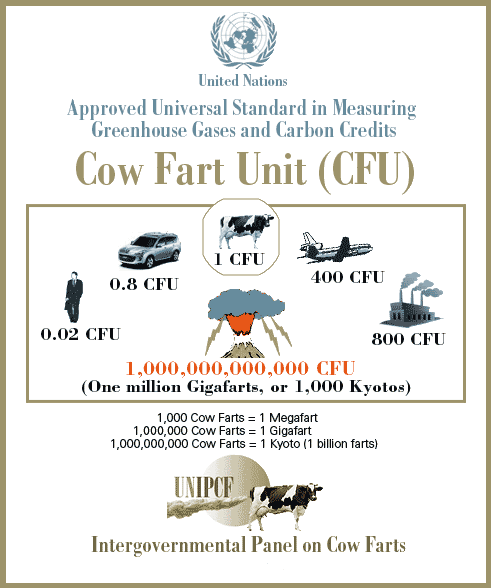


The Competitive Enterprise Institute will be bestowing the Julian Simon Award on Steve McIntyre and Ross McKitrick for their efforts in debunking Mann's hockey stick at CEI's 2010 Dinner, June 17 at Hyatt Regency Capitol Hill 400 New Jersey Ave. NW Washington, DC 20001.
BTW, do you know where the main CO2 measurement station is?
Mauna Loa.
And Mauna Loa is a...........
'-)
I love The People’s Cube. They are simple awesome.
The non-producers and parasites want to call the shots. EPA head Lisa Jackson is a fine example of a parasite who has never contributed to mankind. She is a black activist turned commissar
I recall going round and round with one Air Pollution permit person for over 2 years. We finally called a consultant who reviewed MY work and couldn't figure out what their problem was with issuing the permit. We ended up scheduling a conference meeting with her boss. I brought boxes and boxes of shipping receipts, processing records, etc. plus the variations of permit applications, engineering calculations etc. to demonstrate we were way below needing any air pollution controls for the device in question.
His response? Why had we applied for the permit since the source was not significant? As calmly as I could reply I explained it was his underling that demanded the applications and then responded with constant refusals, instead of a non-signifanct source variance. He tried to defend this nut of an employee, but I simply said we looked forward to the variance letter and picked up our stuff and walked out.
They had all our documentation in their records, we used their engineering formulas etc. They didn't have a leg to stand on.
Disclaimer: Opinions posted on Free Republic are those of the individual posters and do not necessarily represent the opinion of Free Republic or its management. All materials posted herein are protected by copyright law and the exemption for fair use of copyrighted works.