Obama's plan???
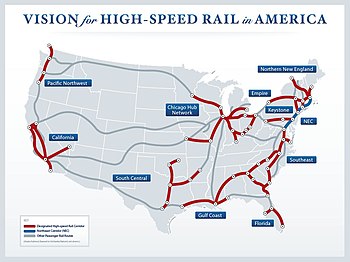
The above map is a 10 high speed corridor proposal made by the Federal Railroad Administration in April, 2009 after a two year study. Can somebody please tell me exactly how this became Obama's plan?
Posted on 01/25/2010 10:29:00 AM PST by Willie Green
Increased funding could present opportunities for manufacturing, but viability questions remain.
Part of President Obama's plan to revitalize U.S. manufacturing includes funds to develop a high-speed rail network. When Obama issued his "framework for revitalizing American manufacturing" in December, he said he would propose an additional $1 billion per year on top of $8 billion Congress already committed to develop high-speed rail.
On Dec. 4, U.S. Transportation Secretary Ray LaHood said more than 30 rail manufacturers and suppliers, both domestic and foreign, had committed to establish or expand their operations base in the United States if they're chosen by states to build high-speed rail lines.
Some of those manufacturers include GE Transportation, Lockheed Martin, Siemens and American Railcar Industries. In a subcommittee House hearing in Pittsburgh last June, GE Transportation CEO Lorenzo Simonelli said his company is prepared to build high-speed diesel-electric passenger locomotives in northwestern Pennsylvania.
"We are ready to partner with the federal government, the states and Amtrak to make higher and high-speed passenger rail a reality by providing locomotives made in the United States of America rather than importing technology and products from overseas," Simonelli said.
The Plan
Obama's plan would include10 major corridors in the United States of 100 to 600 miles in length for high-speed rail systems. Potential areas identified by the president for high-speed rail include lines that would connect the cities of the Pacific Northwest; southern and central Florida; the Gulf Coast to the Southeast to Washington, D.C.; Pennsylvania and New York to the cities of New England; and a central hub network that draws Chicago and other industrial Midwest cities closer together.
So far, state support for the program has been strong, according to LaHood. As of Dec.4, the Federal Railroad Administration had received 45 applications from 24 states totaling approximately $50 billion to proceed with high-speed rail corridor programs and 214 applications from 34 states totaling $7 billion for corridor planning and smaller projects.
When Obama first announced his vision for high-speed rail in the United States, he noted successes in France, where the system "has pulled regions from isolation, ignited growth, remade quiet towns into thriving tourist destinations," and similar stories about Spain, China and Japan.
But some argue that high-speed rail hasn't worked out so well in other countries, and in areas such as California where rail initiatives are underway, the plan has been met with some opposition.
A high-speed rail system would be utilized by few Americans and cost more than highway travel, according to a report written by Randal O'Toole, a senior fellow with libertarian think tank the Cato Institute.
What's the True Cost?
In his September 2009 report "High-Speed Rail is Not 'Interstate 2.0,'" O'Toole cites National Transportation Statistics that show the average American traveled 4,000 miles on interstates in 2007, while high-speed rail proponents estimate Americans would ride less than 60 miles per year on the federal rail system.
On average, residents of France and Japan ride high-speed trains less than 400 miles per year, a number that would be difficult to approach in the United States because of greater geographic expanse and lower population densities, according to O'Toole.
Part of the problem, notes O'Toole, is that trains would only stop in 65 of the nation's 100 largest urban areas, leaving people in smaller cities and towns to access high-speed rail by driving to a major city.
As for cost, O'Toole says Congress has underestimated the project's total expense when it approved the initial $8 billion funds. The federal plan calls for about 8,500 miles of moderate and high-speed rail routes using existing tracks at a $3.5 million-per-mile cost, totaling nearly $30 billion, O'Toole says.
In addition, plans for faster trains on entirely new tracks in California and Florida could push the total price up to $90 billion, according to O'Toole.
Planning Issues
A California legislative report released on Jan. 13 concludes the state's high-speed rail plan lacks many specifics, including unknown confidence in cost, revenue and ridership projections.
In addition, fare forecasts have increased since voters first approved the proposition. The 2008 plan showed fares would cost about $55 one way between Los Angeles and San Francisco, the Palo-Alto Daily News reported. But a new plan calls for a one-way fare of $105, the paper reported.
Confusion over the cost to implement a national high-speed rail system doesn't appear to be getting any clearer. Continued multiyear funding will be necessary to make high-speed rail a reality, says Matt Mayrl, national policy director at the Apollo Alliance, a green jobs labor group.
While there aren't many U.S. manufacturers currently involved in the passenger rail industry, with the right policies in place Maryl says high-speed rail could add jobs throughout the supply chain with new demand for components and infrastructure.
Before that happens, though, legislators need a better understanding of whether the benefits associated with such a major infrastructure project will indeed outweigh the costs.
Any mention of this being done by private industry is extremely lacking here. All big brother transportation services inc.
Why build something no one can afford to ride.
I can fly to California cheaper than the train and I dont have to pay for meals for 5 days.
I can fly to New York for about the same price as train an to Florida a hell of a lot cheaper.
Fast, empty trains.
Sounds like a real winner.
Ah come on Willie, you promotin’ this chit?
Another big time, big brother f-—ing money LOSER.
Notice how GE Transportation is at the top of the list.
Disney’s monorail. ;)
Is High Speed Rail on the Horizon?
No, but thanks for playing.
No passenger rail can be done by private industry. You only have to appreciate the cost of holding the land underneath the track, and paying maintenance of way on the track network, to appreciate why (with one exception - the Northeast Corridor) passenger rail does not work in the U.S. That goes quintuple for the various forms of “high speed” rail.
High speed rail works best at intermediate distances (say Detroit-Chicago or Chicago-St.Louis) where the time economy of the high speed segment pays off. Total trip time - origin to destination - is most advantageous over these distances. At longer distances air travel is much more economical, at shorter distances autos are probably the best mode.
But since high speed rail can only work with massive taxpayer subsidies, what you see are proposals for high speed rail that, as a function of “purchased” political support, are proposed with stops in every tiny town and village along the way between a major origin and destination pair. Which would utterly defeat the time economy involved in “high speed” rail technology.
Long story short. Forget about it.
Yep.
Obama's plan???
The above map is a 10 high speed corridor proposal made by the Federal Railroad Administration in April, 2009 after a two year study. Can somebody please tell me exactly how this became Obama's plan?
The other critical issue is the freight transportation network. Long haul trucking firms are using rail as the connecting service, with truckers getting freight to and from the rail head at an intermodal transfer facility. This greatly reduces the impact of maintenance costs on Interstates, where truck traffic may be 40 percent or more of total traffic and comprise nearly all of the impact on pavement life.
Unfortunately, railroads were overregulated for years and therefore undercapitalized. As a result, we have major capacity restrictions on the rail system for which the Class I railroads simply don’t have the capital to address in the short term. As a result we face critical rail capacity problems in the future. Providing a public-private partnership that expands capacity for both freight and rail benefits all modes.
Finally, we face increased energy demand, especially for fossil fuels, just as the supply is peaking. Does anyone really believe the inflation cost of gasoline will be less in ten years rather than more? Our air system cannot function at $150 per barrel oil. Since 2007 we have lost 17 percent of our seat capacity for the air system, and it continues to drop. If that 500 mile flight costs $800 and gasoline is $6 per gallon, that rail service looks a lot better.
No, passenger rail does not make money. Neither does our highway system or our air system. That is why we as a nation subsidize all of them. If you live in a rural area or a small town, do you really want to pay the real incremental cost of building and maintaining your share of the transportation system? This country tried that early in our history, and it was a total failure. That is why we have a gas tax and later all the other forms of taxes and capital subsidy for all modes of transportation.
Can somebody please tell me exactly how this became Obama's plan?
George W. Bush was too dumb to adopt it during his administration and set it on the back burner???
Why build something no one can afford to ride.
I can fly to California cheaper than the train and I dont have to pay for meals for 5 days.
I can fly to New York for about the same price as train an to Florida a hell of a lot cheaper.
Just don't bother taking any luggage along....
Hey... I wonder when the airlines are going to start charging for passenger tickets by the pound???
After passing through Homeland Security, the FAT Police will herd you to a scale at the ticket counter: "this way ladies and gentlemen... this is your last call to board Flight #666, JFK to LAX at $2.79 a pound round trip nonstop... don't trip when stepping on and off the scales."
If that business model works, more power to them. I hope you aren’t suggesting that big brother regulate prices.
Just don't bother taking any luggage along....U.S. airlines increase traveller baggage fees
There... that's the thread I just posted that stimulated that response.
The 100 to 500 mile range is for driving your own car, then you have it on the other side and don’t have to rent one. Trains won’t change that, all the reasons there are to not fly that distance apply to trains as well.
I’m pro-freight rail, it’s a good system and does a necessary job, usually profitably too. But this passenger rail boondoggle is just plain silliness. Passenger rail is the past, and spending a bunch of money making it fast won’t make it more desirable.
In addition, the uncertainty over energy prices and availability impacts highway construction and maintenance the same way it impacts the cost of driving or flying. Asphalt is already so high in price that little new construction is taking place, and road departments at the state and local level cannot afford to keep up what they already have. We are fast approaching the end of the Happy Motoring era in this country, and the shock we saw with $147 a barrel oil will be nothing compared to the day the friendly local road department converts its low volume roads to gravel, as some counties in Michigan have already started to do.
Bob, if you’re a liberal and you aren’t having wet dreams over Heavy Rail, Light Rail, High Speed Rail, AmTrack Passenger Trains, Commute Trains, trollies, Mass transit in general, then you’re not worth a spit as a liberal, even if you’re a closet liberal hangin around constructive conservative websites!!!
Disclaimer: Opinions posted on Free Republic are those of the individual posters and do not necessarily represent the opinion of Free Republic or its management. All materials posted herein are protected by copyright law and the exemption for fair use of copyrighted works.