
Posted on 12/07/2009 4:55:52 AM PST by myknowledge
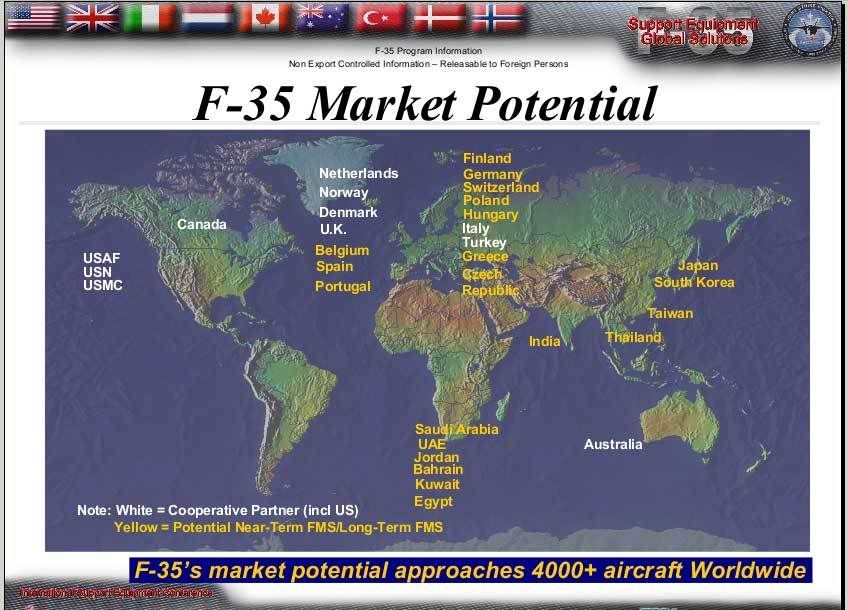
As the JSF founding members squirm for excuses to cut projected orders, anticipating the program's soaring costs consuming growing shares of local defense budgets, Israel is expected to become the first international customer to commit to the next generation stealth fighter, although the country has not formally joined the program as one of the 'founding members'.
Bowing under unprecedented financial pressure, the U.K. is moving to axe the planned construction of one aircraft carrier, along with up to 88 F-35B (V/STOL) fighters that would be operating on board, saving about £7.6 billion in out-year budget.
Financial issues have also led the Australian government to defer the decisions to commit on the planned procurement of 3-4 squadrons. By delaying procurement decisions to 2010 and possibly cutting the number of aircraft operating with each squadron, from 24 to 14, Canberra is hopeful the A$16 billion investment could be approved next year. Netherlands and Denmark have not made their final decision about the aircraft yet, although both are supporting the acquisition of the American stealth fighter. Norway has decided in favour of the JSF but hasn't ordered the aircraft to date. Even the U.S. Air Force ahs not placed orders for serial production fighters to date.
With such malleable backing to their program, no wonder that the U.S. is aiming at the 'captive' markets – clients dependent on U.S. aircraft - such as the Israelis and Turks - to stabilize the program. Turkey has embarked on a shopping spree for defense systems, investing well over $30 billion in arms procurement over the nbext 5 years. As a program member Turkey is planning to produce about 100 of the 130 F-35As it plans to buy over the next decade. Turkey has also produced hundreds of F-16s for its air force. Israel plans to replace at 2-3 F-16A squadrons with the F-35A, however, unlike the Turks, Israel has not received any commitments for its local industries, neither arranged for local assembly. Italy is also considered a strong candidate, although Rome has not yet committed to the procurement phase, the F-35Bs will be needed sooner or later, to replace the Sea Harriers on its aircraft carriers. However, the number of aircraft to be fielded will undoubtedly be influenced by the British decision and the flyaway cost of the F-35B, which is currently supported by the U.S. Marine Corps and the U.K.
Despite the recognition that the IAF needs the new stealth fighter to maintain its qualitative edge within the Middle East, Israel has sofar delayed its decision due to a number of reservations by the Air Force, regarding the aircraft operational range, payload and avionic suite. Through all its recent aircraft acquisitions, Israel insisted including a comprehensive array of electronic systems, primarily electronic warfare suits, command, control and communications, as well as specific weapons operated by the IAF, that provided the Israeli variants of such fighters a qualitative edge over similar types operated by Egypt, Jordan or Saudi-Arabia. These systems also provided the new fighters to be fully integrated within the Israeli command and control system, optimally operate under all conditions, and be prepared to employ indigenously developed weaponry, such as the Spice EO standoff guided weapon or Delilah loitering missiles, which have to be individually integrated into the operating systems of IAF fighters.
However, the architecture that provided the baseline of the JSF design prevents such changes, as they are effecting the entire aircraft operation. Alternatively, users are provided with selective access to the operational system, enabling limited integration of weapons, and avionics systems to operate with on-board assets. While such approach provides more flexibility for users with limited requirements, it does not allow for close linking with on board functions and capabilities, required to maintain the fighter's stealth and low electronic emission.
As for the limited range, Israel has a relatively unique operational requirement – to nbe able to extend its strike capability over thousand miles inside enemy territory, reaching as far as Iran, while flying within potentially hostile airspace. Stealth was considered a key capability for gaining operational flexibility for such operations, which would be based on the fighter's unrefuelled range – internally carrying both fuel and ordnance over extended range. While the basic F-35A has an operational radius of 610 nautical miles, an extra fuel tank could extend its range considerably, matching the proposed stealthy F-15SE 'Silent Eagle' that could be offering an operational radius of 800 nautical miles, with limited stealth capability.
Despite these obstacles, Israel apparently decided to remove these requirements, at least for the first batch of 25 aircraft, realizing that the required changes could drive the acquisition cost of the Israeli F-35A variant to beyond $130 million a peace, delaying delivery schedules far beyond Israel's requirements. The indigenous systems would mean the stealth fighter would maintain a qualitative edge over similar fighters, if (or when) delivered to other U.S. allies in the region. The inclusion of additional internal fuel would contribute to more flexible mission planning, particularly in the 'outer circle' where Israel is required to operate deep inside enemy or hostile territory, beyond 1,000 km, as far as in Iran, where stealth capabilities are mandatory and aerial refueling may not be possible.
Once the special requirements of the IAF are relieved, the aircraft cost could return to just over $80 million a piece. The IAF is expecting the first aircraft to be delivered in 2014 to replace the first F-16As that would be phased out by that time. The projected modifications could delay this schedule by at least 24 months. However, the Israelis could be eluding themselves with $80 million cost per aircraft, as the Pentagon is already preparing the ground for major cost increase. According to a recent report by the Department of Defense Joint Estimating Team (JET), the JSF program may be exceeding budget by $16 billion, and slip off schedule in the next five years. This bleak prediction is not shared by the joint program office, which stresses that development and testing are progressing well and within schedule.
Thank you for my new screensaver!
Do you think this is the replacement for the world’s universal fighter plane, the F-16?
Fifth generation fighters are very expensive to build, and they would not be built in Cold War quantities.
I have selected a military aircraft thread to share the following mind blowing video of a model radio controlled jet plane.
I hope you enjoy it.
http://www.fark.com/cgi/vidplayer.pl?IDLink=4464984
“As a program member Turkey is planning to produce about 100 of the 130 F-35As it plans to buy over the next decade”
What moron let the Turks have the technology to build these things more or less on their own? It may not be the F-22, but it’s still a modern fighter. Letting an increasingly islamic state that defends genocide have this sort of technology is utter madness...
If you’d like to be on or off, please FR mail me.
..................


Unless Turkey was going to war against Israel, you can be sure the Turks would not transfer its tech to other 3rd parties.
Given the increasing influence of islam that’s not impossible.
Turkish PM Erdogan says Allah will destroy Israel..
http://www.jpost.com/servlet/Satellite?cid=1230733177704&pagename=JPost%2FJPArticle%2FPrinter
http://www.jihadwatch.org/2008/11/us-intel-agencies-see-stronger-islamic-turkey-in-2025.html
Turkey is slowly putting an end to Kemalism and returning to its muslim roots with all the hostility towards non-muslims that entails.
Ezekiel 38: 4
And I will turn thee back, and put hooks into thy jaws, and I will bring thee forth, and all thine army, horses and horsemen, all of them clothed with all sorts of armour, even a great company with bucklers and shields, all of them handling swords:
5 Persia, Ethiopia, and Libya with them; all of them with shield and helmet:
6 Gomer, and all his bands; the house of Togarmah of the north quarters, and all his bands: and many people with thee.
7 Be thou prepared, and prepare for thyself, thou, and all thy company that are assembled unto thee, and be thou a guard unto them.
The US Congress upheld the ban on F-22 Raptor foreign sales during a joint conference on 27 September 2006. After talks in Washington in December 2006, the US DoD reported the F-22 would not be available for foreign sale. "The IAF would be happy to equip itself with 24 F-22s, but the problem at this time is the US refusal to sell the aircraft, and its $200 million price tag." Israeli Air Force (IAF) chief procurement officer Brigadier-General Ze'ev Snir.Since we will not give Israel the technology to deter mad men from launching a nuke, we will be the de facto cause of war through negligence in at least 2 ways if Israel preemptively strikes IranThomas D. Crimmins of the Washington Institute for Near East Policy who has written about the possible Israeli strike on Iran says that the F-22 may be the only current aircraft that can evade the Russian S-300 air defense system which the Russians may transfer to Iran. Given the export limitations on the F-22, Israel's lack of any F-22s may force it to preemptively strike the Nuclear program of Iran before the delivery of the S-300 to Iran."
As the JSF founding members squirm for excuses to cut projected orders, anticipating the program's soaring costs consuming growing shares of local defense budgets, Israel is expected to become the first international customer to commit to the next generation stealth fighter, although the country has not formally joined the program as one of the 'founding members'.
Disclaimer: Opinions posted on Free Republic are those of the individual posters and do not necessarily represent the opinion of Free Republic or its management. All materials posted herein are protected by copyright law and the exemption for fair use of copyrighted works.