Skip to comments.
Strategic Negligence:Sierra Club Distortions on Border/Immigration Policy Undermining its Legacy
Center for Immigration studies ^
| October 2009
| Jerry Kammer
Posted on 11/02/2009 11:04:17 AM PST by AuntB
“To explore, enjoy, and protect the planet. To practice and promote the responsible use of the Earth’s ecosystems and resources; to educate and enlist humanity to protect and restore the quality of the natural and human environment; and to use all lawful means to carry out those objectives.” — Sierra Club mission statement.
Strategic Ignorance: Why the Bush Administration Is Recklessly Destroying a Century of Environmental Progress — 2004 book by Sierra Club Executive Director Carl Pope.
“The raging monster upon the land is population growth. In its presence, sustainability is but a fragile theoretical concept.” – Edward O. Wilson, in The Diversity of Life.
In the summer of 2003, a Chicago Tribune story from the Arizona-Mexico border began with this description of Organ Pipe Cactus National Monument:
“For a tract of desert wilderness that is supposed to be left alone by humans, this national park is a mess.
“Fragile ocotillo shrubs and saguaro cactuses lay lifeless where they were mowed down. Foot trails and car tracks scar the delicate sandy ground in all directions. Trash is everywhere.
“The problem is not neglect by the National Park Service. The park has been overrun by illegal immigrants and drug traffickers who use its remote valleys to elude and outrun the U.S. Border Patrol on their clandestine journeys from Mexico.”1
The environmental devastation in the Arizona borderlands caused by illegal immigration and drug smuggling is undeniable, and not just at Organ Pipe. The same account could have been written from other extraordinary places, including the Cabeza Prieta Wilderness, Buenos Aires National Wildlife Refuge, and the Coronado National Forest.
Yet this toll has been trivialized or ignored by the nation’s largest environmental organization, the Sierra Club. The powerful group presents a distorted, propagandistic view of the situation in its Border Policy Campaign, which has produced a website and a film that seek to stir public outrage against the Border Patrol and the border fence that has been constructed along much of Arizona’s border with Mexico.
“This reckless project has meant dire consequences for vast expanses of pristine wild lands, including wildlife refuges, wilderness areas, and national forest lands, among others,’’ claims the website.2 It urges public activism to demand that Congress repeal 2005 legislation that allowed the Secretary of Homeland Security to waive environmental laws in order to complete the fence. It also promotes legislation sponsored by Rep. Raul Grijalva of Arizona that aims to protect the environment by restraining the Border Patrol.
There is an irony at work here, one that occupies the chasm between the club’s professed aims and its political advocacy. Even as the club touts its “strong stance against policies that promote environmental degradation,”3 it has retreated timidly from the national debate over immigration policy at a time when proposals for “comprehensive reform” would set the United States on a course that could nearly triple its population by the year 2100, with enormous environmental consequences.
To the Sierra Club’s credit, the Borderlands Campaign raises legitimate concerns about the Department of Homeland’s Security’s decision to waive environmental laws to construct the border fence. Congressional advocates of the legislation that granted the waiver authority had been frustrated for years by legal challenges to construction of the fence through environmentally sensitive lands at the border south of San Diego. The legislation led to dismissal of a lawsuit that the Sierra Club and the National Audubon Society had filed against the project, alleging that it would damage the Tijuana River Estuary.
But the Sierra Club campaign veers into propaganda as it promotes immigration reform that would provide legal status to millions of illegal immigrants. That advocacy is apparent in a 20-minute film commissioned by the club. It features an immigration activist’s prediction that reform will come because “the masses are uniting and the masses are demanding their rights and demanding their needs."
The film, titled “Wild Versus Wall,” makes the absurd claim that “bulldozers and just the vehicle traffic from the Border Patrol does (sic) more damage than the migrants.” It ignores the damage caused by smugglers of migrants and drugs — whose activities it refers to with startlingly euphemistic understatement as “border traffic.”
In its headlong rush to slam the DHS, the film also ignores the agency’s extensive efforts to mitigate environmental damage caused by efforts to secure the border. Those efforts were begun, at least in part, in response to constructive criticism by environmental groups, especially Defenders of Wildlife.
In 2006 Defenders published a report charging that federal border policies were “ignoring the desperate need for environmental oversight in the efforts to secure our southern border.” In contrast to the Sierra Club’s bombast, the report acknowledged both “the dangerous and important work done by the Border Patrol in its efforts to curtail undocumented immigration, drug trafficking, and other illegal activities” and “the incredible complexities of the immigration issue.”4
The Defenders of Wildlife report complemented this 2004 General Accounting Office critique: “In Arizona, there has been very little coordination or planning between the Border Patrol and land management agencies.”5 Facing such criticism, DHS in 2006 signed a Memorandum of Understanding with the Department of the Interior and the Department of Agriculture to improve cooperation in the borderlands. In 2009, DHS committed $50 million to mitigate environmental damage caused by border security programs.
The Bureau of Land Management’s Jon Young says the improved coordination bridges a cultural divide between land managers, who see themselves as stewards, and Border Patrol agents whose pursuit of their law enforcement mission brought criticism that they were running roughshod over fragile lands in their SUVs and ATVs.
“We have put together training programs that emphasize the importance of treading lightly” on the land, said Young, a former Park Service ranger at Organ Pipe.6
Smugglers Leave Desert Devastation
Of course, smugglers operate under no such constraints. In early 2002, before construction of the border fence at Organ Pipe, Young catalogued the wreckage left behind by a single smuggler who had driven an SUV through a hole in the flimsy border fence.
In his 20-mile, cross-country drive from the border to the spot where the vehicle bogged down in the sand, the smuggler slashed a new road littered by hundreds of destroyed creosote and sage brush plants, dozens of battered mesquite and palo verde trees, and several badly damaged saguaros, the magnificent cactus symbol of the Sonoran Desert. “With the kind of rain we get — or don’t get — it will take 100 or 200 years to repair this damage," Young said.
The rogue vehicle was just one of hundreds of vehicles public land managers near the border had to retrieve every year before construction of the border fence. They were typically stolen in Phoenix or Tucson, driven across the border to be loaded with migrants or drugs, and driven back north, through remote sections of the border often defined only by an easily shredded cattle fence of two or three strands of barbed wire. For smuggling purposes, the border was wide open.
The violence wasn’t just environmental. In the summer of 2002, one of Young’s colleagues at Organ Pipe, Ranger Kris Eggle, was shot to death by an AK-47-toting Mexican criminal who had driven through a hole in the fence. That tragedy was the most dramatic in a series of confrontations that prompted the National Park Rangers Lodge of the Fraternal Order of Police to name Organ Pipe the most dangerous park in the country.7
The dangers have also spread to Arizona’s Coronado National Forest. In 2006 testimony to a congressional panel, the Forest Service’s Tina J. Terrell reported that smugglers “intentionally set diversion or rescue fires, using uncontrolled wildfires to divert law enforcement from their illegal activities.” She added this grim report: “Smugglers traveling at high speeds have run employees off the road, rammed law enforcement vehicles, and caused accidents. Employee and visitor vehicles have been vandalized and stolen while unattended.”8
The situation was much the same in the nearby Buenos Aires National Wildlife Refuge. “We were getting 250,000 [illegal immigrants] coming through here every year,” refuge manager Michael Hawkes said in the summer of 2009. “We had all the damage done by the vehicles. We had bandidos coming up, robbing, raping, murdering people. Our buildings were getting broken into, vehicles were getting stolen. It was a war zone down here. It was a real mess.”9
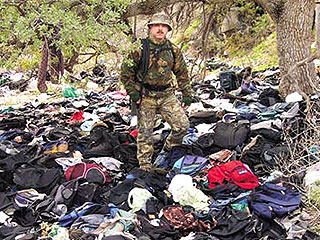
The mess also includes fields of garbage and waste left behind by illegal immigrants, a visual eyesore that also damages wildlife habitat and often kills animals that ingest plastic bags and other refuse. As one Tucson writer put it, lamenting the loss of once-magical landscapes, “In many places, the magic is gone, lost beneath piles of garbage.”10
Now there is a fence shielding Buenos Aires, and Michael Hawkes is glad it’s there. Illegal crossings are down by 80 percent.
Hawkes understands the environmentalists’ concern about wildlife. “There’s a downside to the fence because wildlife can’t get through,” he said, noting that the area is part of the northern range of the jaguar. But he rejects the Sierra Club story that the fence is an environmental disaster. “Overall, it has been a blessing,” he said.
Acknowledging that border enforcement causes some damage, the Interior Department’s Larry Parkinson told the Los Angeles Times, “You’ve got to give up a little to save a lot. If we don’t help the Border Patrol improve their control over the border, we won’t have anything left to save.”11
In 2006, before the fence was built, USA Today columnist Bridget Johnson offered this environmental assessment after a visit to the border: “The carnage makes one wonder why environmental groups aren’t out lobbying for a sturdy border fence — instead of arguing against tougher border enforcement.”12
But the Sierra Club will have none of that. Its Borderlands Campaign seeks not to inform but to agitate. It presents a cartoonishly distorted view of the fence in its film, which glosses over the damage caused by smugglers. The film was produced by Steev Hise, who describes himself as a “filmmaker, artist, activist, journalist.”13 His film is titled “Wild Versus Wall.” A more honest look at the fence could be titled “Wall Versus Chaos.”
Border Barriers
The federal program that has built fences or vehicle barriers along more than 200 miles of Arizona’s 380-mile border with Mexico is an extension of a program that began in the mid 1990s along the border south of San Diego. Here is how the San Diego Tribune recalled the chaos of that era:
“Every night, the understaffed and outnumbered Border Patrol engaged in a losing battle of cat-and-mouse with thousands of illegal immigrants being led by ruthless smugglers. ... San Ysidro residents locked themselves in at night as smugglers and immigrants traipsed through their yards. Caches of drugs were carried across the border by smugglers and the people they were leading. Hundreds of illegal immigrants lingered in the median strip of Interstate 5 waiting for rides northward. Immigrants running across freeways were hit and killed by motorists.14 The paper also reported: "Thieves, smugglers, and drug addicts preyed on the migrants. Fights broke out, and they sometimes ended in deaths. The chaos spilled into nearby U.S. neighborhoods as migrants and smugglers were accused of stealing from homes and vandalizing properties.”15
National politics played a central role in the federal response to the swelling illegal immigration anxiety in California, where voters in 1994 approved controversial Proposition 187, an anti-illegal immigration measure later found to be unconstitutional.
President Clinton, who in 1992 had become the first Democratic presidential candidate to carry the state since Lyndon Johnson, wanted action. Within months a border fence and additional Border Patrol agents restored calm south of San Diego. INS Commissioner Doris Meissner said the buildup, dubbed Operation Gatekeeper, was part of an effort “to restore the rule of law to the border after years of neglect.”16
While the buildup in San Diego imposed order on the previous chaos, it also had the effect of driving smugglers and migrants farther east, to remote parts of the California and Arizona desert. Several hundred have died every year from exposure to the brutal heat. Their deaths are a tragedy that cannot be reduced to the Sierra Club’s simplistic formulation that they are “a shameful consequence of the current border policy.”
Beyond the failure of Mexico to provide opportunities to its people and the failure of the U.S. government to establish credible enforcement at the worksite, the borderlands deaths are the result of a deadly combination of the ruthlessness of smugglers, the migrants’ ignorance of the ferocity of summer in the desert, and their desperation-born determination to enter the United States regardless of U.S. law and the dangers of the journey. Eager to present a melodrama, the Sierra Club turns a blind eye to such borderlands complexity and ambiguity.
The purpose of “Wild Versus Wall” and the border campaign is not to inform. It is to provoke. Unfortunately, such irresponsibility is not new to the Sierra Club. It showed similar willingness to distort in its campaign against club members concerned about rapid U.S. population growth, which is driven primarily by immigration.
Immigration and Population
For years control of the U.S. population has been one of the main goals of the environmental movement. When the first Earth Day was held in 1970 to energize the public’s growing environmental concern, the Portland Oregonian noted, “The hot issues were pesticides, population control, and cleanup of the nation’s air and water.”17
In 1989 the Sierra Club board adopted this policy position: “Immigration to the United States should be no greater than that which will permit achievement of population stabilization in the United States.”18 The board sought to avoid offending ethnic sensibilities with the further declaration: “The Sierra Club will lend its voice to the congressional debate on legal immigration issues when appropriate, and then only on the issue of the number of immigrants — not where they come from or their category, since it is the fact of increasing numbers that affects population growth and ultimately, the quality of the environment.”19
Seven years later the board changed that policy. It opted to “take no position on immigration levels or on policies governing immigration into the United States.”20 That decision spawned a countermovement by club members who proposed a resolution to support a “reduction in net immigration” to the United States. The board refused to allow a straight up, yes-or-no vote. Instead, it added to the ballot an alternative proposal that would affirm the 1996 position and call for action against “the root causes of global population problems.”21
Battle lines formed behind the competing proposals. Those who favored reduced immigration included such eminent figures as Earth Day founder and former U.S. Senator Gaylord Nelson, legendary former Sierra Club director David Brower, former Interior Secretary Stewart Udall, and Harvard biologist Edward O. Wilson, of whom The Humanist magazine later wrote: “For Wilson, environmentalism is intertwined with reverence and respect for the human species — and concern for its future.”22
Sierra Club leaders, determined to thwart the advocates of reduced immigration, launched a smear campaign featuring accusations of guilt by association. As the Washington Post reported, “club leaders charged in a statement mailed to members that the proposal’s supporters included extremists acting from racial prejudice.” They linked former Ku Klux Klan leader David Duke to the effort. Carl Pope, the club’s executive director, told the Washington Post that if the organization favored reduced immigration, “we would be perceived as assisting people whose motivations are racist.”23
Gaylord Nelson, a staunch liberal and civil rights advocate, was furious at the smear tactics. “People have been silenced because they are scared to death of being charged with being a racist,” he said. “But racism has nothing to do with it. It’s a question of numbers.”24
“It’s a question of being environmentally correct versus being politically correct,” said club member Leon Kolankiewicz, a population-control activist. Carl Pope came down firmly on the side of political correctness. As he would declare several years later, as the issue stirred again, “When environmentalists say the human [impact] is just too large, people will suspect we are saying the human footprint is just too dark.”25
Pope got his way. The reduced-immigration proposal failed by a 60-40 margin, with 13 percent of Club members voting.
David Brower highlighted his frustration with the Sierra Club’s immigration stance when he resigned from the board in 2000. “Overpopulation is perhaps the biggest problem facing us, and immigration is part of that problem,” he said. “It has to be addressed.” He added this denunciation of the board: “The world is burning and all I hear from them is the music of violins,” he said. “The planet is being trashed, but the board has no real sense of urgency.”26
Environmentalist Don Weeden laments the club’s ongoing retreat from the issue. “When the principal source of population growth morphed from the baby boom to the immigration boom, that’s when they dropped out of the discussion,” said Weeden.
Weeden, whose family foundation has made the protection of biodiversity a major goal, worked on family planning in South and Southeast Asia for many years. He has written that the immigration-driven growth rate of the U.S. population “exacerbates most environmental problems, and works against important gains made in smart growth, energy efficiency, pollution control, and protection of wild nature.”27
Now Weeden has joined with other conservationists to form an organization that seeks to engage the public on the population consequences of immigration to the United States. Called “Apply the Brakes,” the group traces its growth to concerns about “the decade-long retreat of U.S. environmental organizations from addressing domestic population growth as a key issue in both domestic and global sustainability.”28
One of the other members of Apply the Brakes, Colorado State University philosophy professor Philip Cafaro is the co-author of a paper that makes the environmental case for reducing immigration. The paper notes that 2006 “comprehensive reform” legislation sponsored by Senators Edward Kennedy and John McCain could have led to “nearly tripling America’s population to over 850 million people by 2100.”29 Similar legislation is expected to be introduced in 2010.
Weeden questions Carl Pope’s preference to address the “root causes” of immigration rather than its effects on the United States. While such efforts have value, he said, “We would be foolhardy to postpone dealing directly with our population surge because progress in addressing poverty abroad is grindingly slow.”
Money may also be an inducement to inaction. As an article published in the Tucson Weekly under the headline “Trashing Arizona,” put it, environmental groups “should be hollering from tallest buildings about border trash,” but they have muzzled themselves because “making too much noise might turn off the open-borders liberals they rely on for donations.”30
The Los Angeles Times in 2004 described the Sierra Club’s financial stake in keeping silent on immigration. The paper disclosed Carl Pope’s close ties to a California philanthropist who linked his generosity to his own open-border philosophy. David Gelbaum, whose donation of $101.5 million “dwarfed all previous individual contributions to the club” according to the Times, denied that he had manipulated the board’s position on immigration policy but acknowledged that he had made Pope aware of his preference for an expansive immigration policy.
Gelbaum traced those beliefs to his grandfather Abraham, an immigrant who had fled the persecution of Jews in Ukraine. And so, as he said to the Times, “I did tell Carl Pope in 1994 or 1995 that if they ever came out anti-immigration, they would never get a dollar from me.”31 Gelbaum’s respect for his grandfather had set him against those who tried to stir concern for the world being shaped for his grandchildren.
The population of the United States surged past 300 million in 2006, with most of the growth attributable to immigrants and their children. Two years later, the Pew Research Center offered this analysis: “If current trends continue, the population of the United States will rise to 438 million in 2050… and 82 percent of the increase will be due to immigrants arriving from 2005 to 2050 and their U.S.-born descendants.”32
Yet the Sierra Club has remained committed to the immigration position it adopted in 1996. Indeed, another vote was taken in 2004, with similarly intemperate debate that characterized efforts to limit immigration as “the greening of hate.” Sierra Club spokesman Oliver Bernstein said that effort was the work of “anti-immigrant, extremist, racist groups.”33
Ignoring David Brower
On Earth Day, 2004, the Sierra Club invited members of its liberal coalition to Washington’s Union Station to celebrate the publication of a new book by Carl Pope that excoriated the environmental record of the administration of George W. Bush.
The host committee for the event included Rep. Grijalva (D-Ariz.), Rep. Nancy Pelosi (D-Calif.), Sen. Harry Reid (D-Nev.), and representatives of religious and labor groups who supported “comprehensive immigration reform” that would greatly expand immigration and the nation’s population.
The Sierra Club’s press release for the event touted the book as revealing “a pattern of ideological extremism that is out of step with previous Republican and Democratic administrations, not to mention the American public. The book also explains what happens when the administration’s radical agenda contradicts public opinion, sound science, and even the law.”34
That same critique could be applied to the Sierra Club’s positions on border policy and immigration. They are part of a campaign to discredit and even demonize enforcement of immigration laws while willfully ignoring the environmental damage that effective enforcement can prevent.
Four decades ago, when David Brower was the Sierra Club’s executive director, he made this pointed observation: “We feel you don’t have a conservation policy unless you have a population policy.”35
The Sierra Club’s border and immigration policies are a sad demonstration of how far the organization, driven by the cynicism and political correctness of its leaders, has retreated from that fundamental understanding.
End Notes
1 Hugh Delios, “Cross-Border Traffic Ravages Desert Park,” Chicago Tribune, August 19, 2003.
2 Borderlands Campaign, http://www.sierraclub.org/borderlands/.
3 Borderlands Campaign, http://arizona.sierraclub.org/conservation/border/index.asp.
4 Defenders of Wildlife, “On the Line: The Impacts of Immigration Policy on Wildlife and Habitat in the Arizona Borderlands,” 2006, http://www.defenders.org/resources/publications/programs_and_policy/habi....
5 General Accounting Office, “Agencies Need to Better Coordinate Their Strategies and Operations,” GAO-04-590, p. 40.
6 Author interview with Jon Young.
7 Mitch Tobin, “S. Arizona Parks on List of Most Dangerous,” Arizona Daily Star, May 31, 2001.
8 Terrell testimony before the Senate Subcommittee on Interior, Environment, and Related Agencies, Committee on Appropriations, concerning effects of border management activities on federal land management agencies, June 15, 2006.
9 Author interview with Michael Hawkes.
10 Leo W. Banks, “Trashing Arizona,” Tucson Weekly, April 2, 2009.
11 Julie Cart, “In Border Battle, Land and Wildlife are Casualties,” Los Angeles Times, March 3, 2006.
12 Bridget Johnson, “Trashing the Border,” guest column in USA Today, July 11, 2006.
13 http://www.vimeo.com/user544852.
14 Editorial, “Border Chaos; Arizona Is Weak Link in Stopping Smuggling,” San Diego Union Tribune, June 18, 2002.
15 Anna Cearley, “Pressures Continue on a Bolstered Border,” July 11, 2004.
16 Larry Margasak, “U.S. Strengthening Enforcement along Southwest Border,” Associated Press, January 13, 1996.
17 Kathie Durbin, “Legacy of Earth Day,” The Oregonian, April 23, 1989.
18 Sierra Club Population Report, Spring, 1989, http://www.susps.org/history/popreport1989.html.
19 Ibid.
20 William Branigin, “Immigration Policy Dispute Rocks Sierra Club,” The Washington Post, March 7, 1998.
21 Ibid.
22 “Humanist Profile: Edward O. Wilson 1999 Humanist of the Year,” The Humanist, May 1, 2005.
23 William Branigin, op. cit.
24 Paul Rogers, “Immigration Question Tears at Environmentalists,” San Jose Mercury News, April 12, 1998.
25 Tom Horton, “Immigration an Issue in Overpopulation,” Baltimore Sun, August 19.
26 Glen Martin, “Sierra Club Pioneer Quits Board,” San Francisco Chronicle, May 19, 2000.
27 Weeden letter to E: The Environmental Magazine, September-October, 2008, http://findarticles.com/p/articles/mi_m1594/is_5_19/ai_n31161011/.
28 Apply the Brakes website, http://www.applythebrakes.com/aboutus.asp.
29 Winthrop Staples III and Philip Cafaro, “The Environmental Argument for Reducing Immigration,” Center for Immigration Studies Backgrounder, 2009, http://www.cis.org/EnvironmentalArgument.
30 Leo W. Banks, “Trashing Arizona,” Tucson Weekly, April 2, 2009.
31 Kenneth R. Weiss, “The Man Behind the Land,” Los Angeles Times, October 27, 2004.
32 Jeffrey S. Passel and D’Vera Cohn, U.S. Population Projects: 2005 - 2050, Pew Research Center, http://pewhispanic.org/files/reports/85.pdf.
33 Kari Lydersen, “Border War,” Earth Island Journal, Summer 2009.
34 PR Newswire (U.S. Newswire) “Sierra Club Leader Carl Pope’s New Book Finds Bush Administration Guilty of Strategic Ignorance on the Environment,” April 22, 2004.
35 Edward C. Hartman, Sustainable Population: The Missing Piece of the Immigration Policy Puzzle, Population Press, http://www.populationpress.org/publication/2007-2-hartman.html.
TOPICS: Crime/Corruption; Culture/Society; Foreign Affairs
KEYWORDS: aliens; davidgelbaum; environment; gelbaum; illegalimmigration; immigrantlist; immigration; invasion; mexico; population; sierraclub
Not mentioned are the millions of acres of public lands where the habitat is being destroyed by illegal alien Mexican drug cartels growing plantations of drugs. Last summer they burned down 88,000 just in the La Brea fire in California. A forest service worker died in Oregon trying to clear these farms the same month.
1
posted on
11/02/2009 11:04:19 AM PST
by
AuntB
To: 1_Inch_Group; 2sheep; 2Trievers; 3AngelaD; 3pools; 3rdcanyon; 4Freedom; 4ourprogeny; 7.62 x 51mm; ..
To: AuntB
One of hundreds of photos of how illegal immigrants care for the environment (sorry I haven't master the posting of photos yet):
http://doctorbulldog.wordpress.com/2008/05/08/illegal-immigrants-can-pick-lettuce-but-they-cant-pick-up-their-own-trash/
3
posted on
11/02/2009 11:10:11 AM PST
by
La Lydia
To: Issaquahking; calcowgirl; Grampa Dave; Carry_Okie; Jeff Head; blackie; PhilDragoo; SierraWasp; ...
And where are the enviromentals? Taking advantage of the poorly written ESA whereby their lawyers who run these schemes can collect atty. fees from the taxpayer by suing the government to protect listed ‘endangered species’...from farmers, private land owners...NEVER the illegal alien.
But WE should be using the same statute, sue the government for habitat of those very endangered species (spotted owl in the La Brea fire & much more) being destroyed because they refuse to enforce our borders to stop it. And by every precedent set, we would win.
4
posted on
11/02/2009 11:19:41 AM PST
by
AuntB
(If the TALIBAN grew drugs & burned our land instead of armed Mexican Cartels would anyone notice?)
To: La Lydia
Illegal Immigrants Can Pick Lettuce, But They Can’t Pick Up Their Own Trash?
Note to illegals: For Pete’s sake! Clean up after yourselves! Where do you think you are? Mexico or something?

Groups Struggle to Clean Up Mess Illegal Immigrants Leave Behind
Fox News
The latest battle in the war on illegal immigration isn’t over the smuggling of undocumented workers, it’s over the trash they leave behind.
Government officials and border activists say the garbage dumped in the desert by illegal immigrants and their smugglers is staggering.
And the cleanup is costing taxpayers millions.
In 2006 alone, more than 1.18 million pounds of trash was collected along southern Arizona border, many in the meeting spots where immigrants rest, change clothes and wait to hitch a ride further north with a smuggler.
“You can find everything,” said Shela McFarlin, special assistant for international programs at the Arizona Bureau of Land Management. “Blankets, airline tickets, Bibles, wedding pictures, photos of children, school reports, because clearly people don’t tend to throw away everything they’ve brought with them — they’re forced to.”
Arizonia officials have spent approximately $4.4 million over five years to clean up the mess, that continues to build with each crossing. Nearly $1 million was spent for 2007 from a base BLM appropriation.
Border Patrol’s Tucson sector, which covers most of the Arizona border, doesn’t have statistics about how many people cross through each year, but on average, agents apprehend 1,500 people a day, with 378,000 undocumented immigrants caught in 2007 alone.
The trash is a problem that activist groups, like the Minuteman Civil Defense Corps, say will not stop until the nation’s southern border is secured.

“It’s just like a flood,” said Chris Simcox, the president of the Minuteman Civil Defense Corps. “You can’t clean up the floodwaters until you stop the flood and fix the dam.”
Successful efforts by the Border Patrol to secure well-trafficked crossing spots in San Diego and El Paso have forced many immigrants to cross through federal and state lands along the Arizona border adding to the trash problem, McFarlin said.
Since 2003, the Arizona BLM has run a project to mitigate the damage caused by the migration of illegal immigrants along the state’s border with Mexico.
Click here to read the BLM’s latest report on the cleanup (PDF).
“What we’re beginning to wonder is how extensive is the problem?” McFarlin said. “How many millions of pounds of garbage? How many roads are really damaged? How many miles of illegal trails?”
McFarlin’s agency works with local government, student volunteers and civic groups to bag trash in wilderness areas frequented by immigrants. The BLM also disguises smuggling roads by planting new vegetation over the desert tracks carved by smugglers.
“The first thing you notice if you were to drive across some of this land is you see water bottles, lots of water bottles,” McFarlin said. “Where people stop to wait to be picked up — we call them ‘layup’ spots — then you will see more of the clothing, medicine bottles, papers, everything.
“We recently cleaned up one location with almost 4,000 backpacks left behind,” she said.
Simcox said his group cleans up the private lands of ranchers who help them on their quest to monitor the border.
“We’ve seen it time and time again, where we go in and clean up these areas and within months they’re just filled again with the same debris,” Simcox said.
The Arizona BLM and the Minuteman Civil Defense Corps do not work together on cleanup efforts.
Both groups say it may take years to correct.
“Truly, it’s a national disaster of our cherished outdoor areas,” Simcox said.

5
posted on
11/02/2009 11:23:19 AM PST
by
Cyber Liberty
(Ram "Health Care Reform" down our throats in '09, and we'll ram it up your @ss in '10.)
To: Cyber Liberty
This mess is what turned a lot of formerly pro-illegal Tucson against them. The irony: the environment is more important to them than the Rule of Law.
And don't forget the abandoned and often burned-out trucks that were used to bring drugs across, unloaded and left there.
6
posted on
11/02/2009 11:28:30 AM PST
by
La Lydia
To: AuntB
The Sierra environmental fraud Club is on record stating that illegal immigrants cause no environmental impact. This being the case, all arrested and detained immigrants should be housed in Yosemite.
7
posted on
11/02/2009 11:30:16 AM PST
by
gorilla_warrior
(Metrosexual hairless RINOs for hopey-changey bipartisan-ness)
To: AuntB
Capt Paul Watson of the Sea Shpherds Society was on the board of the Sierra Club. He said the SC was becoming a stooge for open borders. Watson and others have pointed out that the old Sierra Club was for lower populations and against sprawl. The old Club was totally against open borders.
Watson had a long running war against the Sierra Club.
8
posted on
11/02/2009 12:53:01 PM PST
by
Frantzie
(Judge David Carter - democrat & dishonorable Marine like John Murtha.)
To: gorilla_warrior
Any more any group in the country does the exact opposite of what they claim they are doing. ACORN promotes poverty. The Sierra Club is encouraging sprawl and environmental destruction with illegal immigration.
9
posted on
11/02/2009 12:57:16 PM PST
by
Frantzie
(Judge David Carter - democrat & dishonorable Marine like John Murtha.)
To: gorilla_warrior
Any more any group in the country does the exact opposite of what they claim they are doing. ACORN promotes poverty. The Sierra Club is encouraging sprawl and environmental destruction with illegal immigration.
10
posted on
11/02/2009 12:57:22 PM PST
by
Frantzie
(Judge David Carter - democrat & dishonorable Marine like John Murtha.)
To: AuntB
Sierra Club has one problem, it is staffed and composed of white liberals with the suicide syndrome, and they claim the suicide syndrome is virtous. I disagree.
11
posted on
11/03/2009 7:24:07 AM PST
by
junta
(S.C.U.M. = State Controlled Unreliable Media)
Disclaimer:
Opinions posted on Free Republic are those of the individual
posters and do not necessarily represent the opinion of Free Republic or its
management. All materials posted herein are protected by copyright law and the
exemption for fair use of copyrighted works.
FreeRepublic.com is powered by software copyright 2000-2008 John Robinson