Posted on 09/15/2009 4:48:55 AM PDT by paul in cape
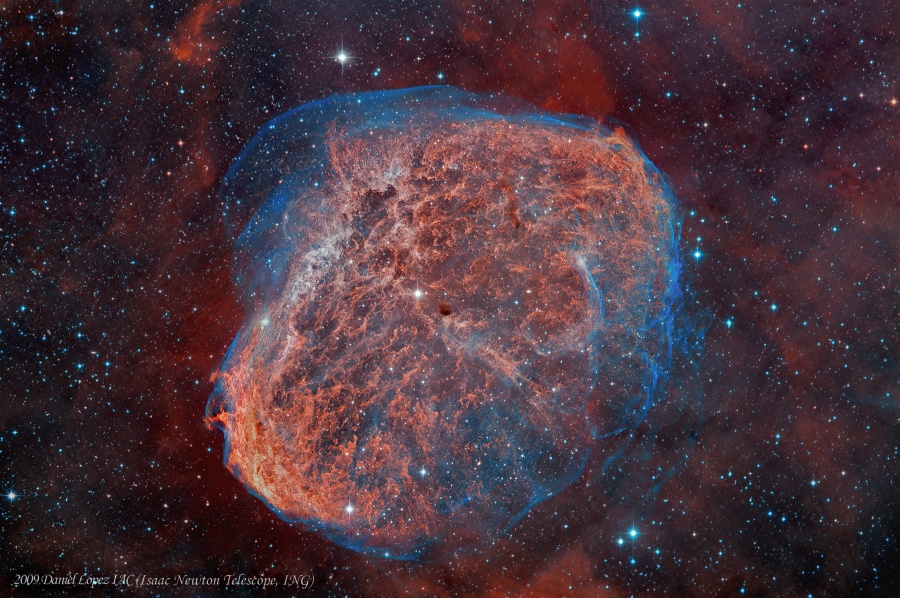
NGC 6888: The Crescent Nebula
Explanation: NGC 6888, also known as the Crescent Nebula, is a cosmic bubble about 25 light-years across, blown by winds from its central, bright, massive star.
This beautiful portrait of the nebula is from the Isaac Newton Telescope at Roque de los Muchachos Observatory in the Canary Islands.
It combines a composite color image with narrow band data that isolates light from hydrogen and oxygen atoms in the wind-blown nebula.
The oxygen atoms produce the blue-green hue that seems to enshroud the detailed folds and filaments.
NGC 6888's central star is classified as a Wolf-Rayet star (WR 136).
The star is shedding its outer envelope in a strong stellar wind, ejecting the equivalent of the Sun's mass every 10,000 years.
The nebula's complex structures are likely the result of this strong wind interacting with material ejected in an earlier phase.
Burning fuel at a prodigious rate and near the end of its stellar life this star should ultimately go out with a bang in a spectacular supernova explosion.
Found in the nebula rich constellation Cygnus, NGC 6888 is about 5,000 light-years away.
“...In them he has pitched a tent for the Sun.”
"It combines a composite color image with narrow band data that isolates light from hydrogen and oxygen atoms in the wind-blown nebula."
Odd that a burning star would produce hydrogen and oxygen and scatter these byproducts of its fiery reaction via it's solar radiation winds rather that consume oxygen and hydrogen and scatter the byproducts of that instead
WOW!
The nuclei hold more energy and being a positive charge don't want to get to close together, but as they accelerate away from each other and literally bounce off other nuclei, they gain acceleration. When enough speed is accumulated nuclei collide and shatter, releasing thermal energy in the form of the lighter elements of hydrogen and oxygen.
The trick is to get the nuclei moving fast enough so many collisions take place at the same time. Result: Star burst or after a time when one of the lighter elements 'burns' off, explosion.
Amen and amen!
That’s not a nebula, thats our exploding national debt
Space pizza.
Looks like something the doctors removed.
APOD (the Archive) has a permanent place on the "Bookmarks Bar" atop my browser pages. I check it frequently, and on occasion, browse through a dozen or so pages in the index.
However, I sometimes find the authors major on the superficial and spectacular -- and leave obvious scientific quesions unaddressed. Such an oversight occurred on today's APOD:

I can't help but be intrigued by that dark "blob" that appears to occupy the very center of the nebula. Is that a fresh, dense "shell" of dust and hydrogen that has recently been ejected? And, is the actual star concealed within that "blob"?
Disclaimer: Opinions posted on Free Republic are those of the individual posters and do not necessarily represent the opinion of Free Republic or its management. All materials posted herein are protected by copyright law and the exemption for fair use of copyrighted works.