Posted on 09/09/2009 3:21:48 PM PDT by paul in cape
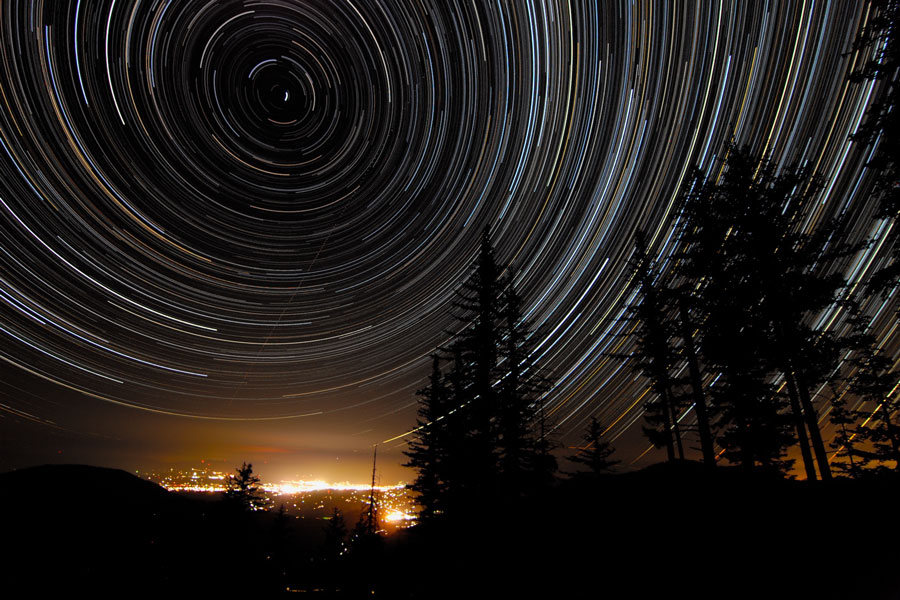
Star Trails Over Oregon
Explanation: As the Earth spins on its axis, the sky seems to rotate around us.
This motion, called diurnal motion, produces the beautiful concentric trails traced by stars during time exposures.
Partial-circle star trails are pictured above over Grants Pass, Oregon, USA last month.
Near the middle of the circles is the North Celestial Pole (NCP), easily identified as the point in the sky at the center of all the star trail arcs.
The star Polaris, commonly known as the North Star, made the very short bright circle near the NCP.
About 12,000 years ago, the bright star Vega was the North Star, and in about 14,000 years, as the Earth's spin axis slowly continues to precess, Vega will become the North Star again.
Great Photo!
Excellent! I’d love to make a shot like that. Too humid and cloudy in my area though.
How does this occur? Wouldn’t one need to be atop the North or South Pole to get it this way? Or is the Earth’s radius way too small compared to the distances the stars are at, hence negating the effect of the Earth’s rotation?
The North Star is basically our fixed point. Relative to the distance the stars are from us, our little bit of movement doesn’t amount to a hill a beans when taking a picture like this.
Thanks!
Interesting tid-bit:
“Due to the precession of the equinoxes the direction of the Earth’s axis is very slowly but continuously changing, and as the projection of the Earth’s axis moves around the celestial sphere over the millennia, the role of North Star passes from one star to another. Since the precession of the equinoxes is so slow, taking about 26,000 years to complete a cycle, a single star typically holds that title for many centuries.
In 3000 BCE the faint up star Thuban in the constellation Draco was the North Star. At magnitude 3.67 (fourth magnitude) it is only one fifth as bright as Polaris, the current North Star.
Gamma Cephei (also known as Alrai, situated 45 light-years away) will become closer to the northern celestial pole than Polaris around 3000 CE.”
Disclaimer: Opinions posted on Free Republic are those of the individual posters and do not necessarily represent the opinion of Free Republic or its management. All materials posted herein are protected by copyright law and the exemption for fair use of copyrighted works.