Posted on 09/08/2009 6:31:28 AM PDT by paul in cape
Unexpected Impact on Jupiter
Explanation: Two months ago, something unexpected hit Jupiter.
First discovered by an amateur astronomer Anthony Wesley on 2009 July 19, the impact was quickly confirmed and even imaged by the Hubble Space Telescope the very next day.
Many of the world's telescopes then zoomed in on our Solar System's largest planet to see the result.
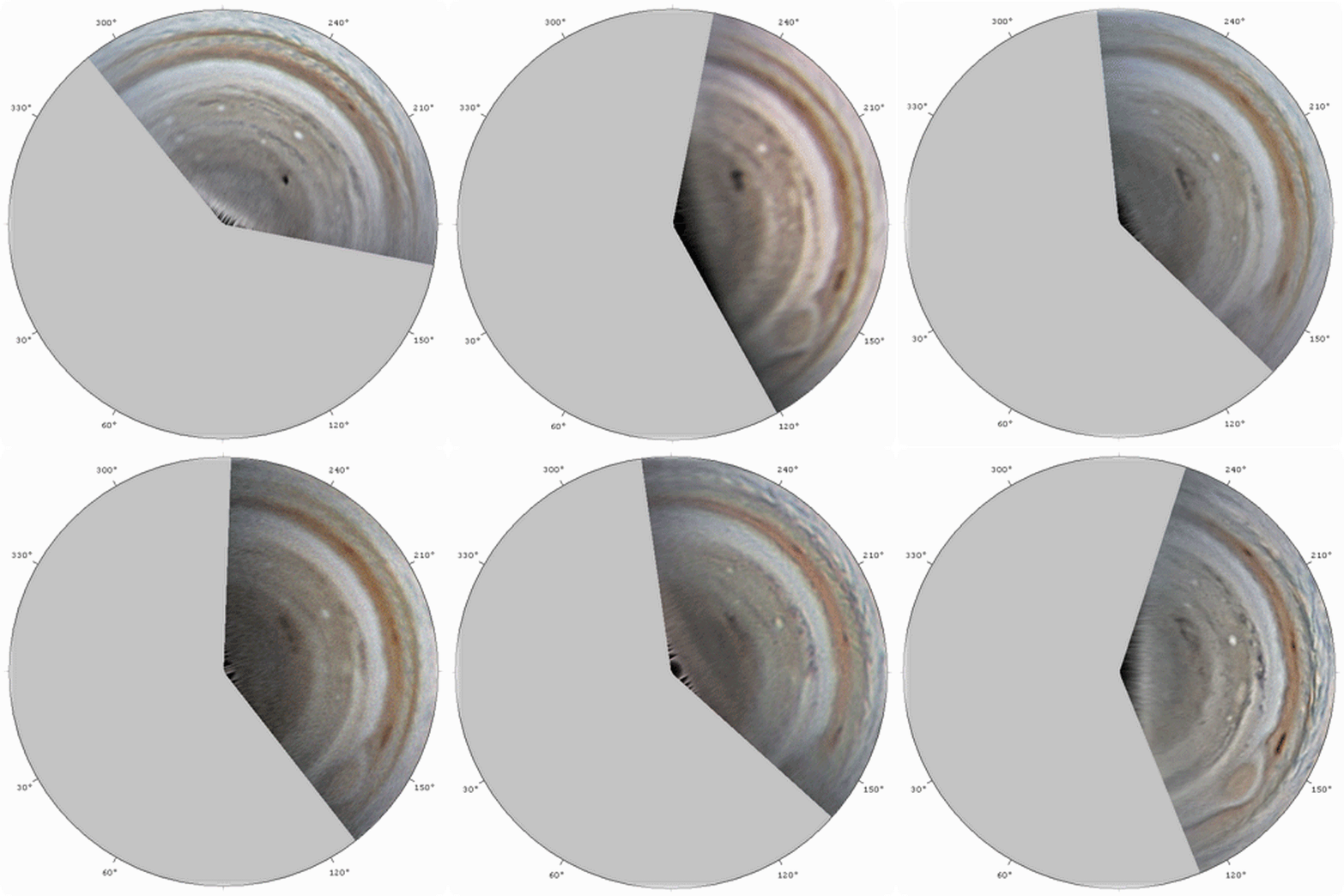
Some of these images have been complied into the above animation.
Over the course of the last month and a half, the above time-lapse sequence shows the dark spot -- first created when Jupiter was struck -- deforming and dissipating as Jupiter's clouds churned and Jupiter rotated.
It is now thought that a small comet -- perhaps less than one kilometer across -- impacted Jupiter on or before 2009 July 19.
Although initially expected to be visible for only a week, astronomers continue to track atmospheric remnants of the impact for new information about winds and currents in Jupiter's thick atmosphere.
Coming someday to a planet you love.
Does Jupiter actually have a surface and a core, or is it all just thick vapors?
Solid core very deep but the gasses under such intense pressure become liquid realtively far out.
Which of these liver spots is the impact zone?
Does Biden or Gibbs know about this? They're always commenting on the "unexpected!"
Just like Obama's plan for economic recovery, it's all thick vapors on the surface with a vicious, burning core at the center.
Time to appoint a Czar of the Unexpected Events
It's been fascinating to see just how many of the newly discovered plants around our galaxy are gas giants (that may or may not have iron or metal cores) located as close or closer to their Suns as our inner planets are to our Sun.
Several theories regarding the formation of the local planet group include having them start out as gas giants close to the Sun. Then the Sun goes mainline and a vast solar wind blows the gas off the closest gas giants revealing their rocky cores.
Finding out about distant planets has revealed to us that more extreme theories of solar formation were probably more nearly correct than otherwise.
I don’t know off the top of my head if it is still a good theory, but, at one point, it was thought that Jupiter had a core of metallic Hydrogen.
There is some thought that there may be a very low yield nuclear reaction going on deep inside, thus, Jupiter puts out more energy than it takes in from the Sun. It’s a very nasty environment no matter what.
Disclaimer: Opinions posted on Free Republic are those of the individual posters and do not necessarily represent the opinion of Free Republic or its management. All materials posted herein are protected by copyright law and the exemption for fair use of copyrighted works.