Posted on 09/04/2009 7:55:57 PM PDT by sickoflibs
In America's Great Depression, originally published in 1963, Murray Rothbard argued that the recession-adjustment that began in 1929 was greatly worsened and turned into a full-blown depression by the policies implemented by Herbert Hoover. Among the Hooverite policies that stifled the adjustment process, Rothbard identified public-works programs, increases in taxes, the imposition of the Smoot-Hawley tariff, but especially Hoover's efforts to prevent the downward adjustment of nominal wages by exerting pressure on big industrialists not to cut (and even to raise) their employees' wage rates.
Rothbard's explanation of how the temporary and benign recession-adjustment process was impeded and diverted into the Great Depression ran counter to the view that Milton Friedman and Anna Schwartz put forth in their classic work A Monetary History of the United States, 1867–1960, also published in 1963. According to Friedman-Schwartz, it was the collapse of the money supply due to the negligence of the Fed that turned what should have been a "garden-variety recession" into the Great Depression. The Friedman-Schwartz view came to dominate mainstream macroeconomics after the collapse of the Keynesian consensus in the 1970s. Indeed, it is today the conventional explanation of the Great Depression, which Bernanke holds to and which governs the policy response of the Fed to the current financial crisis.
Thus, for decades Rothbard and a handful of Misesian economists were virtually alone in maintaining that Hoover's interventionist policies, particularly as they impacted the industrial labor market, were mainly responsible for transforming what should have been a short and sharp recession into the economic catastrophe of epic proportions that we now know as the "Great Depression." Now comes a National Bureau of Economic Research (NBER) working paper written by a prominent macroeconomist with impeccable academic credentials — and accepted for publication by the influential Journal of Economic Theory — which challenges the Friedman-Schwartz view and lends ample evidence to the Rothbardian position on the genesis of the Great Depression. In writing his article, "Who — or What — Started the Great Depression," UCLA economist Lee E. Ohanian spent four years poring over wage data and culling information from sources related to Hoover and his administration.[1]
In order to quantify the magnitude of the effects of Hoover's industrial labor market program, Ohanian used these data and sources to construct and calculate a general-equilibrium model of the Hoover economy and compared it to how the model economy would have behaved without the Hoover program.
Ohanian contends that Hoover's policy of propping up wages and encouraging work sharing "was the single most important event in precipitating the Great Depression" and resulted in "a significant labor market distortion."
Thus, "the recession was three times worse — at a minimum — than it otherwise would have been, because of Hoover."
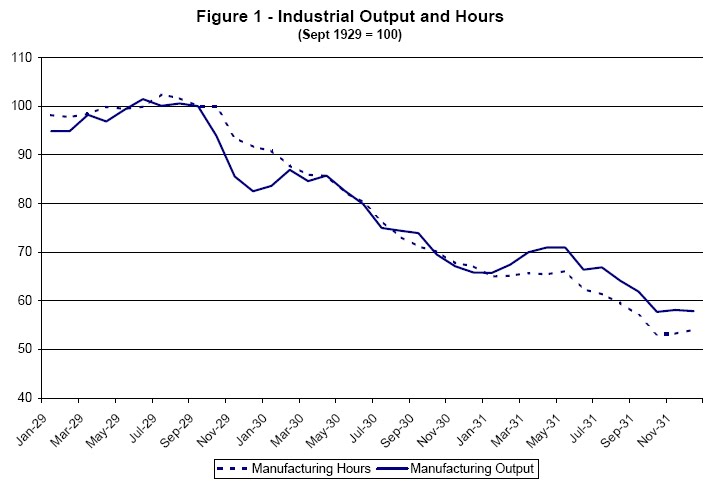
The main reason is that in September 1931 nominal wage rates were 92 percent of their level two years earlier. Since a significant price deflation had occurred during these two years, real wages rose by 10 percent during the same period, while gross domestic product (GDP) fell by 27 percent. By contrast, during 1920–1921 — a period that was accompanied by a severe deflation — "some manufacturing wages fell by 30 percent. GDP, meanwhile, only dropped by 4 percent."
As Ohanian notes, "The Depression was the first time in the history of the US that wages did not fall during a period of significant deflation." Ohanian estimates that the severe labor-market disequilibrium induced by Hoover's policies accounted for 18 percent of the 27 percent decline in the nation's GDP by the fourth quarter of 1931.
Regarding the now-conventional explanations of the Great Depression, such as widespread bank failures and the severe contraction of the money supply, Ohanian points out that these two events did not occur to a significant extent until mid-1931, which was two years after the implementation of Hoover's industrial labor market policies.
Moreover, Ohanian argues,
any monetary explanation of the Depression requires a theory of very large and very protracted monetary nonneutrality. Such a theory has been elusive because the Depression is so much larger than any other downturn, and because explaining the persistence of such a large nonneutrality requires in turn a theory for why the normal economic forces that ultimately undo monetary nonneutrality were grossly absent in this episode.
The conclusion of Ohanian's paper is quite — one is tempted to say "hardcore" — Rothbardian.
The Great Depression that quickly superseded and distorted the benign recession-adjustment process was not in any sense caused by monetary deflation but by government-induced nominal wage rigidities, which of course can be temporarily circumvented by surreptitiously reducing real wages via unanticipated monetary expansion. Thus writes Ohanian:
I conclude that the Depression is the consequence of government programs and policies, including those of Hoover, that increased labor's ability to raise wages above their competitive levels. The Depression would have been much less severe in the absence of Hoover's program. Similarly, given Hoover's program, the Depression would have been much less severe if monetary policy had responded to keep the price level from falling, which raised real wages. This analysis also provides a theory for why low nominal spending — what some economists refer to as deficient aggregate demand — generated such a large depression in the 1930s, but not in the early 1920s, which was a period of comparable deflation and monetary contraction, but when firms cut nominal wages considerably.
This leaves us with a very interesting question.
Here we have a paper, written by a eminent macroeconomist at a top-tier research university, which is an NBER working paper and is soon to be published in the highly ranked Journal of Economic Theory.
Is this sufficient to provide surcease from those Austrian economists who dismiss Rothbard and Mises's analysis of the Great Depression and make the bizarre claim that the inflationary phase and the initial downturn in 1929 is explained by the Austrian theory of the business cycle but that this theory needs to be supplemented by the Friedman-Schwartz story to account for the severity of the contractionary phase of 1930–1933?
If you realize both parties in Washington think our money is theirs and you trust them to do the wrong thing, this list is for you.
If you think there is a Santa Claus who is going to get elected in Washington and cut a few taxes and spend a few trillion and jump start the economy, and get our lost money back, this list is not for you.
You can read past posts by clicking on : schifflist , I try to tag all relevant threads with the keyword : schifflist.
Ping list pinged by sickoflibs.
To join the ping list: FReepmail sickoflibs with the subject line add Schifflist.
(Stop getting pings by sending the subject line drop Schifflist.)
"I conclude that the Depression is the consequence of government programs and policies, including those of Hoover, that increased labor's ability to raise wages above their competitive levels"
Like the minimum wage law being raised in the middle of a deep depression now under Obama, while Obama claims all job losses are republicans fault??
One Ringy Pingy...
BTTT!!
Two Ringy Pingy
One thing that never made sense to me about the Friedmanite explaination is that once deflation happens, and the money that was there in the first place disappears, why can’t prices be allowed to fall into line with wages? In that case, when businesses fail and the economic system is disrupted (temporarily) those who are working can still buy things. Credit will be dried up, yes. But prosperity will return when people start saving again. Remember saving? Americans used to do it, to some degree, way back in the 19th century.
Oh, wait, I know why. Because the curtain can never be pulled back. Industrial concerns, bad and good (who knows which, since none of them are allowed to fail to prove themselves bad), must be allowed to go on stealing their piece of the pie, unencumbered by the foolhardy wishes of the masses to grab hold of their own money.
I meant to say, “...and the money that was NEVER there in the first place disappears...”
I’ll read this in the morning - thanks for the ping Tork.
Great example, I'd say just like that.
It's funny how the authoritarian instincts of leftist politicians always seem to produce not just wrong economic policies, but policies that are the opposite of what is needed.
Yep, deflation was our big foe earlier this year. But Obama got past that. We got rising food and energy prices and high unemployment.
The cash for clunkers destruction of cars reminds me of Roosevelt's destruction of crops to keep prices from falling, to help keep the farmers from losing their farms.
My (homemaker) grandmother would scrape the last drop out of a jelly jar which she learned from the days with little food even before the great depression. She died with the belief that Roosevelt was a hero who saved the people with public works programs.
I'm assuming arguendo, and against available evidence, that Obama actually wants good things to happen for the country and People, and that Bernanke et al. are not driven by ulterior, bankster, Illuminist, NWO, etc., agenda.
Should shortening the recession be the goal at any cost? Is there any cost to the future that is too much that makes it not worth it to ease temporary pain?
The problem with Bush, Obama ,Bernanke is they are getting lame results traded for a bigger disaster in the future. Bush-Greenspan did the same thing in 2002, got Bush reelected, and had the economy crash at the end of the Bush term (bad luck for him huh?)
It doesn't take a genius, but more apparently more than a Democrat, to realize that with all this unknown stuff hanging over business owners heads they aren't going to start hiring people only to be forced to lay them with they get hit by who knows what new tax or regulation.
Much the same thing happened with Clinton and Hillarycare. Finally when it all died and was not hanging over everyone’s heads the economy started to pick up.
Sounds more like the “blame the GOP for the Depression” tripe
Anyone using Smoot-Hawley as the cause, or the worsening, of the Great Depression, cannot be taken seriously.
The current economic situation is proof that a liberal free-trade economy does not work....
Among Ohanian’s previous papers was one contending that FDR’s policies prolonged the depresion by seven years, by promoting union-favoring policies (this was in FDR’s belief that excess competition caused the depression). Ohanaian says the DOJ ended the recession by some union-busting suits. So he isn’t one to bash only Republicans, but maybe Glenn Beck’s progressives.
http://newsroom.ucla.edu/portal/ucla/FDR-s-Policies-Prolonged-Depression-5409.aspx
http://www.freerepublic.com/focus/f-news/2332942/posts
This article , posted today, backs up a lot of what Ohanian said.
...No sympathy for GWB then, No mercy for Obama and Bernanke now. This is your baby, terminate it now, or the heat will increase...
RE :”No sympathy for GWB then, No mercy for Obama and Bernanke now”
That’s the way I feel. Blaming democrats for the bad economy at the start of Obama’s admin makes as much sense as blaming republicans if it doesnt improve, or a big crash later.
But both parties will blame each other, they always do,
“So what would Ohanian and the Rothbardians have Obama and Bernanke do now, to shorten the recession?”
At the very least, I guess, nothing.
Disclaimer: Opinions posted on Free Republic are those of the individual posters and do not necessarily represent the opinion of Free Republic or its management. All materials posted herein are protected by copyright law and the exemption for fair use of copyrighted works.