Skip to comments.
Baseball Cards And The Current Economy (What baseball cards reveal about basic economics)
Forbes Magazine ^
| 8/31/2009
| John Tamny
Posted on 08/31/2009 8:02:41 AM PDT by SeekAndFind
In a high-profile 1991 transaction, hockey great Wayne Gretzky and Los Angeles Kings owner Bruce McNall bought the elusive T206 Honus Wagner baseball card for $451,000. The American Tobacco Co. produced the T206 from 1909 to 1911, but only 50 were ever distributed to the public. As early as 1933, the card could supposedly fetch $50 on the collectibles market, which made it the most expensive baseball card in the world.
The year 1991 isn't only notable for the Gretzky/McNall purchase. It also marked the peak year for baseball-card sales. According to estimates from Sports Collector's Digest, card sales amounted to $1.2 billion in 1991, but by the end of the millennium total sales had declined to $400 million, and last year sales dropped all the way to $200 million. For followers of economics, the modern history of the baseball-card industry offers useful lessons about market responses to profit, anti-trust laws, business failure and inflation.
The years surrounding the sale of the iconic Wagner card generated a lot of investor interest in baseball cards. Sensing huge potential profits, newer entrants Fleer, Donruss, Score, Stadium Club and Upper Deck joined more established card company Topps in pursuit of large gains.
Politicians frequently wring their hands over businesses being too profitable on the backs of allegedly hapless consumers, but their worries are overdone. As evidenced by the market for baseball cards, new entrants did as they've always done when it comes to lowering profit margins in pursuit of, yes, profits.
(Excerpt) Read more at forbes.com ...
TOPICS: Business/Economy; Culture/Society; Editorial
KEYWORDS: baseballcards; economics; ronaldperlman
Navigation: use the links below to view more comments.
first 1-20, 21-23 next last
To: SeekAndFind
I really have no idea what this guy is trying to say.
2
posted on
08/31/2009 8:11:01 AM PDT
by
ClearCase_guy
(Play the Race Card -- lose the game.)
To: SeekAndFind
World Record Price of $2.8 Million Paid For Famed T206 Honus Wagner Baseball Card 09-07-2007
Mission Viejo, Calif. (Sept. 6, 2007) – Another Grand Slam for Honus Wagner. The finest known example of the famed T206 Honus Wagner baseball card has found another new home a little more than six months after selling for a then-record shattering price of $2.35 million in February to a California private collector. Renowned sports card and memorabilia auction company SCP Auctions Inc., has brokered the latest sale to a private collector for a record price of $2.8 million.
The legendary T206 Honus Wagner baseball card, previously owned by Wayne Gretzky, and once the top prize in a national contest conducted by Wal-Mart, has long been recognized as the most famous and valuable baseball card in existence. Dubbed “The Holy Grail” or “Mona Lisa” of baseball cards, it has always been a beacon of the red-hot vintage sports collectibles market.
"The T206 Honus Wagner card is an icon, not only in the field of baseball card collecting, but in the larger field of Americana,” said David Kohler, president and CEO of SCP Auctions.
Said Dan Imler, managing director of SCP Auctions: “For many collectors, owning any example of a T206 Honus Wagner card is the crowning achievement of baseball card collecting. Approximately 70 collectors in the word are fortunate to own one. This example, graded PSA 8 NM-MT, is universally recognized as the ultimate baseball card treasure. We are proud to have had a hand in placing it in a good new home.”
The legacy of the T206 Honus Wagner Card dates back to its creation and initial release by the American Tobacco Company in 1909 as part of a series that included more than 500 different baseball player cards. T206 tobacco cards are among the most widely collected, popular and sought after cards among current collectors. To this day however, it is estimated that less than one hundred examples of the T206 Wagner have surfaced. Numerous myths have been perpetuated and debated over the course of the last century, as to the reason for its scarcity. One of the prevailing theories was that Wagner, one of the premier players in the history of baseball, insisted that he be paid by the tobacco company for the use of his image causing the production of his card to be halted. A more common, and well-documented theory is that Wagner simply did not want children to be influenced into buying tobacco products just to get a “picture” of him, and thus forced the early withdrawal of his image on this principle. The volumes that have been written and countless tales that have been spun have made the T206 Wagner card a part of classic American Folklore.
3
posted on
08/31/2009 8:12:07 AM PDT
by
Yo-Yo
To: SeekAndFind

wander what this is worth? story with card,
While Allen & Ginter were busy releasing exciting tobacco cards, competition in the tobacco market was growing at an extremely rapid rate. Not to be outdone, several additional cigarette manufacturers were also issuing cards. One, the Goodwin and Company, issued a sepia-colored baseball set promoting their Old Judge and Gypsy Queen cigarettes. It’s known as the enormous N172 series. This was the first set the featured baseball players exclusively. There are six different printings expanding over four years extending from 1887 to 1890; three in 1887 and one each in 1888, 1889, and 1890. There are more than 500 known players depicted with as many as 17 different cards each. The thick, sepia-toned, tintype cards depict a studio photograph of a baseball player, surrounded by a white border, pasted to a thick, blank-back piece of cardboard. Printed on the fronts of almost all of these cards are the words, "OLD JUDGE Cigarette Factory" and "GOODWIN & CO. New York."
To: SeekAndFind
Interesting angle but the premise is a bit forced.
Donruss and Fleer entered the baseball card arena in 1982, with Fleer having been in business for some time before (if I remember correctly the company had ties to the Philadelphia gum co. that made football cards in the 1960’s.) Stadium club was a topps product and Upper Deck was the first truly upscale card made for collectors - $2 or $3 a pack that first year (1989, not post-1991 as the author suggests.) Score was a 1988 entrant into the industry.
Sorry for geeking out on this - I was in the heart of the industry during the late 80’s, early 90’s and paid for my first year of college in cash with proceeds from dealing 1989 Score football, 1990 Leaf baseball, and Brett Favre autographs among other sports collectibles.
5
posted on
08/31/2009 8:19:12 AM PDT
by
sbMKE
To: SeekAndFind
....baseball cards and comic books....put them in the has-been file along with Beanie Babies...if you like them, then collect them...if you want an investment, look elsewhere.
To: housemouse 1
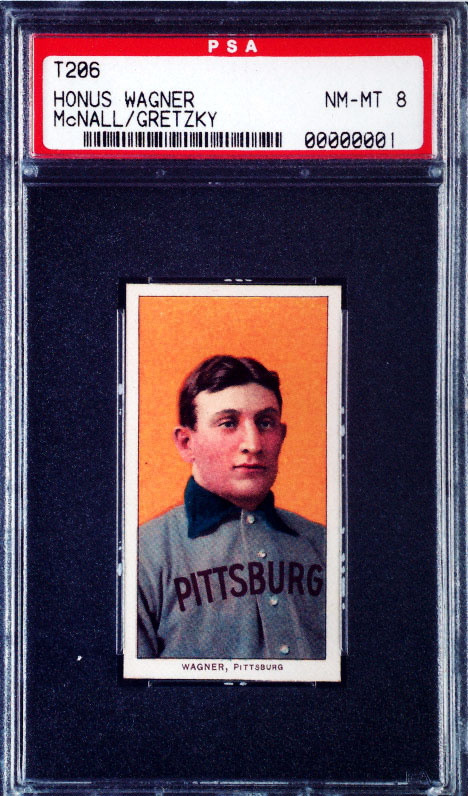
WORLD'S MOST VALUABLE CARD! SOLD IN 2007 FOR $2.8 MILLION
This is the fabled T-206 Honus Wagner card from 1909-1911 that sold in 2007 for a world-record $2.8 million. The card was certified at Near Mint/Mint 8 by BILL HUGHES, who was the OFFICIAL GRADER for PSA at the time of the grading of this, the most important baseball card in the hobby!
(Bill Hughes graded this famous card, but did not own it and was not the seller of the card.)
To: STONEWALLS
Yes, it is better to invest in tulips and carbon offset credits.
8
posted on
08/31/2009 8:24:26 AM PDT
by
a fool in paradise
(Kennedycare?Recall that "Animal Farm" begins with a Socialist Revolution to honor Big Major's legacy)
To: SeekAndFind
The sale of baseball cards seems to be a pretty stupid indicator for measuring the economy. Watching my son and his friends in the bedroom going through their massive Pokeman card collection, I would say card collection is safe. It just not only baseball anymore.
Same can be said for electric trains. Fewer kids these days find them under the tree. Trains just don't make it on the Christmas list anymore. While sales are holding steady and even growing with aging baby boomers who want to reconnect with their childhood, now that they can afford the train they always wanted, and that they have more time on their hands.
9
posted on
08/31/2009 8:26:14 AM PDT
by
NavyCanDo
To: ClearCase_guy
The author is trying to show an analogy between the buying and selling of baseball cards to the economy in general.
For instance -— When too much money is printed, it loses value, and inflation is the result. Much the same has occurred with baseball cards. With a growing number of companies issuing baseball cards, there’s nothing particularly unique or rare about them. Lacking the rarity that attached itself to Wagner’s card in the ‘30s, and Griffey’s rookie card today, their value has plummeted.
To: housemouse 1
Hey, I think that’s the card I put in my bike spokes when I was a kid.
11
posted on
08/31/2009 8:31:43 AM PDT
by
BlueStateBlues
(Blue State business, Red State heart. . . . .Palin 2012----can't come soon enough!)
To: ClearCase_guy
Step #1, Steal Underpants.
Step #2, ??
Step #3, Profit !
12
posted on
08/31/2009 8:33:30 AM PDT
by
fieldmarshaldj
(~"This is what happens when you find a stranger in the Alps !"~~)
To: STONEWALLS
....baseball cards and comic books....put them in the has-been file along with Beanie Babies...if you like them, then collect them...if you want an investment, look elsewhere. The dumbest guy I ever met took out all $50k from his 401k and invested it in Beanie Babies, and some temperature controled holding safe.
Just a remarkable moron this guy was. He once told me that he believed if you flipped a coin 100 times, heads would come up at least 70 times.
Actually, he once drove six hours to go to a bar near Oakland's stadium to root for the Dolphins when the two teams played (got the tar kicked out of himself too).
Beanie Babies as an investment... unbelievable.
13
posted on
08/31/2009 8:42:46 AM PDT
by
End Times Sentinel
(In Memory of my Dear Friend Henry Lee II)
To: SeekAndFind
nice story,i like the post too, thanks for sharing, something different than the same old thing.
To: BlueStateBlues
lol.. so that was you? :-) , i’ll send it to you for a cool million, lol.....
To: NavyCanDo
I have to agree with you , nothing is the same anymore is it? :-(
To: SeekAndFind
I knew a grown man who collected baseball cards. I always thought that was very odd. He probably thinks my porcelain vase collection is very odd, too. LOL
To each his own.
17
posted on
08/31/2009 10:41:51 AM PDT
by
buffyt
(If ObamaScare is so great, WHY won't Congress and President USE IT, TOO????????????????????????)
To: SeekAndFind
I wonder if it is the SAME Bill Hughes. That was the name of the man I knew in San Marino California 1988-1990 who had the baseball card collection.
18
posted on
08/31/2009 10:42:55 AM PDT
by
buffyt
(If ObamaScare is so great, WHY won't Congress and President USE IT, TOO????????????????????????)
To: buffyt
I bet it is the same Bill Hughes, I looked up the baseball card expert, says Los Angeles. Bill had the largest baseball card collection I have ever seen. Just huge. And he was very excited about it, big baseball fan.
19
posted on
08/31/2009 10:48:27 AM PDT
by
buffyt
(If ObamaScare is so great, WHY won't Congress and President USE IT, TOO????????????????????????)
To: sbMKE
A couple of nits: Donruss and Fleer began competing with Topps in 1981; Fleer had printed a couple of sets back in the late 50s or early 60s (including a “Ted Williams set” IIRC).
20
posted on
08/31/2009 2:37:43 PM PDT
by
AuH2ORepublican
(Fred Thompson appears human-sized because he is actually standing a million miles away.)
Navigation: use the links below to view more comments.
first 1-20, 21-23 next last
Disclaimer:
Opinions posted on Free Republic are those of the individual
posters and do not necessarily represent the opinion of Free Republic or its
management. All materials posted herein are protected by copyright law and the
exemption for fair use of copyrighted works.
FreeRepublic.com is powered by software copyright 2000-2008 John Robinson