Posted on 06/24/2009 12:27:03 PM PDT by jazusamo
Three of the most senior House appropriators are planning to discuss exporting Lockheed Martin’s F-22 Raptor fighter jet to the Japanese government, which wants badly to buy the stealth plane.
Rep. John Murtha (D-Pa.), the chairman of the House Appropriations Defense subcommittee, said Wednesday that he intends to meet in the coming days with Appropriations Committee Chairman David Obey (D-Wis.) and Rep. Bill Young (Fla.), Murtha’s GOP counterpart on the Defense subcommittee, to discuss lifting the export ban on the F-22.
The key player in that briefing will be Obey, who in 1998 wrote the legislation that bans the exports of the F-22 mainly to keep secret the aircraft’s radar-evading stealth technology. Obey has not budged since, and it’s unclear whether he is willing to relent.
“He is willing to listen,” Murtha said at a breakfast with reporters on Wednesday.
Industry and congressional sources, however, tell The Hill that Obey was adamantly opposed even to including what basically amounts to noncommittal language in the 2009 war-spending bill. Obey’s Senate counterpart, Daniel Inouye (D-Hawaii), is a strong supporter of exporting the F-22 to the Japanese and has engaged government representatives with details on what it would entail for Japan to buy the jet.
Obey has been against exporting the F-22 from the very beginning and his base position has not changed, said Obey's spokesman, Ellis Brachman.
He is always willing to listen, Brachman added.
Ultimately, Inouye was able to include language in the war supplemental bill that says some funds in the spending measure (which has money for four F-22s) can be used to explore options to develop an export variant of the F-22 A. Sources say that provision was adopted despite Obey’s objections.
Murtha, who is willing to work with Inouye on facilitating the sale of the F-22 to the Japanese, admitted it is an expensive proposition that also depends on whether Lockheed Martin’s Marietta, Ga., production line will stay open for several more years. That production line in turn depends on U.S. domestic orders for the plane. The Obama administration did not ask for money for the production of the fighter jet in fiscal 2010 and is adamant about halting production after the 187th airplane is delivered to the Air Force.
Murtha said that he would like to be able to purchase another 20 aircraft in 2010, but that he is uncertain whether that would be possible, considering the total price tag for those planes is $3.2 billion. Murtha also said that he is concerned about the high cost of operating and maintaining the existing planes.
But the veteran defense appropriator said he wants to assess future threats to the United States when considering the purchase of more than 187 planes and also on the topic of selling them to Japan.
He said he will consult CIA Director Leon Panetta and Director of National Intelligence Dennis Blair on the nation’s threat level.
“Intelligence tends to define itself by what the White House says. Give me an objective estimate of what is down the road,” said Murtha.
Murtha said China should be considered a threat down the road, particularly as it will compete directly with the United States for energy supplies. He indicated that, such being the case, it would be good for another country to have the F-22.
For the F-22 to end up in Japan, Lockheed Martin would have to spend a considerable amount of time — several years — demilitarizing the plane. That essentially means stripping the jet of sensitive technologies employed by the U.S. military. That could be costly. By Murtha’s calculations the research and development to remove those capabilities would cost at least $1 billion and could go much higher, and it is unclear whether the Japanese would be able to pay such a steep price.
The F-22 quandary could lead to some intense negotiations on the fiscal 2010 defense appropriations bill, which Murtha’s panel is taking up after the Fourth of July recess.
Murtha also gave a glimpse into some of the decisions he may make on the bill. Among them is finding money to buy more Boeing F/A-18 Super Hornets to make up for a Navy and Marine Corps strike fighter shortfall. “We know we are going to do something about it,” he said.
The Appropriations Defense chairman — who earlier this year was adamant about splitting the Air Force’s midair refueling tanker contract between Boeing and Northrop Grumman — said he has a provision he is prepared to present to his subcommittee that will let Defense Secretary Robert Gates decide whether he wants to see one or two contractors build the tankers.
Murtha said he believed a split contract would be the way to go on the contentious program, fearing it will never take off because of prolonged protests by the losing bidders.
He met with Gates on Tuesday and said the secretary “listened … he was noncommittal.” But Murtha indicated that the administration may be willing to consider a split buy on the tanker. He said that the administration has about four issues on which it is not willing to negotiate.
“The tanker is not one of them,” Murtha said, refusing to disclose the non-negotiable items.
Gates has been strongly opposed to a split-buy for the tanker, arguing that it would be too expensive and a bad deal for taxpayers.
Japan’s had a few high profile issues around keeping American technology secret.
More recently, Toshiba’s accidental release of sub-quieting technology a few years back.
Otherwise, I think it’s fair to say that Japan will be the first to use this weapon in an Asian conflict. And, if it keeps the F-22 lines open until a natural-born American is elected back to the Oval Office, it works for me.
The only one I’ve read about is that secret info will be less secure with the Japanese but if the plane is refit for export I don’t see the problem.
Perry's anti-Japan opinion is typical of the left, which is against US power. They see Japan as a faithful U.S. ally with mutual interests to ours as a possible extension of US power.
The left is blithe about China stealing US MIRV ICBM technology, but terrified of selling US stealth technology to Japan.
You captured my thoughts exactly.
Thanks,
Mc
I think you're exactly right on that. If something big goes down in Asia it would be more than good to have a well equipped Japan on our side.
Don’t forget that the inscrutable Japanese have already proven themselves untrustworthy. Hitachi and Toshiba sold top secret machining technology for making silent submarine propellers to the Soviets. What makes this any different?
The Japanese played the US during the Cold War. While there were allies, they weren’t above manipulating the situation to their economic advantage. Allies can be like that. (Israel selling F-16 technology to China is a more recent example).
I’m wondering if the Japanese might take the present Chinese threat more seriously than they took the Soviet one and so be less inclinded toward such games? I think the animosity runs far deeper between China & Japan.
Obey, Murtha, Gates, Clinton — they leave the taste of vomit in the mouth.
Yes they do and especially Murtha for me.
Yes it does and it has for many years. Like you say, they may treat this a lot differently because they desperately want to counter the Chinese threat.
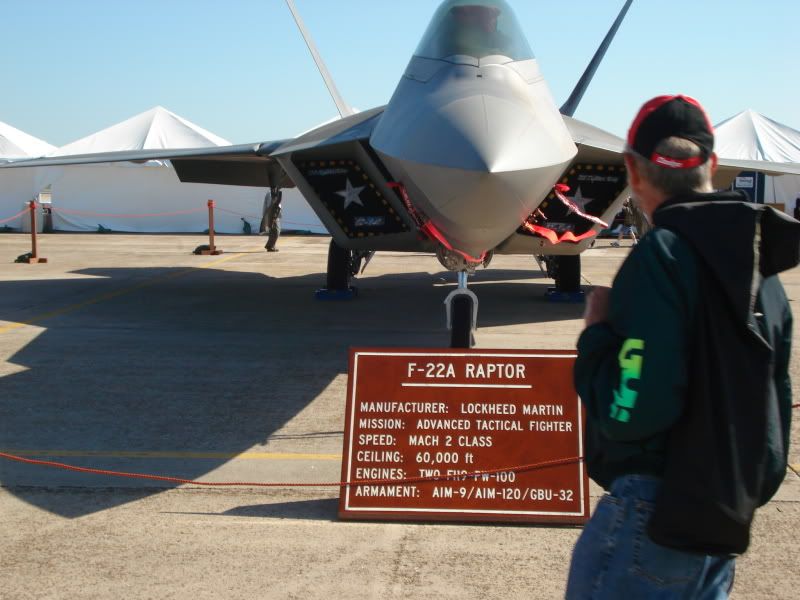
Interesting stats. I think that service ceiling on that puppy is a lot higher than 60K ft. I think that they plan to use this stealth jet at very high altitude. Nice round number though.
I think that the MSDF’s act of giving the PRC all the Aegis technology would qualify as a reason...?
Great ally, sure, but they’re got some embarrassing stuff they REALLY haven’t owned up to...
Maybe the PRC will develop top-of-the-line fighters, but should US taxpayers subsidize it?
Nope...
Let them buy export versions off the shelf —and all critical parts of the radar, etc. is 2b maintained by US personnel only, with no help from JASDF.
And let them buy 100 or so copies.
Are they really serious about their DEFENSE needs, and not some juicy tech transfer?
If so, the Japanese should be delighted to BUY OFF THE SHELF, even with lots of black-boxing...
Disclaimer: Opinions posted on Free Republic are those of the individual posters and do not necessarily represent the opinion of Free Republic or its management. All materials posted herein are protected by copyright law and the exemption for fair use of copyrighted works.