Posted on 03/14/2009 3:05:20 PM PDT by Vince Ferrer
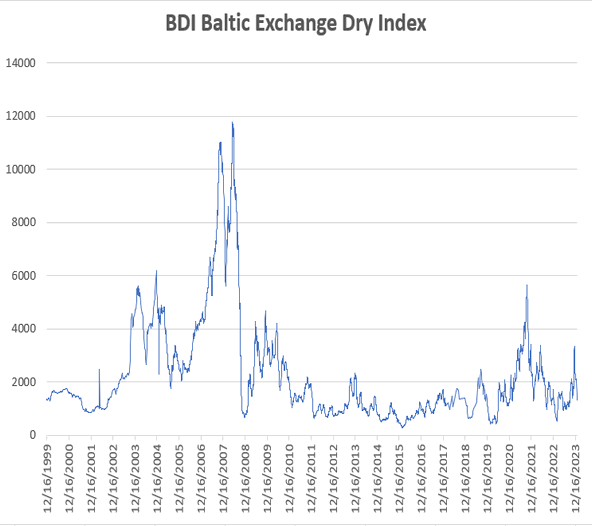
LONDON -- Container ship charter owners are preparing to idle scores of vessels for extended periods over the coming weeks as hire rates reach new lows and ocean carriers press for steeper discounts to compensate for collapsing liner freight rates.
There were 392 box ships of 1.1 million TEUs, or 8.8 percent of the world fleet, without work in mid-February, according to AXS-Alphaliner, a Paris-based consultant that tracks laid-up tonnage.
But that figure “may yet even prove to be a conservative estimate,” says London shipbroker Clarkson.
Leading charter owners are laying up their ships because hire rates don’t cover vessel financing costs. Euroseas, the Nasdaq-listed box ship and bulk carrier owner, has already laid up one of its 10 container vessels and this week said it might be more economical to temporarily lay-up ships coming off hire rather than sign new charters that are likely to generate low revenue through 2009.
Earlier, Euroseas agreed to renegotiate two charters -- from $18,500 a day to $12,000 for a 1,742-TEU ship, and from $16,500 to $11,000 for a 1,932-TEU vessel. It also agreed to extend the charters at even lower daily rates of $10,000 for a year and $7,000 for six months, respectively.
Claus-Peter Offen, one of Germany’s biggest charter owners, plans to lay up around 10 vessels ranging between 1,200 and 2,500 TEUs. It has already laid up three ships that couldn’t find work after their charters expired.
Until now, charter owners and ocean carriers have opted for “hot” lay-ups where vessels are kept ready to resume trading very soon after a charter is fixed or freight rates and cargo demand pick up.
But an increasing number of owners are now mulling “cold” lay-ups, a more drastic step involving considerable expenditure in maintaining the idled vessel for a prolonged period and eventually returning it to trading.
The trend toward cold lay-ups reflects the steep slide in charter rates, and more recently, the shrinking demand from ocean carriers for tonnage as they axe services and lay-up their own vessels.
Average daily charter rates for a 1,700-TEU ship fell this week to $5,418, less than a third of the $17,905 it commanded in early May and a 2,500-TEU vessel is earning $6,940 a day, down from $25,074, according to the Hamburg Shipbrokers’ Association. Its closely watched ConTex index this week had fallen to 305 from 974 in early May.
Rates for larger vessels also are retreating, with the daily rate for a 3,500-TEU gearless Panamax ship down 44 percent in the past three months to $10,500 from $15,500, according to Clarkson.
But ocean freight rates have fallen even more, widening the gap with charter rates, particularly deals when carriers were competing for scarce tonnage to meet double-digit traffic growth. All-in rates from South China to Europe have plunged nearly 70 percent since November, according to London’s Drewry Shipping Consultants.
Ocean carriers have responded by announcing rate increases, mostly effective from April, and putting further pressure on charter owners to slash rates and accept clauses allowing them to break and renegotiate charters at short notice.
An increasing number of charter owners are opting for cold lay-up, but the majority are caving in to carriers’ demands in order to cover as much as possible of their ships’ financing and insurance costs.
But an increasing number of owners are now mulling “cold” lay-ups, a more drastic step involving considerable expenditure in maintaining the idled vessel for a prolonged period and eventually returning it to trading.
The trend toward cold lay-ups reflects the steep slide in charter rates, and more recently, the shrinking demand from ocean carriers for tonnage as they axe services and lay-up their own vessels.
Looks like they are forecasting an extended recession. Shipping companies once considered themselves recession proof, since all they had to do was reroute their ships from one sinking country to another, growing one. While the industry is cycllical, they never forecasted this.
I’ve sailed through the container port at Hong Kong on the way to Shekou.
You really don’t appreciate just how much cargo is being shipped out of China until you see something like that.
I just *had* to look up TEU to add to my vast store of useless trivia:
Container capacity is often expressed in twenty-foot equivalent units (TEU, or sometimes teu). An equivalent unit is a measure of containerized cargo capacity equal to one standard 20 ft (length) × 8 ft (width) container. As this is an approximate measure, the height of the box is not considered, for instance the 9 ft 6 in (2.9 m) High cube and the 4-ft 3-in (1.3 m) half height 20 ft (6.1 m) containers are also called one TEU. Similarly, the 45-ft (13.7 m) containers are also commonly designated as two TEU, although they are 45 and not 40 feet (12 m) long. Two TEU are equivalent to one forty-foot equivalent unit (FEU).
And this, boys and girls, is why the Chinese are PO’ed about our debt. We aren’t buying as much of their junk anymore.
Interesting article on here the other day about moving manufacturing back to the US because the supply chain is shorter, more flexible, less costly and US manufacturing can be more efficient.
ZERO and his union thugs will fix that but at least it may have been a possibility.
What it means to me as an intermodal trucker is not good. Not good at all. But as an American first and foremost it is GREAT NEWS! The Chinoisee sre troubled, but, the Chinoisee backed US dollar is in major trouble. Guess I better invest in a year or two’s supply of Quaker Oats, dried beef and ammo. Just damn!
I’ve never seen a container ship, so I found a picture in case anyone else is in my boat. The little pilot ship alongside is 105’ long. Boy, those container ships are huge!
http://www.boatingsf.com/photopage.php?photo=790
[*Sniff,* *Sob*]
In other words, they want more hundreds of billions of US dollars in “bailout” welfare from the United States to cover for their laziness and lack of self-discipline needed to save capital for future work.
a 20ft container's inside dimension (length) is between 19ft10in and 19ft8in. Let's be careful out there, everybody--don't go shipping stuff you can't fit in a box.
Well this proves one thing:The power of the American comsumer
We don’t buy and spend like crack whores and the world falls apart
The picture shows the economy of scale pretty well, and why ocean shipping is so economical. A crew of about 20 people can run a new container ship (11,000 TEU), while for interstate trucking, its 2 TEU per driver.
I skipped the stuff about container dimensions.
I figured that if you were going to actually be shipping stuff in a container, you’d do a little research first.
And there’s a limit to the things I can remember in my trivia memory space.
:-)
We might run perilously short of cheap toys, tennis shoes, and even those toxic food additives.
.
A TEU is a 20’ equivalent, according to Google, so does that mean those ships are 11,000 x 20 or 220,000 feet long?
I don’t think there is a word that describes that adequately. Just wow.
Now that is unintentionally hilarious. It is a serious situation.
Yep, that's what they look like. You can sit on the shore of San Francisco Bay and watch those go in and out all day long (I enjoy watching them when we go over to SF). Not too different from watching airplanes line up for takeoff and landing at a major airport.
We get a lot more things used commonly around the house on those ships.
Stock up.
Here’s an article about building houses from used shipping containers. I think it sounds neat.
http://www.bobvila.com/HowTo_Library/Building_a_Container_House-Building_Systems-A2413.html
Ship out all the jobs, and people don’t buy stuff. A lot of us have been pointing this out for years.
The landlord of the farm where I lived kept a couple as storage sheds, and they were surprisingly well-suited for the task.
Disclaimer: Opinions posted on Free Republic are those of the individual posters and do not necessarily represent the opinion of Free Republic or its management. All materials posted herein are protected by copyright law and the exemption for fair use of copyrighted works.